
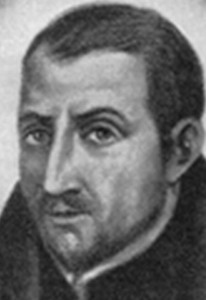
Henry Walpole and William Byrd
Tertullian’s oft-quoted phrase, “the blood of the martyrs is the seed of the Church,” immediately evokes scenes of the early Christians in the Roman Colosseum, but this adage remains ageless across the centuries. St. Henry Walpole (1558-1595) was born in Docking, Norfolk, into the turbulence of the English Reformation. As a young man, he studied law in Cambridge and London. It was during his time in London that he first came to the attention of government spies for his association with known recusants.
In September 1581, the 23-year-old law student attended the four public disputations between Edmund Campion, a captured Jesuit priest, and the foremost Anglican theologians. When Campion was executed at Tyburn on December 1st, 1581, Walpole was present, standing so close that his cloak was hit by a drop of the martyr’s blood.
Inspired by the splattered scarlet, Walpole resolved to travel to the continent and follow in Campion’s footsteps to become a Jesuit. Entering the English College at Rheims in July 1582, eventually ordained in Paris on December 17th, 1588. He was first assigned as a chaplain to English Catholics serving in the Spanish Army stationed in the Low Countries, where he was captured by Calvinists in 1589. After a year in prison and his eventual release, he was assigned to the English College at Valladolid, Spain. His desire to follow Campion was not satisfied in his work as a seminary professor, and in 1593 he asked to be sent to minister in England, which was granted. After ten days of sailing, Father Walpole arrived at Flamborough Head, Yorkshire, on December 4th,1593, but his time would be cut short. Within a day, he was arrested for being a priest, a fellow passenger having betrayed him.
Sixteen months of imprisonment followed, spending his first three months at York Castle but later transferred to the Tower of London. The infamous priest hunter Richard Topcliffe tortured him on the rack and suspended him by his wrists for hours at a time in fourteen different sessions, spaced out to avoid accidental death caused during interrogation.
In early 1595, Father Walpole was returned to York to stand trial, where he was charged with high treason under the law that forbade Englishmen from returning home after receiving Catholic ordination. The former law student declared that he had not violated that law, since it required priests to turn themselves in within three days, but he was captured within hours. He was then compelled by the judge to take the Oath of Supremacy, but refused, unwilling to acknowledge the Queen’s alleged authority over religion. Father Walpole was convicted of high treason and sentenced, alongside Father Alexander Rawlins, to be hanged, drawn, and quartered. At the gallows, he prayed the Our Father, but just as he started the Hail Mary, he was pushed away from the scaffold and hanged.
Before initially leaving for the continent, Walpole composed a long poem on the death of St. Edmund Campion. Published as a small book, it was so popular among Catholics that its printer had his ears cut off as punishment. The famous English recusant composer William Byrd (1540–1623) set three of its stanzas as a song for solo singer and viol consort.
Why do I use my paper, ink and pen?
And call my wits to counsel what to say?
Such memories were made for mortal men;
I speak of Saints whose names cannot decay.
An Angel’s trump were fitter for to sound
Their glorious death if such on earth were found.
That store of such were once on earth pursued,
The histories of ancient times record,
Whose constancy great tyrants’ rage subdued
Through patient death, professing Christ the Lord:
As his Apostles perfect witness bare,
With many more that blessed Martyrs were.
Whose patience rare and most courageous mind,
With fame renowned perpetual shall endure,
By whose examples we may rightly find,
Of holy life and death a pattern pure.
That we therefore their virtues may embrace
Pray we to Christ to guide us with his grace.
Byrd selected some of the most subdued stanzas for his setting. Here are just two of the more controversial parts:
England, look up, thy soil is stained with blood,
Thou hast made martyrs many of thine own,
If thou hast grace their deaths will do thee good,
The seed will take which in such blood is sown,
And Campion’s learning fertile so before,
Thus watered too, must needs of force be more.
You thought perhaps when learned Campion dies,
his pen must cease, his sugared tongue be still,
but you forgot how loud his death it cries,
how far beyond the sound of tongue and quill,
you did not know how rare and great a good
it was to write his precious gifts in blood.
How precious a gift St. Henry Walpole’s own martyrdom was!, interceding now for his beloved country alongside St. Edmund Campion and the myriad martyrs of the English Reformation. May England and our own Canada to return to Christ and His Church by their blood-seeded prayers.
(Saint Henry Walpole is one of the glorious Forty Martyrs of England and Wales. His feast is on April 7th).

Saint Kateri , Canada’s Protectress
This was the title given to Saint Kateri Tekakwitha, by Pope Benedict XVI, when he canonized her on October 28th, 2012, along with six others, in Saint Peter’ Square (she had been beatified by Pope John Paul II back in 1980). With Saint Joseph as our protector, along with the Canadian martyrs, we seem to[…]Continue reading→

Remembering Father Alphonse de Valk
(Today marks the sixth anniversary of the death of Father Alphonse de Valk, C.S.B., a faithful, courageous and indefatigable Basilian priest, pro-life-and-family apostle, and the founder of Catholic Insight magazine. Here is what we wrote those on his entering into eternity five years ago, as we continue to remember him in our prayers and thoughts)[…]Continue reading→

A Tale of Two Benedicts
A grace-filled Holy Week to all our readers! As we await and prepare for the Resurrection about to dawn upon us, we might keep in mind two Benedicts: Pope Emeritus Benedict XVI, requiescat in pace, elected on this day in 2005; and today’s commemoration of the mystic pilgrim, Benedict Joseph Labre, who died on this[…]Continue reading→

My Name is Bernadette
April 16th is a propitious day, for besides the anniversary of Father de Valk’s death, who founded Catholic Insight in its print form decades ago, and the commemoration of the ‘two Benedicts’, mentioned in accompanying posts, today we also recall Saint Bernadette Soubirous, the young visionary to whom the Virgin Mary appeared numerous times at[…]Continue reading→

Saint Lydwina of Schiedam and Suffering Joyfully
Saint Lydwina of Schiedam (1380 – 1433) was one of the countless and glorious ‘victim souls’ in the history of the Church, those whose lives are filled with suffering, often of an unimaginable intensity, but who suffer joyfully. She was a fifteen-year old Dutch girl, out skating one day, when she fell and broke one[…]Continue reading→

The Glorious Martyrdoms of Martin and Maximus
As we enter into Eastertide, we recall on this 13th of April Pope Saint Martin I (+655), one of the noblest, if most tragic, of the successors of Saint Peter. Born in Umbria, Italy, he was of noble lineage, with great intelligence combined with charity and love of the poor and the Church. While still[…]Continue reading→
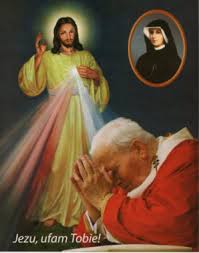
Canonizing Sister Faustina and Divine Mercy
HOMILY OF THE HOLY FATHER MASS IN ST PETER’S SQUARE FOR THE CANONIZATION OF SR MARY FAUSTINA KOWALSKA Sunday, 30 April 2000 1. “Confitemini Domino quoniam bonus, quoniam in saeculum misericordia eius”; “Give thanks to the Lord for he is good; his steadfast love endures for ever” (Ps 118: 1). So the Church sings on the Octave of[…]Continue reading→

Divine Mercy Sunday – An Echo of Every Mass
Reach out your hand and put it in my side. Do not doubt but believe’… ‘My Lord and my God!’ (Jn. 20:18)). Today is Divine Mercy Sunday, and as we celebrate the end of the Easter Octave, we contemplate the wounded side of our Saviour, the Church’s source of life. On Good Friday in the[…]Continue reading→

Saint Stanislaus of Szczepanów
We celebrate Saint Stanislaus today (+ April 11, 1079), in light of this Easter Octave, a bishop and martyr who accepted the episcopacy only at the direct order of Pope Alexander II. He proved a wise and courageous leader of his flock, put to death by his own king, Boleslaus, for rebuking the monarch’s ‘immoral[…]Continue reading→
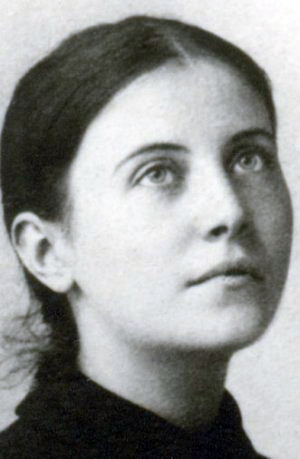
Saint Gemma Galgani
On this April 11th, in 1903 – the same year that the Italian Guiseppe Sarto was elected Pope later that summer as Pius X – a lovely, young Italian woman died, by the name of Gemma Galgani. She lived a brief life of 24 years, as did a number of other young saints, including Pier[…]Continue reading→