
On Sunday 29 December 2024, the liturgical feast of the Holy Family of Jesus, Mary and Joseph, the Archdiocese of Malta started the Jubilee of Hope. The grand celebration was done at Mdina Cathedral in a pontifical mass at 6.00 pm.
In a packed cathedral, the Archbishop of Malta, Mgr Charles J. Scicluna, started his beautiful and to-the-point homily with the quote of the second reading of the liturgy of the word of feast day of the Holy Family: See what love the Father has given us, that we should be called children of God; and so we are (1 John 3:1). He said that this word is of great courage to us, who are now beginning together, as a Church, this Jubilee of Hope in the year 2025. Archbishop Scicluna reminded everyone present at the Cathedral that the Pope wishes that in this jubilee we all grow as pilgrims of hope. Then the Archbishop made the following profound comments: The pilgrim is a man on a journey; the pilgrim of hope knows that there is a promise, a word, that will not fail, and that will not deceive him. That is why, added Archbishop Scicluna, our hope is not an illusion, it is not a myth, it is not a human creation; our hope is a person: Jesus. We are pilgrims, who step by step, sometimes we choose, and sometimes we don’t; approach him.
In a very personal way, Archbishop Scicluna shared with the Maltese flock the experience he, Mgr Joseph Galea-Curmi and Gozo Bishop Mgr Anton Teuma had on May 17 when they had the ad limina visit with Pope Francis. They asked him about the significance of the Jubilee of Hope. Mgr Scicluna said: Pope Francis to us the Bishops of Malta and Gozo, I feel that he has given us a special delivery, a special message. When we met him on May 17, and we asked him what his heart’s desire was for this jubilee he used these words in Italian: ‘Una grande festa di misericordia (a great feast of mercy)’.
In his homily, Archbishop Scicluna emphasized the fact that the first experience of mercy is to recognize who God loves you. “See with what love the Father has given us” (1 Jn 3:1). The first experience of mercy, brothers, is not to be consumed by the thought of your sin and that of others; but to recognize how much God loves you; who chose you as his daughter, as his son; who sent his Son into the world, so that we may become his children, and be truly his children, and brothers among us. So that the Lord Jesus can teach us, we pray like this: “Our Father, who art in heaven, hallowed be thy name” (Mt 6:9). The Risen One tells the Magdalene that “I am going to my Father and your Father, my God and your God” (Jn 20:17).
But what is the bottom line of God’s loving mercy? According to Archbishop Scicluna is our faithful response to acknowledge our sins and be responsible in resorting to the sacrament of confession. The Pope wished that in all the dioceses of the world the Jubilee would begin today for the local community, even for the local churches. He inaugurated it in Rome on Christmas Eve, as you know. And today, we are starting this Jubilee as a community of faith. A moment of grace and an invitation to mercy. And Jesus, when he wanted to give us mercy and show us mercy, established a sacrament. The first sacrament is baptism, which forgives all sins; but after baptism there is the sacrament of confession.
At this point Mgr Charles J. Scicluna snatched the opportunity to present to us, the faithful, both those in the Cathedral as well as those who were sick, an excellent short catechesis on the fruitfulness of the sacrament of confession. He said: Whoever wants to celebrate the Jubilee this year, starts with a rhythm of regular confession. There is no need to go to confession every day, but regularly, according to the need, and according to the emergency as well. We enter into the spirit of this sacrament, which is a sacrament of truth but also a sacrament of mercy; not as in a chamber of torture, as the Pope likes to say: listen, confession is not a torture! Confession is a feast of mercy and of truth.
You tell me: ‘but in this Jubilee, is there any special grace?’ Yes! The Pope explains it to us. When we celebrate the Jubilee, as we are doing today, the Church, in the mystery of the Communion of Saints, also gives us pardon from all the atonement of our sins. Our sins are forgiven by confession; their atonement is also forgiven by the grace of the Jubilee, what they call the Plenary Indulgence; when the Lord cleanses you well from the inside; and even through you, he takes care of your loved ones who have gone before us. The first sacrament is baptism, which forgives all sins; but after baptism there is the sacrament of confession.
Towards the conclusion of his beautiful homily, Archbishop Scicluna emphasized the point that the grace of being forgiven by God is to be translated in the mercy we show to our brothers and sisters in need. He said:
But the Pope is also suggesting to us ‘the Works of Mercy’. Because I welcome God’s mercy but I also want to show my mercy to my brothers. And the works of mercy are those that relate to the body: feed the hungry, we remember our soup kitchens – in Marta’s Kitchen; give water to the thirsty, clothe the stranger, welcome the stranger, visit the sick, visit the prisoners, bury the dead. These are the material works of mercy, which relate to the body. But there are also works of mercy that relate to the spiritual soul: give advice to our beloved, comfort a troubled man and not adding to his trouble; teach the one who does not know – open the eyes of others; rebuke sinners, sometimes we prefer silence so we can live a comfortable life (starting with myself); comfort the afflicted, forgive sins. Perhaps the latter is the most difficult. Can you get a plenary indulgence if there is someone you are angry against him? Forgive him. … Here the price is going up! Be patient with those who trouble you – this too, patience. If we understood this, that even in traffic we are patient with each other, you would say today I drove and took a plenary indulgence. Pray to God for the living and the dead. But then the Pope also insists on the visits to those who are in need or in difficulty: sick, prisoners, elderly alone, disabled people.
In his conclusion Archbishop Scicluna said: Let us dream how we can show concrete love to everyone, so that this great feast of mercy is not only good for me, but comforting for my neighbor. And truly this year for our people is a great feast of mercy.
Let us all work during this Jubilee Year of Hope to be a hope through initiatives which champion the defense and protection of human life, in all its phases; abandoned children, the lonely; young people with difficulty; elderly people in need; migrants and every person who needs our constant help and attention. After all, the Son of God, who became our Brother, made us brothers and sisters to him in each other.
A Closed, Unsustainable, Descending Loop
As a follow-up to my thoughts on Payette’s payout, here be a stark image of where are here in Canada. As the graph shows in, well, graphic terms, since 2025, the public sector has contributed to 95.5% of economic growth. The private sector – which funds the public sector, or is supposed to – has[…]Continue reading→
Presidential Pardon of Weronika Krawczyk
As a good news, follow-up to our story from Poland, of the persecution of Weronika Krawczyk for her pro-life views, we heard that she has been granted a presidential pardon. One might still wonder why one needs a presidential pardon for simply holding the long-held belief that the child within the womb is a child,[…]Continue reading→
Pope Leo and a Rosary for Peace
Pope Leo XIV has asked Catholics across the world to join him in a Rosary for peace today, at 18:00 Rome time (6 pm), which would be noon from where I write (EST). If you are able, whether at that time or another, and in whatever way you pray, to join in intercession with the[…]Continue reading→
Payette’s Payout
I was glancing through some headlines, and noticed a mention of Julie Payette – engineer and astronaut and sometime the Queen’s representative in Canada – which brought back vague memories. She was appointed Governor-General by Justin Trudeau in 2017. Ms. Payette resigned in 2021, amidst claims that she created a ‘toxic work environment’, with allegations[…]Continue reading→
Weronika Krawczyk and Injustice in Poland
Catholic Action in Poland has issued a formal statement appealing to the President of the Republic of Poland to pardon Weronika Krawczyk—convicted for warning other women against an abortion-performing gynaecologist. Catholic Action (AK) emphasizes that no apology is owed to a doctor who has performed numerous abortions and proposed others; furthermore, the organization considers the[…]Continue reading→
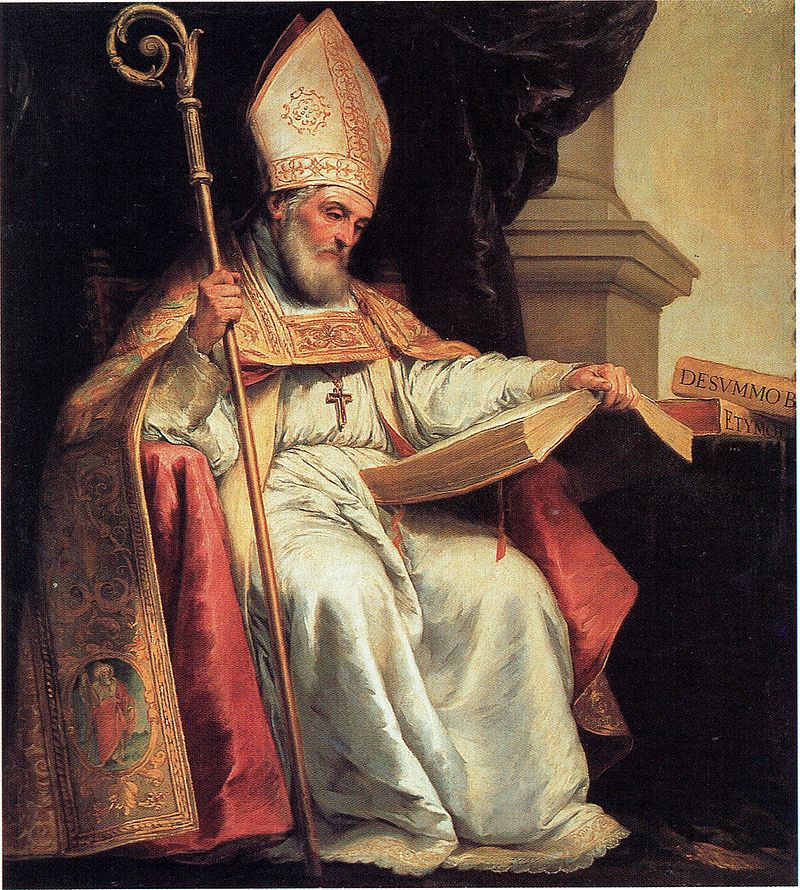
Saint Isidore of Seville, the Internet and Industriousness
Today, April 4th, muted this year by Holy Saturday, is the commemoration of Saint Isidore of Seville (560-636) a bishop and doctor of the Church during a tumultuous age, when civilization was crumbling, coming apart at its very seams, which may sound sort of au courant. Then again, the form of this world has always[…]Continue reading→
Bishop Fulton Sheen’s 58th Good Friday Reflection
Incredible, at the beginning of this reflection, that the Venerable Bishop Sheen declares that he has given nearly 58 Good Friday reflections – this, as far as I can gather, was his final one, and he seems in full vigour in mind and body. The good bishop and evangelist died in his 84th year on[…]Continue reading→
A Minimal Friar and the Death of a Great Pope
This April the second- overshadowed by Holy Thursday this year – marks the memorial of Saint Francis of Paola (1417-1507), founder of the ‘Minim’ friars, so called for their humility and poverty, who interpreted the rule of Saint Francis of Assisi in quite a literal sense: extreme poverty, trust in God, foregoing all animal and[…]Continue reading→
Woven versus Seamless Garments
The reflection on the worthy project by Magie Dominic was intriguing, and I thought I would offer a brief follow-up commentary. The garment woven out of many pieces is a poignant symbol, even a ‘sacramental’, inspired by prayer and grace. We are all united in some way, and should strive for such unity, wherever we[…]Continue reading→
Bill C-9: Prelude to Persecution?
Well, it happened, as I suppose was inevitable, at least in a secular sense (from God’ perspective, there’s always hope). Bill C-9, the ironically named ‘Combatting Hate Act’ passed the House of Commons with a 186-137 vote. Look on the good side – there’s still over a hundred sane people in parliament who believe in[…]Continue reading→