
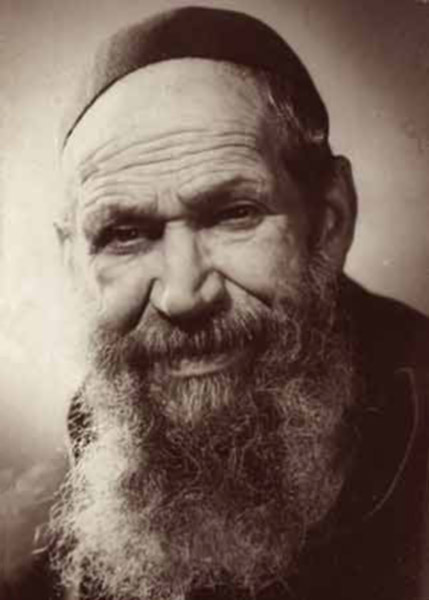
Blessed Nicholas of Gesturi
The 8th of June also marks the liturgical memorial of Blessed Nicholas of Gesturi. Who was this lay brother? Why is his example so eloquent in today’s world?
Brother Nicholas is the last Franciscan figure, in chronological order, who lived in Cagliari, to reach the glory of the altars, after Saints Salvatore da Horta (1520-1567) friar Minor, miracle worker, and Saint Ignazio da Laconi (1701-1781) a Capuchin, a lay brother and a questor. In the same convent of Cagliari and with the same task as begging for alms like Saint Ignazio, the Capuchin friar Nicholas of Gesturi lived a holy life. He was beatified on 3 October 1999 by Pope John Paul II.
His lay name was Giovanni Medda. Giovanni was born on 5 August 1882 in Gesturi (Cagliari) archdiocese of Oristano. He was sixth of the seven children born to Giovanni Medda and Priama Cogoni Zedda, who came of humble social conditions although honest and religious. At the age of four in 1886, according to the customs of the time, he received Confirmation.
However mourning and poverty soon entered the family. Giovanni was just five years old when his father died and thirteen years old when his mother passed away. The boy was then entrusted to his sister Rita’s father-in-law. The wealthy master kept him as a servant, without any pay while receiving only accommodation and sustenance. The young Giovanni spent his days working in the fields and looking after the livestock. Once his master died, he moved permanently to his sister’s house, always as a punctual and honest servant. After the first elementary school years his life of a farmer began.
At the age of 14, on 18 December 1896, Giovanni Medda received his First Communion and from then on began to live a life devoted to virtue and holiness. Even from the brother-in-law for whom he worked, he did not want monetary compensation. Giovanni was content with little food and accommodation in a cubby hole. The mortification in which he lived was the incentive for him to aspire to priestly life. Poverty, however, was an insurmountable obstacle.
Other years passed like this, working and cultivating within himself the vocation that he felt more and more strongly. Giovanni Medda was 29 years old when in March 1911, helped by an excellent report from the parish priest of Gesturi, entered the Capuchin convent of San Antonio in Cagliari, as an Oblate Tertiary.
After two years, on 30 October 1913, he put on the Capuchin habit and took the name Brother Nicholas. A few months later he was transferred to the convent of Sanluri, where he completed a year of novitiate and made his first solemn profession. Brother Nicholas alternated between the Capuchin convent of Sanluri (CA), those of Sassari, Oristano, Cagliari, and again in Sanluri. He was always in charge of the kitchen, even if his cooking apparently did not satisfy of his brothers.
Following the recommendation of a brother, he was released from the kitchen duties and in 1924 he was transferred to Cagliari, with the task of collecting alms in the city.
For 34 years he carried out this delicate task with tenacity and patience, always walking in all weathers, rain, cold, heat, miles upon miles. He begged alms in the name of Saint Francis, always with the same words, receiving the offering for the needs of the convent and for Franciscan charity while also welcoming insults and mockery from those who saw in the Capuchin questor a lazy and a good-for-nothing chap.
After the first few years, Brother Nicholas of Gesturi no longer asked for anything, because the people of Cagliari had understood that that silent, humble friar was an exceptional person. Thus, donations in money or of any other kind were given to him spontaneously. As the years passed his figure became increasingly popular in Cagliari and the nearby towns. Many approached him to ask for advice, asked for prayers, and invited him to enter homes and hospitals to give comfort to the sick. His life story tells us that sudden healings occurred and his fame thus increased everywhere. Brother Nicholas had become everyone’s friend and confidant. As a result he could no longer be able to cover the entire territory which he usually covered in one day as he used to do before. Brother Nicholas had now become an indispensable “presence”. In fact, he listened to everyone but the privileged ones for him were the poor whom he visited even in their miserable homes.
During the Second World War, the city of Cagliari became one of the most bombarded in Italy. Everyone who could, moved away, including the friars of the convent of Saint Antonio, who were transferred elsewhere, except four, including the Superior, friar Nicholas who didn’t want to leave. Once the closure was abolished from the convent, displaced persons and people left alone were welcomed, cared for and fed. It was in this difficult situation that Brother Nicholas of Gesturi went out of his way to help and console everyone. But his meritorious work was not limited to the convent. As a matter of fact, Brother Nicholas went to help the crowd of miserable and ragged people who had taken refuge in the many caves scattered around the city. After each bombing he rushed to the disaster sites to bring aid to the wounded, console the broken-hearted and bury the dead. For the citizens of Cagliari Brother Nicholas took on the vision of a silent figure.
Silence was his constant characteristic, both when he received and when he gave. His life story tells us that he interrupted it only to remember the will of God. On June 1, 1958, physically exhausted, he presented himself to the Father Guardian and said to him: “Father, I can’t do it anymore, thus he asked to be exempt from begging. The superior immediately sensed that Brother Nicholas was nearing his end. Hence, the next day he was admitted to the hospital and underwent emergency surgery. But it was all in vain. In fact, after four days, after receiving the anointing of the sick and holy communion he passed away peacefully on 8 June 1958 at the age of 76 years old.
The fame of his sanctity was great and the funeral saw the impressive participation of the people. Tens of thousands of people from all walks of life paid homage to his body. His funeral on June 10, was literally the climax of it all.
From 1966 to 1971 the first process took place for his beatification which eventually occurred in 1999. On 6 June 1980 his remains were moved and buried in the Chapel of the Immaculate Conception of the Capuchin Church of San Antonio in Cagliari.
Let us recall the magnificent words spoken by Pope St John Paul II on the occasion of the the beatification of Blessed Nicholas of Gesturi on Sunday 3 October 1999:
“The very stone which the builders rejected has become the head of the corner” (Mt 21: 42). These words, which Jesus applied to himself in the Gospel, recall the mystery of the Son of God’s abasement and humiliation, the source of our salvation. And our thoughts naturally turn to Bl. Nicholas of Gesturi, a Capuchin, whose life remarkably embodied this mysterious reality. A man of silence, he radiated an aura of spirituality and the powerful attraction of the absolute.
Affectionately called “Brother Silence” by the people, Nicholas of Gesturi displayed an attitude that was more eloquent than words: freed from the superfluous and in search of the essential, he was never distracted by what was useless or harmful, preferring to bear witness to the presence of the Incarnate Word beside every person.
In a world often sated with words but poor in values, there is a need for men and women who, like Bl. Nicholas of Gesturi, emphasize the urgent need to recover the capacity for silence and for listening, so that their whole life can become a “song” of praise to God and of service to their brothers and sisters (no. 7).
God our Father, you taught blessed Nicholas to serve you in humility and simplicity, and to be attentive on the greater things. Grant that we may imitate his example here on earth so that we may share in his glory in heaven. We ask this through our Lord Jesus Christ, your Son, who lives and reigns with you and the Holy Spirit, one God, for ever and ever. Amen.

Saint Kateri , Canada’s Protectress
This was the title given to Saint Kateri Tekakwitha, by Pope Benedict XVI, when he canonized her on October 28th, 2012, along with six others, in Saint Peter’ Square (she had been beatified by Pope John Paul II back in 1980). With Saint Joseph as our protector, along with the Canadian martyrs, we seem to[…]Continue reading→

Remembering Father Alphonse de Valk
(Today marks the sixth anniversary of the death of Father Alphonse de Valk, C.S.B., a faithful, courageous and indefatigable Basilian priest, pro-life-and-family apostle, and the founder of Catholic Insight magazine. Here is what we wrote those on his entering into eternity five years ago, as we continue to remember him in our prayers and thoughts)[…]Continue reading→
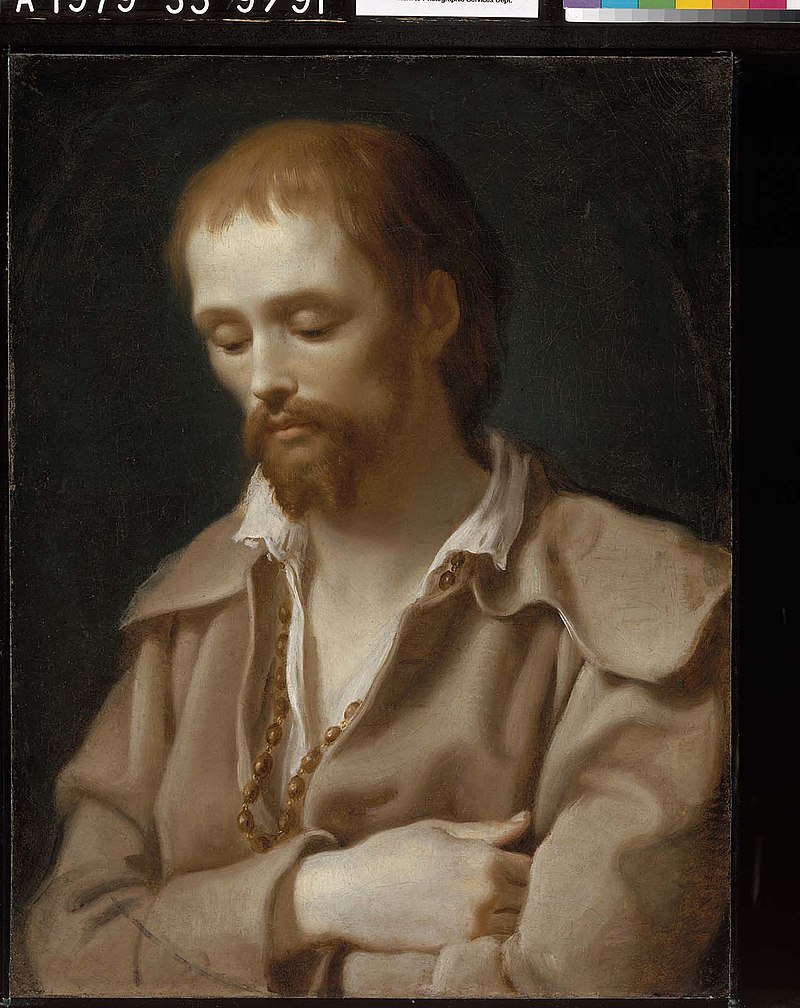
A Tale of Two Benedicts
A grace-filled Holy Week to all our readers! As we await and prepare for the Resurrection about to dawn upon us, we might keep in mind two Benedicts: Pope Emeritus Benedict XVI, requiescat in pace, elected on this day in 2005; and today’s commemoration of the mystic pilgrim, Benedict Joseph Labre, who died on this[…]Continue reading→

My Name is Bernadette
April 16th is a propitious day, for besides the anniversary of Father de Valk’s death, who founded Catholic Insight in its print form decades ago, and the commemoration of the ‘two Benedicts’, mentioned in accompanying posts, today we also recall Saint Bernadette Soubirous, the young visionary to whom the Virgin Mary appeared numerous times at[…]Continue reading→
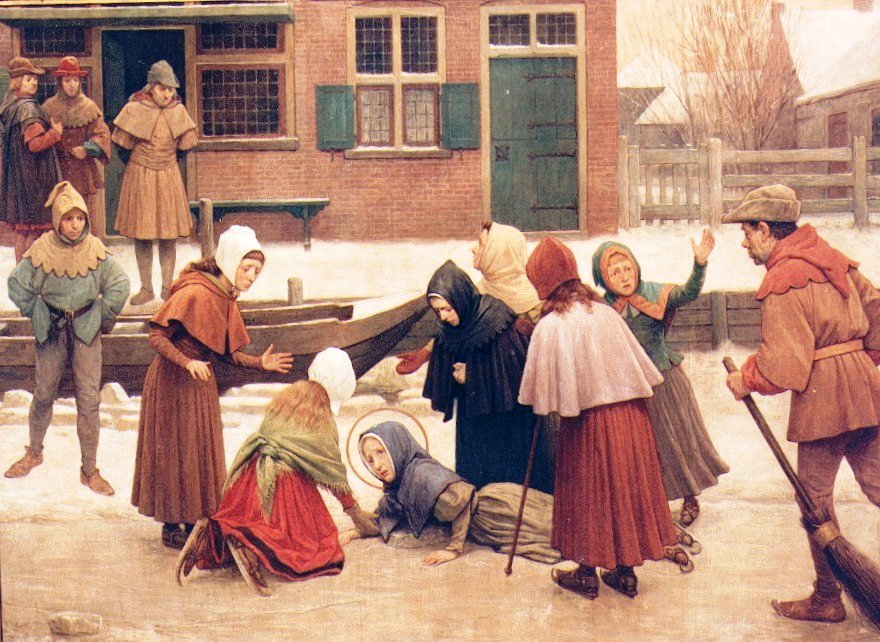
Saint Lydwina of Schiedam and Suffering Joyfully
Saint Lydwina of Schiedam (1380 – 1433) was one of the countless and glorious ‘victim souls’ in the history of the Church, those whose lives are filled with suffering, often of an unimaginable intensity, but who suffer joyfully. She was a fifteen-year old Dutch girl, out skating one day, when she fell and broke one[…]Continue reading→
The Glorious Martyrdoms of Martin and Maximus
As we enter into Eastertide, we recall on this 13th of April Pope Saint Martin I (+655), one of the noblest, if most tragic, of the successors of Saint Peter. Born in Umbria, Italy, he was of noble lineage, with great intelligence combined with charity and love of the poor and the Church. While still[…]Continue reading→
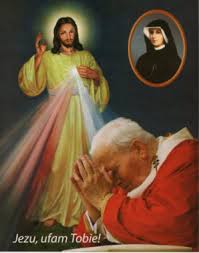
Canonizing Sister Faustina and Divine Mercy
HOMILY OF THE HOLY FATHER MASS IN ST PETER’S SQUARE FOR THE CANONIZATION OF SR MARY FAUSTINA KOWALSKA Sunday, 30 April 2000 1. “Confitemini Domino quoniam bonus, quoniam in saeculum misericordia eius”; “Give thanks to the Lord for he is good; his steadfast love endures for ever” (Ps 118: 1). So the Church sings on the Octave of[…]Continue reading→

Divine Mercy Sunday – An Echo of Every Mass
Reach out your hand and put it in my side. Do not doubt but believe’… ‘My Lord and my God!’ (Jn. 20:18)). Today is Divine Mercy Sunday, and as we celebrate the end of the Easter Octave, we contemplate the wounded side of our Saviour, the Church’s source of life. On Good Friday in the[…]Continue reading→

Saint Stanislaus of Szczepanów
We celebrate Saint Stanislaus today (+ April 11, 1079), in light of this Easter Octave, a bishop and martyr who accepted the episcopacy only at the direct order of Pope Alexander II. He proved a wise and courageous leader of his flock, put to death by his own king, Boleslaus, for rebuking the monarch’s ‘immoral[…]Continue reading→
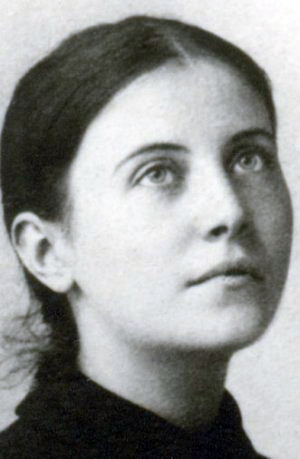
Saint Gemma Galgani
On this April 11th, in 1903 – the same year that the Italian Guiseppe Sarto was elected Pope later that summer as Pius X – a lovely, young Italian woman died, by the name of Gemma Galgani. She lived a brief life of 24 years, as did a number of other young saints, including Pier[…]Continue reading→