
Pope St Pius V and His Relationship with Valletta, Malta’s Capital City
On this last day of April, we celebrate the liturgical memorial of the Dominican Pope St Pius V. As Church history would tell us this holy pope remains notable for his unique role in the Council of Trent, the Counter-Reformation program of reform as well as the standardization of the Roman Rite within the Latin Church. Furthermore, Pope St Pius V declared his fellow Dominican brother, St Thomas Aquinas, a Doctor of the Church.
The Maltese have a great esteem and love for this Dominican Pope. Besides being a great supporter of the supporter of the Knights of Saint John in their ongoing commitment of defending the Roman Catholic Apostolic Faith, Pope Pius V greatly helped in the building of our capital city Valletta. After the horror of the Ottoman Turkish invasion, the Knights knew very well that they had to have a fortified city so as to bring some stability on the Island from the frequent attacks of the enemy. Therefore they turned to their protector, St Pius V, to help them realise their dream.
Pope St Pius V was born Antonio Ghislieri on January 17, 1504, in Bosco, Duchy of Milan. At the age of 14 he joined the Dominican Order, taking the name Michele. He was ordained as a priest in 1528. Gradually he rose in the Roman Catholic hierarchy by first becoming a Bishop of Sutri and Nepi (1556-1557), Cardinal of Santa Maria sopra Minerva (1557-1561), Cardinal of Santa Sabina (1561-1566) and finally secretary of the Supreme Sacred Congregation of the Roman and Universal Inquisition (1564-1566) just before being elected pope to the seat of St Peter in 1566.
As a sign of respect for his instrumental help to strengthen Malta’s defensive position, Maltese people made a bronze bust of Pope Pius V by Giuseppe Valenti and placed it atop the back side of City Gate. This was inaugurated on July 24, 1892. Then, when in the 1960s, King’s Gate was regarded too small to cope with the influx of people entering Valletta it was decided that the gate be pulled down and the bronze bust of Pius V was removed and left abandoned in the office of the Valletta Local Council for more than 25 years.
After that time the government of the day had commissioned two cold-dip-bronze fibre copies, one of which was kept in storage and the other erected on the main doorway of the parish church of Our Lady of Porto Salvo and St Dominic in Merchant Street. Now the council was more than adamant to commit itself at detecting the best place to erect a column on which the other replica of this historic monument would stand for public appreciation. As a matter of fact, the bust was placed steps away from the entrance of St John’s Cathedral, overlooking Great Siege Square. Pope Pius V died on May 1, 1572. He was beatified on May 1, 1672 by Pope Clement X and was canonised on May 22, 1712 by Pope Clement XI.
Monsignor Professor Emmanuel Agius, President of The St John’s Co-Cathedral Foundation, wrote an interesting tribute to Pope St Pius V as both Co-founder of Valletta as well as an icon of the Maltese national identity. Here are some extracts from his beautiful tribute to such a great Church reformer and saint.
Valletta owes its existence to the chivalric Order of the Knights of St John, the determination of its Grand Master Frà Jean Parisot de Valette, and the backing and generous financial support of Pope St Pius V. It was after the Great Siege of 1565 that the Knights launched their Valletta project of a new state of the art fortified city; a place that in its concept and magnificence would one day deserve the appellation of “a city built by gentlemen for gentlemen”.
Pope St Pius V nourished a great interest in Grand Master de Valette’s project. He strongly shared the latter’s ambition of building Valletta both as a fortress in defence of Christendom, and also as an architectural jewel. Pius V toiled incessantly to bring together all Christian princes to match the might of the Ottoman Empire and check its serious threat to Europe. Malta’s geopolitical position at the very centre of the Mediterranean Sea was of particular interest to the powerful Turks in their expansionist designs, and the Ottomans adamantly wanted to take over the island from their sworn enemies the Knights of St John, because if Malta were to fall the enemy would have acquired a base from where to penetrate the European mainland and launch its assault on the Eternal City.
It is for this reason that Pope St Pius V supported the Knights in their strategic endeavour of building a new city as a bastion against the Infidel who was seriously threatening Christian Europe. In 1567, besides his own financial contributions, Pope Pius V also took the initiative to collect additional monies for the construction of Valletta’s fortifications, and for this same reason he even persuaded religious orders to channel one tenth of the revenues of their convents for such urban ventures across Europe. The Pope also hastened to despatch his foremost military engineer, Francesco Laparelli da Cortona, to design the new city of Valletta as an impregnable fortress and at the same time create a cultural masterpiece. It was only thanks to the Pope’s financial assistance and the expertise of his personal military engineer that the once arid peninsula of Mount Sceberras was transformed into a heavily fortified city, an epitome of military ingenuity, and a showpiece of Baroque architecture. In this regard Pope Pius V rightfully deserves to be regarded as a great benefactor of our island.
O God, who in your providence raised up Pope Saint Pius the Fifth in your Church that the faith might be safeguarded and more fitting worship be offered to you, grant, through his intercession, that we may participate in your mysteries with lively faith and fruitful charity. Through our Lord Jesus Christ, your Son, who lives and reigns with you in the unity of the Holy Spirit, God, for ever and ever. Amen.
A Closed, Unsustainable, Descending Loop
As a follow-up to my thoughts on Payette’s payout, here be a stark image of where are here in Canada. As the graph shows in, well, graphic terms, since 2025, the public sector has contributed to 95.5% of economic growth. The private sector – which funds the public sector, or is supposed to – has[…]Continue reading→
Presidential Pardon of Weronika Krawczyk
As a good news, follow-up to our story from Poland, of the persecution of Weronika Krawczyk for her pro-life views, we heard that she has been granted a presidential pardon. One might still wonder why one needs a presidential pardon for simply holding the long-held belief that the child within the womb is a child,[…]Continue reading→
Pope Leo and a Rosary for Peace
Pope Leo XIV has asked Catholics across the world to join him in a Rosary for peace today, at 18:00 Rome time (6 pm), which would be noon from where I write (EST). If you are able, whether at that time or another, and in whatever way you pray, to join in intercession with the[…]Continue reading→
Payette’s Payout
I was glancing through some headlines, and noticed a mention of Julie Payette – engineer and astronaut and sometime the Queen’s representative in Canada – which brought back vague memories. She was appointed Governor-General by Justin Trudeau in 2017. Ms. Payette resigned in 2021, amidst claims that she created a ‘toxic work environment’, with allegations[…]Continue reading→
Weronika Krawczyk and Injustice in Poland
Catholic Action in Poland has issued a formal statement appealing to the President of the Republic of Poland to pardon Weronika Krawczyk—convicted for warning other women against an abortion-performing gynaecologist. Catholic Action (AK) emphasizes that no apology is owed to a doctor who has performed numerous abortions and proposed others; furthermore, the organization considers the[…]Continue reading→
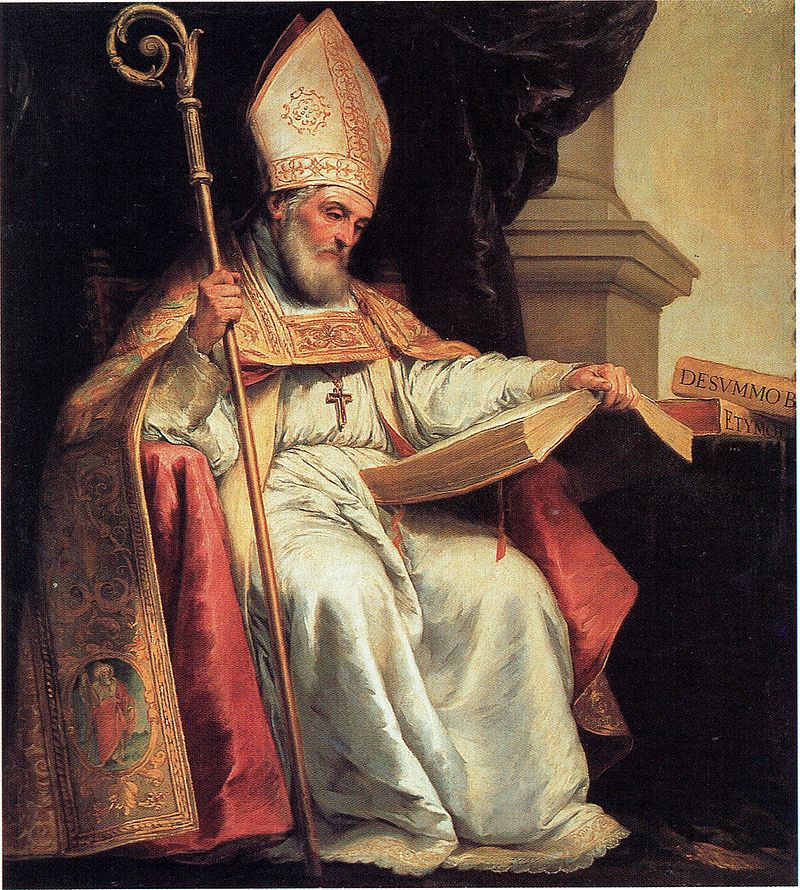
Saint Isidore of Seville, the Internet and Industriousness
Today, April 4th, muted this year by Holy Saturday, is the commemoration of Saint Isidore of Seville (560-636) a bishop and doctor of the Church during a tumultuous age, when civilization was crumbling, coming apart at its very seams, which may sound sort of au courant. Then again, the form of this world has always[…]Continue reading→
Bishop Fulton Sheen’s 58th Good Friday Reflection
Incredible, at the beginning of this reflection, that the Venerable Bishop Sheen declares that he has given nearly 58 Good Friday reflections – this, as far as I can gather, was his final one, and he seems in full vigour in mind and body. The good bishop and evangelist died in his 84th year on[…]Continue reading→
A Minimal Friar and the Death of a Great Pope
This April the second- overshadowed by Holy Thursday this year – marks the memorial of Saint Francis of Paola (1417-1507), founder of the ‘Minim’ friars, so called for their humility and poverty, who interpreted the rule of Saint Francis of Assisi in quite a literal sense: extreme poverty, trust in God, foregoing all animal and[…]Continue reading→
Woven versus Seamless Garments
The reflection on the worthy project by Magie Dominic was intriguing, and I thought I would offer a brief follow-up commentary. The garment woven out of many pieces is a poignant symbol, even a ‘sacramental’, inspired by prayer and grace. We are all united in some way, and should strive for such unity, wherever we[…]Continue reading→
Bill C-9: Prelude to Persecution?
Well, it happened, as I suppose was inevitable, at least in a secular sense (from God’ perspective, there’s always hope). Bill C-9, the ironically named ‘Combatting Hate Act’ passed the House of Commons with a 186-137 vote. Look on the good side – there’s still over a hundred sane people in parliament who believe in[…]Continue reading→