
Saint Felix – A Hermit Turned Friar
On the eve of November 4, 1212, in a remote town in Meaux, France, a monk, in his dying bed, asked that his brothers sing him one last lullaby, the sweet prayer of hope to the Blessed Mother – Salve Regina. It must have reminded him of the time, not too long ago, of the Lady who appeared to him in the empty choir stall of his monastery, a woman much more than a Mother, consoling him with the thrones of angelic voices, reassuring him of her grace, blessings, and providence.
Tradition holds that St. Feliz of Valois, as his name suggests, is from the region of Valois. Various accounts associate him with the French nobility linking him to Hugh, the Count of Vermandois, and Herny I, alluding to his surname as not just an appropriation of his hometown but an affiliation to the aristocracy. However, no surviving resources can attest to this claim and the only document that we have is from the Trinitarian Monastery of Burgundy which speaks of his birth on the 6th of April 1127 and death on the 4th of November 1212.
His early childhood, as well as his adulthood, were not recorded either. A lot of biographical accounts of his life came up in the later medieval period but all these were unsupported by the existing historical manuscripts. There were anecdotes of his younger years where his mother dreamt of a child with a flower which were interpreted as a sign of St. Felix’s role in reinvigorating the religious life of the 12th and 13th centuries. Others were accounts of miracles of the young Felix raising someone from the dead using the invocation of the Most Holy Trinity, and other miracles of healing performed throughout his life. All of these stories, albeit legends, were not included in the Trinitarian History on the basis of their credibility; nonetheless, the volumes of narratives attesting to this saint’s early life and sanctity prove that Felix, even before canonization, was an extraordinary man of God even at a very young age.
Details of St. Felix’s life only emerged after 1194 and later at the approbation of the Trinitarian rule of life (1198). In the Trinitarian document of 1203 at the donation of one of the houses in France, a little snippet of the life of St. Felix was inserted and mentions that the minister of the house, whose name is Felicius – Felix, was a hermit of Cerfoid who after meeting St. John of Matha, devoted himself into prayer and to the mission of ransoming captive Christians. The pious man was often described by the documents as “always in communion with God” and “never ceases to contemplate heavenly things” This might be the reason why St. Felix has become the image of contemplation in the Trinitarian family as he embodies that constant communion with God through prayer and acts of penance.
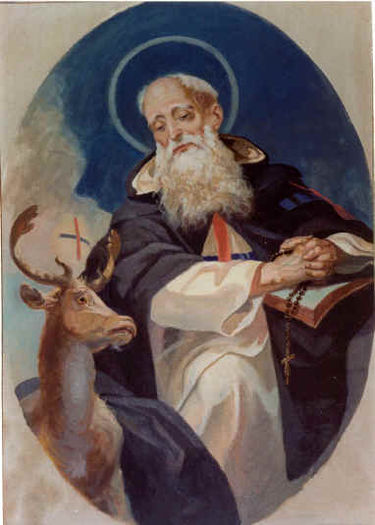
St. Felix’s iconography contains several elements which can help us learn more about this holy man. On his side is a stag that bears on its antlers a red and blue cross. According to Tradition, St. John de Matha, upon meeting the holy hermit, confided with him the vision he had seen on his ordination of 1192. He told him that God gave him a sign to start a missionary order dedicated to ransoming captive Christians. Together, St. John and St. Felix contemplated this sign for forty days, and on the 41st day of prayer, fasting, and contemplation, St. Felix saw a stag with a red and blue cross on its antlers confirming the vision of St. John de Matha.
Convinced that the project of Brother John (St. John de Matha) was of divine origin, St. Felix, together with some hermits around Cerfoid, (The word Cerofoid is a compounded Latin word Cervus Frigid – cold deer, refreshed deer) joined his quest and dedicated their next four years in living a life of missionary aspiration and community while maintaining the spirit of contemplation and silence. This is the first instance in Church history that a certain group of hermits formed a community and aspired to live a life of mission and contemplation. This paved the way for the development of the Mendicant orders in the later years which maintained the spirit of contemplation through the communal praying of the Liturgy of the Hours, and the performance of missionary activity grounded in their Charism.
Sts. Felix and John set out for Rome in the hope of getting the Holy Father’s approval for the new way of religious life they were trying to initiate. So after brief consultation with the College of Cardinals and with the guidance of the Bishop of Paris which serves as the Ordinary diocese of Cerfoid, and with the recommendation of the Abbot of St. Victor, Pope Innocent III in 1198 approved the Trinitarian Rule, one the few rules in the church together with that of St. Augustine, St. Basil, and St. Benedict. St. Francis’s rule would be approved later.
St. Felix’s life in the Order was intensified as he helped St. John sustain and raise funds for the establishment of Monasteries around Europe. They also worked together in collecting donations and monetary funds for the ransoming of the captive Christians which was the heart of the Trinitarian charism. It is for this reason that all of the brothers of the Order, to this day, are asked to save a third of the donation given to the community for the sole purpose of redeeming the captives. At present, the Trinitarians do the same, especially with their active missions in Africa, the Middle East, Asia, and Europe.
Another interesting icon in the image of St. Felix is the rosary. This is a point of contention here as the Rosary was not well developed in 1194; however, the insertion of such Marian devotion is due to the fact that St. Felix exuded love for the Blessed Mother. Together with St. John, St. Felix implored the love for Our Lady of Good Remedy which has become the Order’s principal patroness. John and Felix entrusted to our Lady all of their endeavors both in starting communities and in their missionary efforts to redeem those who were captive.
It is said that Mary once appeared to St. Felix on the feast of her nativity and prayed with him together with the choirs of angels. One night, on the vigil, no brother showed up due to extreme exhaustion of the day gathering funds for the mission. In disappointment, St. Felix started to chant the vigil even teary-eyed to celebrate the birth of our Lady, and it is there, at the moment of the antiphon that the Lady dressed in the Trinitarian habit together with the heavenly angels, prayed the psalms with him. This is the reason at present, the Trinitarians commemorate the vigil of the nativity of Mary with a matutinum and a midnight mass to commemorate the memory of our Lady’s maternal love to St. Felix consoling him in moments like this.
St. Felix is venerated as the co-founder of the Order of the Most Holy Trinity and of the Captives (Trinitarians). He is the model of the contemplative dimension of the Trinitarian life combining both activity and contemplation. His love for our Lady and his constant “communing” with God made him not just a Father to the Trinitarian but a model to every one of us that our prayers are not just mere verbal utterances but a call to action in response to our neighbour in need.
In the silence of Cerfoid, in the hermitage he built together with some hermits who became followers, St. Felix heard the voice of God, a voice in the wilderness that called him to “proclaim liberty to captives, give sight to the blind and free those in bondage” a call in a deeper call that allowed him to respond and to listen to the will of God for his life. Like St. Felix, may we discover this call in us, listening to it and allowing it to transform us in this world that needs more witnesses and saints.
And so we return to that eve of November 4, 1212, in a remote town in Meaux, France, that Saint Felix, dressed in the habit he loved so dearly, calling to his Mother, again with the heavenly angels, breathed his last.
St. Felix of Valois, Co-founder of the Order of the Most Holy Trinity and of the Captives, pray for us!

Saint Kateri , Canada’s Protectress
This was the title given to Saint Kateri Tekakwitha, by Pope Benedict XVI, when he canonized her on October 28th, 2012, along with six others, in Saint Peter’ Square (she had been beatified by Pope John Paul II back in 1980). With Saint Joseph as our protector, along with the Canadian martyrs, we seem to[…]Continue reading→

Remembering Father Alphonse de Valk
(Today marks the sixth anniversary of the death of Father Alphonse de Valk, C.S.B., a faithful, courageous and indefatigable Basilian priest, pro-life-and-family apostle, and the founder of Catholic Insight magazine. Here is what we wrote those on his entering into eternity five years ago, as we continue to remember him in our prayers and thoughts)[…]Continue reading→

A Tale of Two Benedicts
A grace-filled Holy Week to all our readers! As we await and prepare for the Resurrection about to dawn upon us, we might keep in mind two Benedicts: Pope Emeritus Benedict XVI, requiescat in pace, elected on this day in 2005; and today’s commemoration of the mystic pilgrim, Benedict Joseph Labre, who died on this[…]Continue reading→

My Name is Bernadette
April 16th is a propitious day, for besides the anniversary of Father de Valk’s death, who founded Catholic Insight in its print form decades ago, and the commemoration of the ‘two Benedicts’, mentioned in accompanying posts, today we also recall Saint Bernadette Soubirous, the young visionary to whom the Virgin Mary appeared numerous times at[…]Continue reading→

Saint Lydwina of Schiedam and Suffering Joyfully
Saint Lydwina of Schiedam (1380 – 1433) was one of the countless and glorious ‘victim souls’ in the history of the Church, those whose lives are filled with suffering, often of an unimaginable intensity, but who suffer joyfully. She was a fifteen-year old Dutch girl, out skating one day, when she fell and broke one[…]Continue reading→

The Glorious Martyrdoms of Martin and Maximus
As we enter into Eastertide, we recall on this 13th of April Pope Saint Martin I (+655), one of the noblest, if most tragic, of the successors of Saint Peter. Born in Umbria, Italy, he was of noble lineage, with great intelligence combined with charity and love of the poor and the Church. While still[…]Continue reading→

Canonizing Sister Faustina and Divine Mercy
HOMILY OF THE HOLY FATHER MASS IN ST PETER’S SQUARE FOR THE CANONIZATION OF SR MARY FAUSTINA KOWALSKA Sunday, 30 April 2000 1. “Confitemini Domino quoniam bonus, quoniam in saeculum misericordia eius”; “Give thanks to the Lord for he is good; his steadfast love endures for ever” (Ps 118: 1). So the Church sings on the Octave of[…]Continue reading→

Divine Mercy Sunday – An Echo of Every Mass
Reach out your hand and put it in my side. Do not doubt but believe’… ‘My Lord and my God!’ (Jn. 20:18)). Today is Divine Mercy Sunday, and as we celebrate the end of the Easter Octave, we contemplate the wounded side of our Saviour, the Church’s source of life. On Good Friday in the[…]Continue reading→
Saint Gemma Galgani
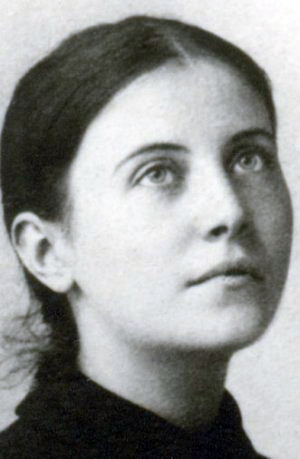
On this April 11th, in 1903 – the same year that the Italian Guiseppe Sarto was elected Pope later that summer as Pius X – a lovely, young Italian woman died, by the name of Gemma Galgani. She lived a brief life of 24 years, as did a number of other young saints, including Pier[…]Continue reading→

First Holy Communion: Sermon from May 16, 1943
Here is a sermon from the good old days by +Rev. Msgr. Vincent Nicholas Foy (August 14, 1915 – March 13, 2017), from 1943. Readers may recall that Pope Saint Pius X, by the decree Quam Singulari in 1910, lowered the customary age of reception of Holy Communion – after the rigours of the plague[…]Continue reading→