
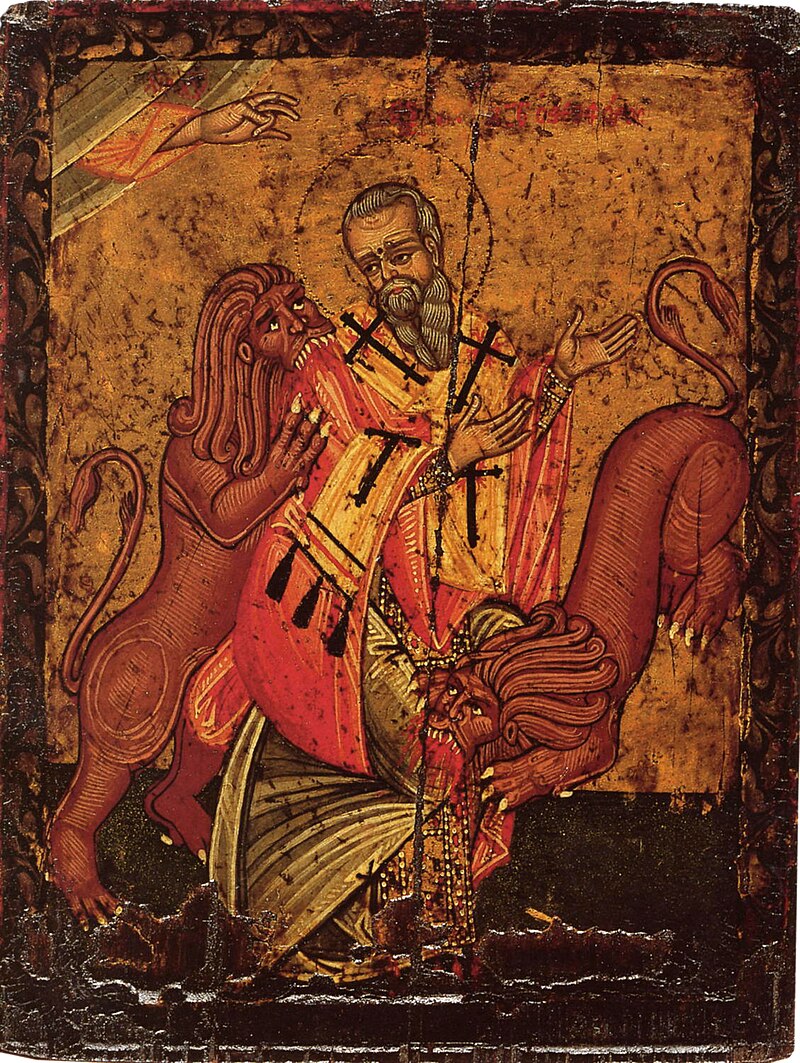
Pope Benedict and Saint Ignatius of Antioch
BENEDICT XVI
GENERAL AUDIENCE
St Peter’s Square
Wednesday, 14 March 2007
Saint Ignatius of Antioch
Dear Brothers and Sisters,
As we already did last Wednesday, we are speaking about the figures of the early Church. Last week we spoke of Pope Clement I, the third Successor of St Peter. Today, we will be speaking of St Ignatius, who was the third Bishop of Antioch from 70 to 107, the date of his martyrdom. At that time, Rome, Alexandria and Antioch were the three great metropolises of the Roman Empire. The Council of Nicea mentioned three “primacies”: Rome, but also Alexandria and Antioch participated in a certain sense in a “primacy”.
St Ignatius was Bishop of Antioch, which today is located in Turkey. Here in Antioch, as we know from the Acts of the Apostles, a flourishing Christian community developed. Its first Bishop was the Apostle Peter – or so tradition claims – and it was there that the disciples were “for the first time called Christians” (Acts 11: 26). Eusebius of Caesarea, a fourth-century historian, dedicated an entire chapter of his Church History to the life and literary works of Ignatius (cf. 3: 36).
Eusebius writes: “The Report says that he [Ignatius] was sent from Syria to Rome, and became food for wild beasts on account of his testimony to Christ. And as he made the journey through Asia under the strictest military surveillance” (he called the guards “ten leopards” in his Letter to the Romans, 5: 1), “he fortified the parishes in the various cities where he stopped by homilies and exhortations, and warned them above all to be especially on their guard against the heresies that were then beginning to prevail, and exhorted them to hold fast to the tradition of the Apostles”.
The first place Ignatius stopped on the way to his martyrdom was the city of Smyrna, where St Polycarp, a disciple of St John, was Bishop. Here, Ignatius wrote four letters, respectively to the Churches of Ephesus, Magnesia, Tralli and Rome. “Having left Smyrna”, Eusebius continues, Ignatius reached Troas and “wrote again”: two letters to the Churches of Philadelphia and Smyrna, and one to Bishop Polycarp.
Thus, Eusebius completes the list of his letters, which have come down to us from the Church of the first century as a precious treasure. In reading these texts one feels the freshness of the faith of the generation which had still known the Apostles. In these letters, the ardent love of a saint can also be felt.
Lastly, the martyr travelled from Troas to Rome, where he was thrown to fierce wild animals in the Flavian Amphitheatre.
No Church Father has expressed the longing for union with Christ and for life in him with the intensity of Ignatius. We therefore read the Gospel passage on the vine, which according to John’s Gospel is Jesus. In fact, two spiritual “currents” converge in Ignatius, that of Paul, straining with all his might for union with Christ, and that of John, concentrated on life in him. In turn, these two currents translate into the imitation of Christ, whom Ignatius several times proclaimed as “my” or “our God”.
Thus, Ignatius implores the Christians of Rome not to prevent his martyrdom since he is impatient “to attain to Jesus Christ”. And he explains, “It is better for me to die on behalf of Jesus Christ than to reign over all the ends of the earth…. Him I seek, who died for us: him I desire, who rose again for our sake…. Permit me to be an imitator of the Passion of my God!” (Romans, 5-6).
One can perceive in these words on fire with love, the pronounced Christological “realism” typical of the Church of Antioch, more focused than ever on the Incarnation of the Son of God and on his true and concrete humanity: “Jesus Christ”, St Ignatius wrote to the Smyrnaeans, “was truly of the seed of David”, “he was truly born of a virgin”, “and was truly nailed [to the Cross] for us” (1: 1).
Ignatius’ irresistible longing for union with Christ was the foundation of a real “mysticism of unity”. He describes himself: “I therefore did what befitted me as a man devoted to unity” (Philadelphians, 8: 1).
(To continue reading, please see here).

Saint Kateri , Canada’s Protectress
This was the title given to Saint Kateri Tekakwitha, by Pope Benedict XVI, when he canonized her on October 28th, 2012, along with six others, in Saint Peter’ Square (she had been beatified by Pope John Paul II back in 1980). With Saint Joseph as our protector, along with the Canadian martyrs, we seem to[…]Continue reading→

Remembering Father Alphonse de Valk
(Today marks the sixth anniversary of the death of Father Alphonse de Valk, C.S.B., a faithful, courageous and indefatigable Basilian priest, pro-life-and-family apostle, and the founder of Catholic Insight magazine. Here is what we wrote those on his entering into eternity five years ago, as we continue to remember him in our prayers and thoughts)[…]Continue reading→

A Tale of Two Benedicts
A grace-filled Holy Week to all our readers! As we await and prepare for the Resurrection about to dawn upon us, we might keep in mind two Benedicts: Pope Emeritus Benedict XVI, requiescat in pace, elected on this day in 2005; and today’s commemoration of the mystic pilgrim, Benedict Joseph Labre, who died on this[…]Continue reading→

My Name is Bernadette
April 16th is a propitious day, for besides the anniversary of Father de Valk’s death, who founded Catholic Insight in its print form decades ago, and the commemoration of the ‘two Benedicts’, mentioned in accompanying posts, today we also recall Saint Bernadette Soubirous, the young visionary to whom the Virgin Mary appeared numerous times at[…]Continue reading→

Saint Lydwina of Schiedam and Suffering Joyfully
Saint Lydwina of Schiedam (1380 – 1433) was one of the countless and glorious ‘victim souls’ in the history of the Church, those whose lives are filled with suffering, often of an unimaginable intensity, but who suffer joyfully. She was a fifteen-year old Dutch girl, out skating one day, when she fell and broke one[…]Continue reading→

The Glorious Martyrdoms of Martin and Maximus
As we enter into Eastertide, we recall on this 13th of April Pope Saint Martin I (+655), one of the noblest, if most tragic, of the successors of Saint Peter. Born in Umbria, Italy, he was of noble lineage, with great intelligence combined with charity and love of the poor and the Church. While still[…]Continue reading→

Canonizing Sister Faustina and Divine Mercy
HOMILY OF THE HOLY FATHER MASS IN ST PETER’S SQUARE FOR THE CANONIZATION OF SR MARY FAUSTINA KOWALSKA Sunday, 30 April 2000 1. “Confitemini Domino quoniam bonus, quoniam in saeculum misericordia eius”; “Give thanks to the Lord for he is good; his steadfast love endures for ever” (Ps 118: 1). So the Church sings on the Octave of[…]Continue reading→

Divine Mercy Sunday – An Echo of Every Mass
Reach out your hand and put it in my side. Do not doubt but believe’… ‘My Lord and my God!’ (Jn. 20:18)). Today is Divine Mercy Sunday, and as we celebrate the end of the Easter Octave, we contemplate the wounded side of our Saviour, the Church’s source of life. On Good Friday in the[…]Continue reading→

Saint Gemma Galgani
On this April 11th, in 1903 – the same year that the Italian Guiseppe Sarto was elected Pope later that summer as Pius X – a lovely, young Italian woman died, by the name of Gemma Galgani. She lived a brief life of 24 years, as did a number of other young saints, including Pier[…]Continue reading→
Saint Jean-Baptiste de la Salle: A Teacher for Teachers
Jean-Baptiste de la Salle (1651 – 1719), a French nobleman, ordained a priest, founded the first order in the Church’s history entirely without priests, and this came about almost by accident. I say ‘almost’, for, of course, there are no accidents with God. Destined for ordination from an early age, Jean-Baptiste never looked back, even[…]Continue reading→