
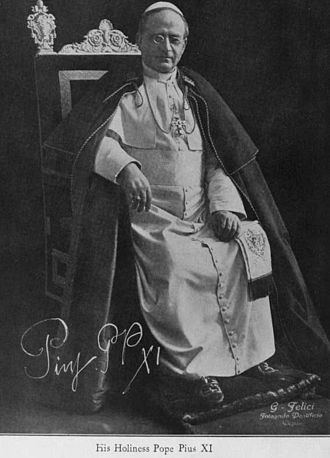
Pope Pius XI’s Letter on Saint Francis de Sales
(On the 26th of January, 1923, Pope Pius XI promulgated an encyclical on Saint Francis de Sales on the 300th anniversary of his death, a very profitable read on this his feast, a ‘sure remedy’ as he says in the first lines, for ‘the great evils’ threatening our world, which have only increased in the last century. These words complement those of Marcus Peter’s recent reflection in these pages, on the effect of digitalization and the internet on our own consumption of words. The gentle and generous bishop of Geneva, and doctor of the Church, is a light and guide in the darkness.)
RERUM OMNIUM PERTURBATIONEM
ENCYCLICAL OF POPE PIUS XI
ON ST. FRANCIS DE SALES
TO OUR VENERABLE BRETHREN THE PATRIARCHS, PRIMATES,
ARCHBISHOPS, BISHOPS, AND OTHER ORDINARIES
IN PEACE AND COMMUNION WITH THE APOSTOLIC SEE.
1. In Our recent encyclical We examined the disorders with which the world today struggles for the purpose of discovering a sure remedy for such great evils. At that time We pointed out that the roots of these evils lie in the souls of men and that the sole hope of curing them is to have recourse to the assistance of the Divine Healer Jesus Christ by the means which He has placed at the disposal of His Holy Church. The great need of our day is to curb the unmeasured desires of mankind, desires which are the fundamental cause of wars and dissensions, which act, too, as a dissolving force in social life and in international relations. It is no less necessary to turn back the minds of men from the passing things of this world to those which are eternal, which latter unhappily are too often neglected by the great majority of mankind. If every individual would resolve faithfully to live up to his obligations, a great social improvement would be realized almost immediately. Such an improvement is precisely the objective of the teachings and ministry of the Church, for her special mission is to instruct mankind by the preaching of truths which have been divinely revealed and to sanctify them by means of the grace of God. By the use of these methods she hopes to call back civil society to ways conformable to the spirit of Christ which once upon a time we followed. This she feels impelled to do as often as she finds society straying from the paths of righteousness.
2. The Church is most successful in this work of sanctification when it is possible for her, through the mercy of God, to hold up to the imitation of the faithful one or other of her dearest children who has made himself conspicuous by the practice of every virtue. This work of sanctification is of the very genius of the Church, since she was made by Christ, her Founder, not only holy herself but the source of holiness in others. All who accept the guidance of her ministry should, by the command of God, do everything in their power to sanctify their own lives. As St. Paul says, “This is the will of God, your sanctification.” (I Thess. iv, 3) Christ Himself has taught what this sanctification consists in – “Be ye therefore perfect as your heavenly Father is perfect.” (Matt. v, 48)
3. We cannot accept the belief that this command of Christ concerns only a select and privileged group of souls and that all others may consider themselves pleasing to Him if they have attained a lower degree of holiness. Quite the contrary is true, as appears from the very generality of His words. The law of holiness embraces all men and admits of no exception. The great number of souls of every condition in life, both young and old, who as history informs us have reached the zenith of Christian perfection, these saints felt in themselves the weaknesses of human nature and had to conquer the selfsame temptations as we. So true is this that as St. Augustine has so beautifully written, “God does not ask the impossible of us. But when He does order us to do something He, by His very commands, admonishes us to do that which we are able to do and to ask from Him for assistance in that which we are not of ourselves able to do.” (de Natura et Gratia, Chap. 43, No. 50.)
4. The solemn commemoration last year of the third centenary of the canonization of five great saints – Ignatius Loyola, Francis Xavier, Philip Neri, Teresa of Jesus, and Isidore the Farmer – helped greatly, Venerable Brothers, toward reawakening among the faithful a love for the Christian life. We are now happily called upon to celebrate the Third Centenary of the entrance into heaven of another great saint, one who was remarkable not only for the sublime holiness of life which he achieved but also for the wisdom with which he directed souls in the ways of sanctity. This saint was no less a person than Francis de Sales, Bishop of Geneva and Doctor of the Universal Church. Like those brilliant examples of Christian perfection and wisdom to whom We have just referred, he seemed to have been sent especially by God to contend against the heresies begotten by the Reformation. It is in these heresies that we discover the beginnings of that apostasy of mankind from the Church, the sad and disastrous effects of which are deplored, even to the present hour, by every fair mind. What is more, it appears that Francis de Sales was given to the Church by God for a very special mission. His task was to give the lie to a prejudice which in his lifetime was deeply rooted and has not been destroyed even today, that the ideal of genuine sanctity held up for our imitation by the Church is impossible of attainment or, at best, is so difficult that it surpasses the capabilities of the great majority of the faithful and is, therefore, to be thought of as the exclusive possession of a few great souls. St. Francis likewise disproved the false idea that holiness was so hedged around by annoyances and hardships that it is inadaptable to a life lived outside cloister walls.
5. Our esteemed Predecessor, Benedict XV, referring to the five saints We have spoken of, also made mention of the approaching Centenary of the death of Francis de Sales and expressed the hope of writing particularly of him in an encyclical addressed to the whole world. Gladly We will try to fulfill this as well as the other wishes of Our Predecessor, for We look upon them as a sacred heritage left Us by him. In this particular matter We follow his desires all the more willingly since We expect from this Centenary no less marvelous fruits than those which accompanied the feasts which have preceded it.
6. Whoever attentively reviews the life of St. Francis will discover that, from his earliest years, he was a model of sanctity. He was not a gloomy, austere saint but was most amiable and friendly with all, so much so that it can be said of him most truthfully, “her conversation (wisdom) hath no bitterness, nor her company any tediousness, but joy and gladness.” (Wisdom, viii, 16) Endowed with every virtue, he excelled in meekness of heart, a virtue so peculiar to himself that it might be considered his most characteristic trait. His meekness, however, differed altogether from that artificial gentility which consists in the mere possession of polished manners and in the display of a purely conventional affability. It differed, too, both from the apathy which cannot be moved by any force and from the timidity which does not dare to become indignant, even when indignation is required of one. This virtue, which grew in the heart of St. Francis as a delightful effect of his love of God and was nourished by the spirit of compassion and tenderness, so tempered with sweetness the natural gravity of his demeanor and softened both his voice and manners that he won the affectionate regard of everyone whom he encountered.
(To continue reading, please see here).

Saint Kateri , Canada’s Protectress
This was the title given to Saint Kateri Tekakwitha, by Pope Benedict XVI, when he canonized her on October 28th, 2012, along with six others, in Saint Peter’ Square (she had been beatified by Pope John Paul II back in 1980). With Saint Joseph as our protector, along with the Canadian martyrs, we seem to[…]Continue reading→

Remembering Father Alphonse de Valk
(Today marks the sixth anniversary of the death of Father Alphonse de Valk, C.S.B., a faithful, courageous and indefatigable Basilian priest, pro-life-and-family apostle, and the founder of Catholic Insight magazine. Here is what we wrote those on his entering into eternity five years ago, as we continue to remember him in our prayers and thoughts)[…]Continue reading→

A Tale of Two Benedicts
A grace-filled Holy Week to all our readers! As we await and prepare for the Resurrection about to dawn upon us, we might keep in mind two Benedicts: Pope Emeritus Benedict XVI, requiescat in pace, elected on this day in 2005; and today’s commemoration of the mystic pilgrim, Benedict Joseph Labre, who died on this[…]Continue reading→

My Name is Bernadette
April 16th is a propitious day, for besides the anniversary of Father de Valk’s death, who founded Catholic Insight in its print form decades ago, and the commemoration of the ‘two Benedicts’, mentioned in accompanying posts, today we also recall Saint Bernadette Soubirous, the young visionary to whom the Virgin Mary appeared numerous times at[…]Continue reading→

Saint Lydwina of Schiedam and Suffering Joyfully
Saint Lydwina of Schiedam (1380 – 1433) was one of the countless and glorious ‘victim souls’ in the history of the Church, those whose lives are filled with suffering, often of an unimaginable intensity, but who suffer joyfully. She was a fifteen-year old Dutch girl, out skating one day, when she fell and broke one[…]Continue reading→

The Glorious Martyrdoms of Martin and Maximus
As we enter into Eastertide, we recall on this 13th of April Pope Saint Martin I (+655), one of the noblest, if most tragic, of the successors of Saint Peter. Born in Umbria, Italy, he was of noble lineage, with great intelligence combined with charity and love of the poor and the Church. While still[…]Continue reading→

Canonizing Sister Faustina and Divine Mercy
HOMILY OF THE HOLY FATHER MASS IN ST PETER’S SQUARE FOR THE CANONIZATION OF SR MARY FAUSTINA KOWALSKA Sunday, 30 April 2000 1. “Confitemini Domino quoniam bonus, quoniam in saeculum misericordia eius”; “Give thanks to the Lord for he is good; his steadfast love endures for ever” (Ps 118: 1). So the Church sings on the Octave of[…]Continue reading→

Divine Mercy Sunday – An Echo of Every Mass
Reach out your hand and put it in my side. Do not doubt but believe’… ‘My Lord and my God!’ (Jn. 20:18)). Today is Divine Mercy Sunday, and as we celebrate the end of the Easter Octave, we contemplate the wounded side of our Saviour, the Church’s source of life. On Good Friday in the[…]Continue reading→

Saint Gemma Galgani
On this April 11th, in 1903 – the same year that the Italian Guiseppe Sarto was elected Pope later that summer as Pius X – a lovely, young Italian woman died, by the name of Gemma Galgani. She lived a brief life of 24 years, as did a number of other young saints, including Pier[…]Continue reading→
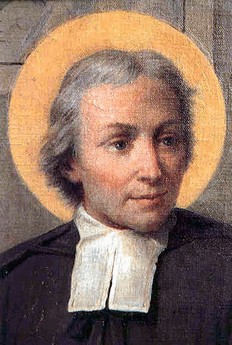
Saint Jean-Baptiste de la Salle: A Teacher for Teachers
Jean-Baptiste de la Salle (1651 – 1719), a French nobleman, ordained a priest, founded the first order in the Church’s history entirely without priests, and this came about almost by accident. I say ‘almost’, for, of course, there are no accidents with God. Destined for ordination from an early age, Jean-Baptiste never looked back, even[…]Continue reading→