
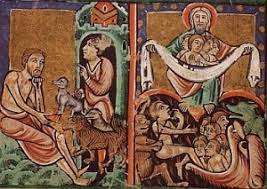
Twenty-Sixth Sunday: Lazarus and Helping the Poor
As for you, man of God; pursue righteousness, godliness, faith, love, endurance, gentleness (1 Tim. 6:11).
The parable of Lazarus and the rich man is found only in the Gospel of St. Luke. As the scribe of Our Lord’s meekness or gentleness, St. Luke records a parable that was one of the most frequently illustrated in medieval art, perhaps because of its vivid account of the afterlife or because it addresses the universal question of mercy and compassion in the face of suffering, along with our duty to alleviate the suffering of others. This obligation is very simply ours because Our Lord has clearly said, Truly, I say to you, as you did it to one of the least of these my brethren, you did it to me (Mt. 25:40). These very familiar words are from the parable of the Last Judgment. A very important truth is conveyed to us by these parables; namely, that God Himself is honoured and served by our compassion and in turn, that the practice of mercy will be the measure of our judgment.
What can we learn from this parable beyond what is very evident simply at the literal level? Evidently, we should extend mercy and compassion to the poor. God will surely judge us. This is clear. Perhaps the name that Our Lord gives to the poor man contains the very heart of the parable, whether we are charitable through the works of mercy or we are the recipients of this charity. This lesson; that of trust in God’s help in both our need and in the generous exercise of Christian charity is found in the very name of the poor man in the parable: Lazarus, in Hebrew, Eleazar; a name which means God is my help. If we have raised a family or have looked after ailing parents or relatives, all of us have performed the corporal works of mercy: we have fed the hungry, clothed the naked, and sheltered the homeless. Sometimes we have done these things at the cost of great sacrifice and in the midst of great uncertainty and yet we persevered and we were generous, perhaps heroically so. It is our trust in God and His Divine Providence that enables us to do this and even more. Sometimes the most self-evident truths are the ones we fail to appreciate.
Our help is in the Name of the Lord; Who made heaven and earth. This is a verse that is often recited especially in prayers of both supplication and blessing. The conviction of God’s sovereignty and care for us His children and for all His creation is at the very heart of our relationship with Our Heavenly Father. That is why before we are nourished with the Food of the Eucharist we dare to say, Our Father. As we worship, so we become; and so it is not surprising that those souls who are most faithful to prayer and to sacrifice more perfectly make present the love and mercy of God. As for you…pursue righteousness, godliness, faith, love, endurance, gentleness (1 Tim. 6:11). These words are addressed to all of us; and the prayerful pursuit of these virtues is the work of a lifetime. Our Lord calls us not simply to walk after Him but to imitate the pattern of His life; so that trusting in His grace and goodness, we might re-present, literally make present here and now the full measure of His mercy and kindness.
One of the most popular Saints of the Middle Ages was a former soldier, St. Martin of Tours, born of pagan parents around the year 316. There is an episode in his life often represented in art through the ages. On a bitterly cold winter day, the young soldier on garrison duty rode through the city gates of Amiens in France, probably dressed in the regalia of his unit – gleaming flexible armor, ridged helmet, and a beautiful cloak whose upper section was lined with lamb’s wool. As he approached the gates he saw a beggar, with clothes so ragged that he was practically naked. The beggar must have been shaking and blue from the cold but no one reached out to help him. Martin, overcome with compassion, took off his mantle and in one quick stroke slashed the mantle in two with his sword, handed half to the freezing man and wrapped the remainder on his own shoulders. Many in the crowd thought this was so ridiculous a sight that they laughed and jeered, but some realized they were seeing Christian goodness. That night Martin dreamed that he saw Our Lord wearing half the mantle he had given the beggar and Our Lord saying to the angels and saints that surrounded him. ‘See! This is the mantle that Martin, yet a catechumen, gave me.’ When he woke, it was the ‘yet a catechumen’ that spurred Martin on and he went immediately to be baptized. He was eighteen years old. Eventually Martin became a monk, a priest and eventually bishop of Tours, an outstanding shepherd. His biographer Simplicius Severus said of St. Martin that he was a man in whom the compassion of Our Lord was continually revealed (From a letter by Simplicius Severus, The Liturgy of the Hours, Vol. IV, p. 1553). In all humility and in a spirit of fervent Christian commitment, ideally, this should be said of each one of us as we endeavour to follow the example of Our Lord and pattern our life on His.
All of us will one day experience the particular judgment at the time of our death, and please God, our good deeds will go before us. In our Latin liturgy these words of a chant known as the In paradisum are sung as the deceased is taken from the church to the cemetery: May the ranks of angels receive you, and with Lazarus, who was poor, may you have eternal rest (Chorus angelorum te suscipiat, et cum Lazaro quondam paupere aeternam habeas requiem). This is a reference to the Lazarus, Eleazar of our parable. If we keep in our minds and hearts the lessons of Our Lord and the example of the saints, our help in time of need will indeed be in the Name of the Lord and we too will become men and women in whom the compassion of Our Lord is continually revealed. Let us continue then to pursue righteousness, godliness, faith, love, endurance, gentleness; that we too may one day be received Heaven, carried away by the Angels to be with Abraham (Lk. 16:22).

Saint Kateri , Canada’s Protectress
This was the title given to Saint Kateri Tekakwitha, by Pope Benedict XVI, when he canonized her on October 28th, 2012, along with six others, in Saint Peter’ Square (she had been beatified by Pope John Paul II back in 1980). With Saint Joseph as our protector, along with the Canadian martyrs, we seem to[…]Continue reading→

Remembering Father Alphonse de Valk
(Today marks the sixth anniversary of the death of Father Alphonse de Valk, C.S.B., a faithful, courageous and indefatigable Basilian priest, pro-life-and-family apostle, and the founder of Catholic Insight magazine. Here is what we wrote those on his entering into eternity five years ago, as we continue to remember him in our prayers and thoughts)[…]Continue reading→

A Tale of Two Benedicts
A grace-filled Holy Week to all our readers! As we await and prepare for the Resurrection about to dawn upon us, we might keep in mind two Benedicts: Pope Emeritus Benedict XVI, requiescat in pace, elected on this day in 2005; and today’s commemoration of the mystic pilgrim, Benedict Joseph Labre, who died on this[…]Continue reading→

My Name is Bernadette
April 16th is a propitious day, for besides the anniversary of Father de Valk’s death, who founded Catholic Insight in its print form decades ago, and the commemoration of the ‘two Benedicts’, mentioned in accompanying posts, today we also recall Saint Bernadette Soubirous, the young visionary to whom the Virgin Mary appeared numerous times at[…]Continue reading→

Saint Lydwina of Schiedam and Suffering Joyfully
Saint Lydwina of Schiedam (1380 – 1433) was one of the countless and glorious ‘victim souls’ in the history of the Church, those whose lives are filled with suffering, often of an unimaginable intensity, but who suffer joyfully. She was a fifteen-year old Dutch girl, out skating one day, when she fell and broke one[…]Continue reading→

The Glorious Martyrdoms of Martin and Maximus
As we enter into Eastertide, we recall on this 13th of April Pope Saint Martin I (+655), one of the noblest, if most tragic, of the successors of Saint Peter. Born in Umbria, Italy, he was of noble lineage, with great intelligence combined with charity and love of the poor and the Church. While still[…]Continue reading→

Canonizing Sister Faustina and Divine Mercy
HOMILY OF THE HOLY FATHER MASS IN ST PETER’S SQUARE FOR THE CANONIZATION OF SR MARY FAUSTINA KOWALSKA Sunday, 30 April 2000 1. “Confitemini Domino quoniam bonus, quoniam in saeculum misericordia eius”; “Give thanks to the Lord for he is good; his steadfast love endures for ever” (Ps 118: 1). So the Church sings on the Octave of[…]Continue reading→

Divine Mercy Sunday – An Echo of Every Mass
Reach out your hand and put it in my side. Do not doubt but believe’… ‘My Lord and my God!’ (Jn. 20:18)). Today is Divine Mercy Sunday, and as we celebrate the end of the Easter Octave, we contemplate the wounded side of our Saviour, the Church’s source of life. On Good Friday in the[…]Continue reading→
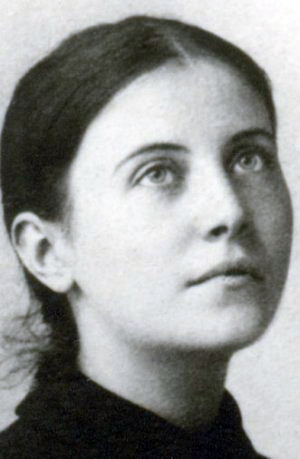
Saint Gemma Galgani
On this April 11th, in 1903 – the same year that the Italian Guiseppe Sarto was elected Pope later that summer as Pius X – a lovely, young Italian woman died, by the name of Gemma Galgani. She lived a brief life of 24 years, as did a number of other young saints, including Pier[…]Continue reading→
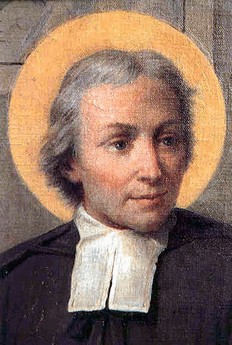
Saint Jean-Baptiste de la Salle: A Teacher for Teachers
Jean-Baptiste de la Salle (1651 – 1719), a French nobleman, ordained a priest, founded the first order in the Church’s history entirely without priests, and this came about almost by accident. I say ‘almost’, for, of course, there are no accidents with God. Destined for ordination from an early age, Jean-Baptiste never looked back, even[…]Continue reading→