
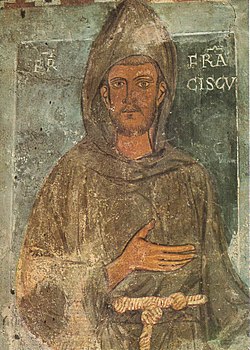
The Feast of the Stigmata of St Francis: A Sign of Hope
September 17th is the traditional feast of the Stigmata of St Francis, commemorating the event of the saint receiving the wounds of Christ on Mount La Verna in September 1224, two years before he died.
A good historical source for this feast is surely the letter which Brother Elias, whom Francis himself opted to govern his Order, sent to the Brothers in France so as to announce St Francis death: From the beginning of ages there has not been heard so great a wonder, save only in the Son of God who is Christ our God. For a long while before his death, our father and brother appeared crucified, bearing in his body the five wounds which are verily the Stigmata of Christ; for his hands and feet had as it were piercings made by nails fixed in from above and below, which laid open the scars and had the black appearance of nails; while his side appeared to have been lanced, and blood often trickled there from.
Another source which speaks about the Stigmata of St Francis was left to us by St Bonaventure, which offers the impression that Francis had the vision of Jesus wounded in the hands, feet and side, twice. In fact, the first vision took place exactly after Francis’ conversion from a worldly life to a one committed to Christ. Following that experience, St Bonaventure comments: One day, while Francis was praying in a secluded spot and became totally absorbed in God through his extreme fervor, Jesus Christ appeared to him fastened to the cross. Francis’ soul melted at the sight, and the memory of Christ’s passion was so impressed on the innermost recesses of his heart that from that hour, whenever Christ’s crucifixion came to mind, he could scarcely contain his tears and sighs.
The end result of such a powerful experience for Francis was his giving himself completely to serve the poor and the marginalized. Bonaventure says that from that experience onwards, Francis started rendering humble service to lepers with human concern and devoted kindness….He visited their houses frequently, and generously distributed alms to them and with great compassion kissed their hands and their mouths.
Towards the end of his life Bonaventure recounts a second vision of Christ, this time on Mount La Verna toward the end of the life of the Poverello:
Two years before his death, Francis, faithful servant of Christ, was led by divine providence to a high mountain called La Verna, where he could be alone. There he began a forty‐day fast in honour of Saint Michael the Archangel, as was his custom, and he soon experienced an extraordinary in‐pouring of divine contemplation. He was all on fire with heavenly desires and he realised that the gifts of divine grace were being poured out on him in greater abundance than ever.
The fervour of his seraphic longings raised Francis up to God and in an ecstasy of compassion made him like Christ who allowed himself to be crucified in the excess of his love. Then one morning about the feast of the Exaltation of the Holy Cross, while he was praying on the mountainside, Francis saw a seraph with six fiery wings coming down from the highest point in the heavens. The vision descended swiftly and came to rest in the air near him. Then he saw the image of a man crucified in the midst of the wings, with his hands and feet outstretched and nailed to a cross. Two of the wings were raised above his head and two were stretched out in flight, while the remaining two shielded his body. Francis was dumbfounded at the sight and his heart was flooded with a mixture of joy and sorrow. He was overjoyed at the way Christ regarded him so graciously under the appearance of the seraph, but the fact that he was nailed to a cross pierced his soul with a sword of compassionate sorrow.
As the vision disappeared, it left his heart ablaze with eagerness and impressed upon his body a miraculous likeness. There and then, the marks of the nails began to appear in his hands and feet, just as he had seen them in the vision of the man nailed to a cross. His hands and feet appeared pierced through the centre with nails, the heads of which were in the palms of his hands and on the instep of each foot, while the points stuck out on the opposite side. His right side seemed as if it had been pierced with a lance and was marked with a livid scar which often bled.
True love of Christ had now transformed his lover into his image, and when the forty days which he had intended spending in solitude were over and the feast of Saint Michael had come, Saint Francis came down from the mountain. With him he bore the representation of Christ crucified which was not the work of an artist in wood or stone, but had been reproduced in the members of his body by the hand of the living God (Legenda Minor XIII, 1-4).
From this vision we can deduce that the presence of the Seraph suggests those angels of God who are closest to and burning with love for Him shouting his Most Holy Name: Holy, holy, holy! (see Is 6:2-3). The fiery wings show the flaming intensity of God’s love which Christ gave to Francis whereas this inflamed the saint’s heart. St Francis is called seraphic so as to manifest his passionate way of relating to God.
The meaning of the Feat of the Stigmata of St Francis is that the more the Poverello experienced the magnificent effluence of God’s love for him the more he got to inspired to reciprocate to that kind of love not only to God personally but also to his children, particularly the needy and those lying at the periphery. How truly is the feast of the Stigmata of St Francis is, in fact, a resource of hope!
Almighty God, you renewed the marks of the sufferings of Jesus in the body of our holy Father Francis in order to inflame our hearts with the fire of our love. Through his prayers may we be made conformable to the death of your Son and thus share also in his resurrection. We ask this through our Lord Jesus Christ, your Son, who lives and reigns with you and the Holy Spirit, one God, forever and ever. Amen.

Saint Kateri , Canada’s Protectress
This was the title given to Saint Kateri Tekakwitha, by Pope Benedict XVI, when he canonized her on October 28th, 2012, along with six others, in Saint Peter’ Square (she had been beatified by Pope John Paul II back in 1980). With Saint Joseph as our protector, along with the Canadian martyrs, we seem to[…]Continue reading→

Remembering Father Alphonse de Valk
(Today marks the sixth anniversary of the death of Father Alphonse de Valk, C.S.B., a faithful, courageous and indefatigable Basilian priest, pro-life-and-family apostle, and the founder of Catholic Insight magazine. Here is what we wrote those on his entering into eternity five years ago, as we continue to remember him in our prayers and thoughts)[…]Continue reading→

A Tale of Two Benedicts
A grace-filled Holy Week to all our readers! As we await and prepare for the Resurrection about to dawn upon us, we might keep in mind two Benedicts: Pope Emeritus Benedict XVI, requiescat in pace, elected on this day in 2005; and today’s commemoration of the mystic pilgrim, Benedict Joseph Labre, who died on this[…]Continue reading→

My Name is Bernadette
April 16th is a propitious day, for besides the anniversary of Father de Valk’s death, who founded Catholic Insight in its print form decades ago, and the commemoration of the ‘two Benedicts’, mentioned in accompanying posts, today we also recall Saint Bernadette Soubirous, the young visionary to whom the Virgin Mary appeared numerous times at[…]Continue reading→

Saint Lydwina of Schiedam and Suffering Joyfully
Saint Lydwina of Schiedam (1380 – 1433) was one of the countless and glorious ‘victim souls’ in the history of the Church, those whose lives are filled with suffering, often of an unimaginable intensity, but who suffer joyfully. She was a fifteen-year old Dutch girl, out skating one day, when she fell and broke one[…]Continue reading→

The Glorious Martyrdoms of Martin and Maximus
As we enter into Eastertide, we recall on this 13th of April Pope Saint Martin I (+655), one of the noblest, if most tragic, of the successors of Saint Peter. Born in Umbria, Italy, he was of noble lineage, with great intelligence combined with charity and love of the poor and the Church. While still[…]Continue reading→

Canonizing Sister Faustina and Divine Mercy
HOMILY OF THE HOLY FATHER MASS IN ST PETER’S SQUARE FOR THE CANONIZATION OF SR MARY FAUSTINA KOWALSKA Sunday, 30 April 2000 1. “Confitemini Domino quoniam bonus, quoniam in saeculum misericordia eius”; “Give thanks to the Lord for he is good; his steadfast love endures for ever” (Ps 118: 1). So the Church sings on the Octave of[…]Continue reading→

Divine Mercy Sunday – An Echo of Every Mass
Reach out your hand and put it in my side. Do not doubt but believe’… ‘My Lord and my God!’ (Jn. 20:18)). Today is Divine Mercy Sunday, and as we celebrate the end of the Easter Octave, we contemplate the wounded side of our Saviour, the Church’s source of life. On Good Friday in the[…]Continue reading→
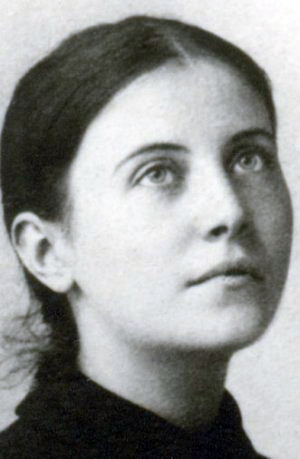
Saint Gemma Galgani
On this April 11th, in 1903 – the same year that the Italian Guiseppe Sarto was elected Pope later that summer as Pius X – a lovely, young Italian woman died, by the name of Gemma Galgani. She lived a brief life of 24 years, as did a number of other young saints, including Pier[…]Continue reading→
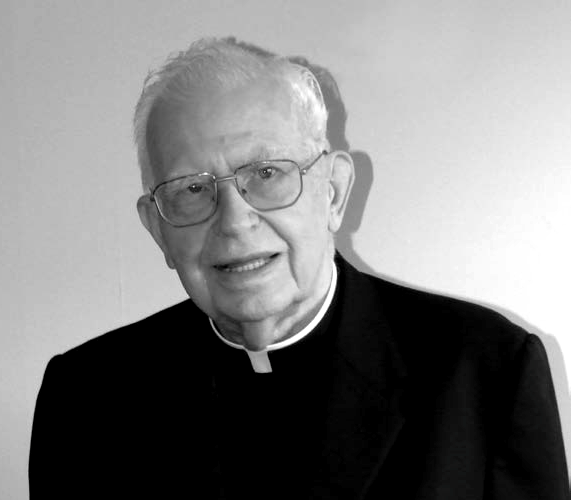
First Holy Communion: Sermon from May 16, 1943
Here is a sermon from the good old days by +Rev. Msgr. Vincent Nicholas Foy (August 14, 1915 – March 13, 2017), from 1943. Readers may recall that Pope Saint Pius X, by the decree Quam Singulari in 1910, lowered the customary age of reception of Holy Communion – after the rigours of the plague[…]Continue reading→