
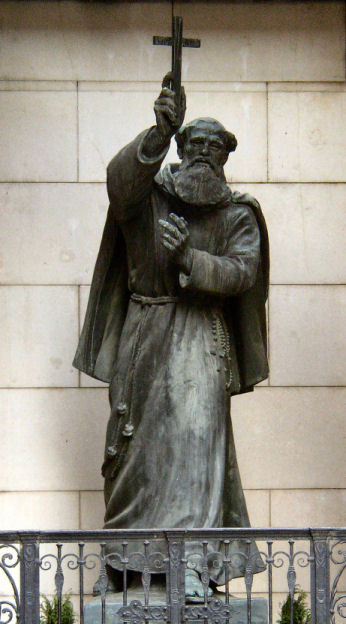
Blessed Marco D’Aviano: The Staunch Defender of the Freedom and Unity of Christian Europe
August 13th is the feast of Blessed Marco D’Aviano, who played a curcial role in Christian Europe of the seventh century. His importance can be seen even nowadays, in a Europe of integration of multi-ethnic and multi-faith context.
He was born in Aviano on November 17, 1631, the third of eleven children of Pasquale Cristofori and Rosa Zanoni. On the same day he was baptized with the name of Carlo Domenico, and in 1643 he received confirmation. He then attended higher studies in the college which was run by the Jesuits in Gorizia. From here, four years later, he fled from home, with the desire to help the Venetians engaged in the defense of the island of Candia which was besieged by the Turks.
In Koper he gave up on this adventure and was taken back home by the Capuchins to whom he had asked for help. In 1648, at the age of seventeen, he entered the Capuchin novitiate in Conegliano, adopting the habit and religious profession, taking the name of Fra Marco d’Aviano. On 18 September 1655 he was ordained a priest in Chioggia. In 1664 he received the “permission” to preach to the people, an office which he immediately exercised with great effectiveness. Father Marco was also the guardian of two convents, Belluno and Oderzo.
His preaching, combined with an exemplary life, were such that he attained continental fame, from 1676. So many prodigious conversions and healings began to take place that he was given the tiitle of “thaumaturge of the century”. His popularity reached France, Belgium, Holland, Switzerland, Tyrol, Bavaria, Austria, the states of Germany, Bohemia and Slovenia, where Father Marco went on missionary journeys requested by the bishops for the spiritual renewal of those nations. Immense crowds gathered to listen to him as well as to receive his blessing, which was inevitably followed by exceptional events. The first concern of Father Marco was to exhort and procure the repentance of sins, and for this he had the act of contrition recited publicly. It is intriguing to note that Fr Marco showed great respect for the Protestants whom he considered brothers and urged them to union.
But his appointment with history is set for 1683, on the occasion of the invasion of Europe by the Ottoman army (about one hundred and fifty thousand armed men), who had come to besiege the city of Vienna, seat of the emperor of Austria, Leopoldo I. For some years Emperor Leopold I had enjoyed the friendship of Marco d’Aviano and benefited from his precious advice in government activity, often characterized by indecision and hesitation. In the impending danger, when the Turks wanted to make Vienna the capital of a second Turkish empire in the heart of Europe, something which greatly concerned Pope Blessed Innocent XI, Father Marco was sent as papal legate to the defense coalition, composed of no more than seventy thousand men. His mediating work brought about the agreement between the various rival leaders of the alliance, and placed the King of Poland John Sobieski as the common leader.
Marco d’Aviano took the opportunity of heartening the army during a day of prayer. At the dawn of the fateful day of September 12, 1683, he celebrated mass, served by the Polish king, instilled enthusiasm and certainty of victory in everyone and offered his life to God for the salvation of Christian Europe. Victory followed gloriously, marking a milestone in the history of Europe, preserved in its identity of Christian faith and civilization.
Marco d’Aviano’s mission continued in the following years, promoting the alliance between European states for the liberation of the Balkans from Turkish oppression. In September 1686 Buda, the capital of Hungary, was freed after almost a century and a half of Ottoman domination, while in 1688 their stronghold of Belgrade was captured by the Christian army. Here, Father Marco saved the lives of eight hundred Turkish soldiers. In the meantime, he continued to devote himself to his fiery and convincing preaching, particularly in the Venetian regions. Who can ever forget his Lenten celebrations which remained well ingrained in the homiletic history of the period? On a political level Father Marco always kept correspondence with influential people of the time, particularly by being the spiritual adviser to Emperor Leopold I who often asked for Father Marco’s precious help.
During his last trip to the capital of Austria, Father Marco d’Aviano died, consumed by fatigue, in the presence of the emperor and his wife Eleonora, holding the crucifix he always carried with him in his hands. It was eleven o’clock on 13 August 1699. He was buried in Vienna in the Capuchin church.
After a long and careful process on his Christian virtues, which were declared heroic, and after the official attribution of a miracle connected to his intercession, Blessed Mark of Aviano was elevated by St Pope John Paul II to the honor of the altars with the title of blessed at St Peter’s Square of the Vatican Basilica on April 27, 2003. Here are the words St Pope John Paul II said about Blessed Marco d’Aviano:
In a different time and context, Blessed Mark of Aviano shone with holiness as his soul burned with a longing for prayer, silence and adoration of God’s mystery. This contemplative who journeyed along the highways of Europe was the centre of a wide-reaching spiritual renewal, thanks to his courageous preaching that was accompanied by numerous miracles. An unarmed prophet of divine mercy, he was impelled by circumstances to be actively committed to defending the freedom and unity of Christian Europe. Blessed Mark of Aviano reminds the European continent, opening up in these years to new prospects of cooperation, that its unity will be sounder if it is based on its common Christian roots (no.4).
On an supplementary note, legend has it that Father Marco D’Aviano inspired the fashionable cappuccino coffee which presently is drunk by millions across the globe. It is said that following the victory over the Turkish Army, the Viennese reportedly found sacks of coffee abandoned by the enemy and, finding it too strong for their taste, diluted it with cream and honey. The drink being of a brown colour looked perfectly like our Capuchin habit. Hence, the Viennese named it cappuccino in honour of Marco D’Aviano’s order, our Capuchin Order. May those who drink the cappuccino coffee be blessed by the powerful intercession of Blessed Marco D’Aviano.
Most Holy Trinity,
Father, Son and Holy Spirit,
we worship you and give you glory
because you are the Good,
the greatest Good,
from whom all good springs forth.
You made Blessed Marco of Aviano
an Apostle of Peace, a Promoter of Unity
among the people of Europe,
a Father for the weakest and most vulnerable,
a powerful Worker of spiritual
and physical miracles.
Grant us also, through his intercession,
the same Spirit of Faith, Brotherly Love,
Harmony and Peace and the grace we implore…
Glory be to the Father…

Saint Kateri , Canada’s Protectress
This was the title given to Saint Kateri Tekakwitha, by Pope Benedict XVI, when he canonized her on October 28th, 2012, along with six others, in Saint Peter’ Square (she had been beatified by Pope John Paul II back in 1980). With Saint Joseph as our protector, along with the Canadian martyrs, we seem to[…]Continue reading→

Remembering Father Alphonse de Valk
(Today marks the sixth anniversary of the death of Father Alphonse de Valk, C.S.B., a faithful, courageous and indefatigable Basilian priest, pro-life-and-family apostle, and the founder of Catholic Insight magazine. Here is what we wrote those on his entering into eternity five years ago, as we continue to remember him in our prayers and thoughts)[…]Continue reading→

A Tale of Two Benedicts
A grace-filled Holy Week to all our readers! As we await and prepare for the Resurrection about to dawn upon us, we might keep in mind two Benedicts: Pope Emeritus Benedict XVI, requiescat in pace, elected on this day in 2005; and today’s commemoration of the mystic pilgrim, Benedict Joseph Labre, who died on this[…]Continue reading→

My Name is Bernadette
April 16th is a propitious day, for besides the anniversary of Father de Valk’s death, who founded Catholic Insight in its print form decades ago, and the commemoration of the ‘two Benedicts’, mentioned in accompanying posts, today we also recall Saint Bernadette Soubirous, the young visionary to whom the Virgin Mary appeared numerous times at[…]Continue reading→

Saint Lydwina of Schiedam and Suffering Joyfully
Saint Lydwina of Schiedam (1380 – 1433) was one of the countless and glorious ‘victim souls’ in the history of the Church, those whose lives are filled with suffering, often of an unimaginable intensity, but who suffer joyfully. She was a fifteen-year old Dutch girl, out skating one day, when she fell and broke one[…]Continue reading→

The Glorious Martyrdoms of Martin and Maximus
As we enter into Eastertide, we recall on this 13th of April Pope Saint Martin I (+655), one of the noblest, if most tragic, of the successors of Saint Peter. Born in Umbria, Italy, he was of noble lineage, with great intelligence combined with charity and love of the poor and the Church. While still[…]Continue reading→

Canonizing Sister Faustina and Divine Mercy
HOMILY OF THE HOLY FATHER MASS IN ST PETER’S SQUARE FOR THE CANONIZATION OF SR MARY FAUSTINA KOWALSKA Sunday, 30 April 2000 1. “Confitemini Domino quoniam bonus, quoniam in saeculum misericordia eius”; “Give thanks to the Lord for he is good; his steadfast love endures for ever” (Ps 118: 1). So the Church sings on the Octave of[…]Continue reading→

Divine Mercy Sunday – An Echo of Every Mass
Reach out your hand and put it in my side. Do not doubt but believe’… ‘My Lord and my God!’ (Jn. 20:18)). Today is Divine Mercy Sunday, and as we celebrate the end of the Easter Octave, we contemplate the wounded side of our Saviour, the Church’s source of life. On Good Friday in the[…]Continue reading→
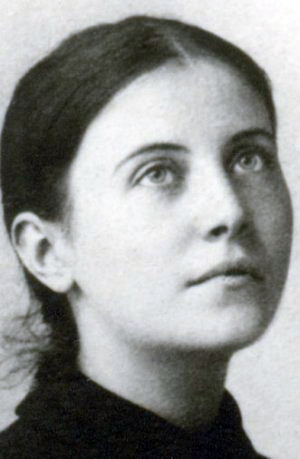
Saint Gemma Galgani
On this April 11th, in 1903 – the same year that the Italian Guiseppe Sarto was elected Pope later that summer as Pius X – a lovely, young Italian woman died, by the name of Gemma Galgani. She lived a brief life of 24 years, as did a number of other young saints, including Pier[…]Continue reading→
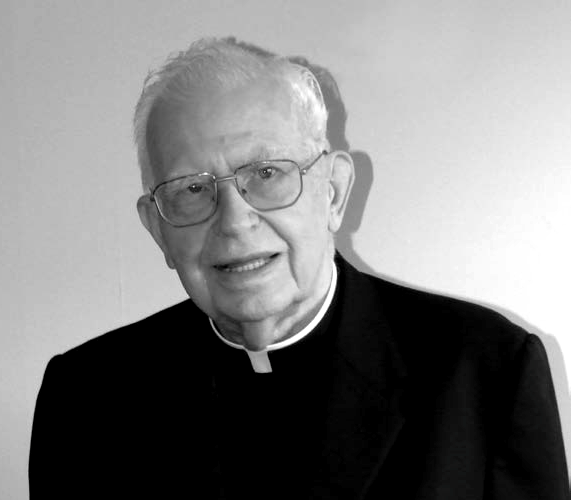
First Holy Communion: Sermon from May 16, 1943
Here is a sermon from the good old days by +Rev. Msgr. Vincent Nicholas Foy (August 14, 1915 – March 13, 2017), from 1943. Readers may recall that Pope Saint Pius X, by the decree Quam Singulari in 1910, lowered the customary age of reception of Holy Communion – after the rigours of the plague[…]Continue reading→