
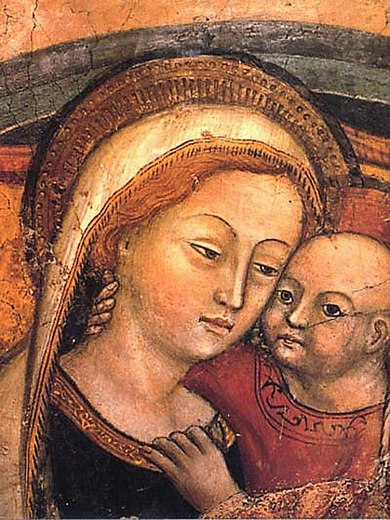
The Ten Blessings of the Immaculate Conception
If a blessing is God’s favour and protection, can there be an eminent example of such than the Solemnity of the Immaculate Conception of Mary?
In his tertium librum Sententiarum, 3.q.I, Blessed Duns Scotus, a humble and most erudite Franciscan theologian writes:
Mary did not contract original sin because of the excellence of her Son. Inasmuch as he is Redeemer, Reconciler and Mediator. For the most perfect mediator would perform the most perfect act of mediation on behalf of any person for whom he mediated. But Christ is the most perfect Mediator. Therefore, Christ showed the most perfect possible degree of mediation to any creature or person whose Mediator he was. But for no other person did he exhibit a more excellent degree of mediation than he did for Mary. . . But this would not have happened if he had not merited that she would be preserved from original sin.
I prove this with three arguments. First, in reference to God, to whom Christ reconciles others; second, in reference to evil, from which he liberates others; third, in reference to the debt of the person whom he reconciles too God.
First. No one placates another in the highest or most perfect way for an offense that someone might commit except by preventing him from being offended. For, if he placates someone who has already been offended, so that the offended party remits [punishment], he does not placate perfectly. . . Therefore, Christ does not perfectly placate the Trinity for the guilt to be contracted by the sons of Adam if he does not prevent the Trinity from being offended by at least someone, so that consequently the soul of some one descendant of Adam would not have this guilt.
Second. The most perfect Mediator merits the removal of all punishment from the one whom he reconciles. But the original fault is a grater punishment than even loss of the vision of God. . . because, of all punishments that might befall the intellectual nature, sin is the greatest. Therefore, if Christ reconciled in the most perfect way possible, he merited to remove that most heavy punishment form [at least] someone – and this could only be his Mother.
Further, it seems that Christ restored and reconciled us from original sin more directly than from actual sin, because the necessity of the Incarnation, Passion, and so forth, is commonly attributed to the original sin, but it is commonly supposed that he was a perfect Mediator with respect [at least] one person; for example, Mary, given that he preserved her from all actual sin. Therefore, he acted similarly on her behalf and preserved her fro original sin…
Third. A person who has been reconciled is not indebted in the greatest possible way to his mediator unless he has received the greatest possible good from him. But that innocence, which is the preservation from contracting or needing to contract guilt, can be had by means of a mediator. Therefore, no person would be indebted in the highest possible way to Christ as his Mediator if Christ had not been preserved someone from original sin.
The sanctification of the Blessed Virgin cannot be understood to have happened before ensoulment, for two reasons. In the first place, because the sanctification of which we speak consists in purification from original sin, for sanctity is “total purity,” as Dionysius says. But guilt can be purified only by grace, and only a rational creature can be the subject of grace. Therefore the Blessed Virgin was not sanctified before the infusion of a rational soul.
In the writings of Pope St John Paul II, it clearly emerges from the fact that the Immaculate Conception of Mary’s Solemnity is a magnificent blessing. Why? First, because Mary is full of grace because it is filled with divine love! Pope St John Paul reflects: The background for today’s solemnity is the biblical icon of the Annunciation, when the angel’s mysterious greeting resounded: “Hail, full of grace, the Lord is with you” (Lk 1:28). “Full of grace”! Here is Mary, as God conceived of her and desired her in his inscrutable plan: a creature filled with divine love, all goodness, all beauty, all holiness.
Second, in the Immaculate Conception of Mary’s Solemnity, God looks at the human person on the inside. He chose Mary as the model of our Christian expectation and hope. Pope John Paul said: Man looks on the outward appearance, but the Lord looks on the heart” (1 Sm 16:7). And Mary’s heart was fully disposed to the fulfilment of the divine will. This is why the Blessed Virgin is the model of Christian expectation and hope… In her heart there is no shade of selfishiness: she desires nothing for herself except God’s glory and human salvation. For her, the very privilege of being preserved from original sin is not a reason to boast, but one for total service to her Son’s redemptive mission.
Third, the Immaculate Conception of Mary’s Solemnity is an blessing because it teaches us watchfulness and prayer. Thus reflected Pope St John Paul II: This important Marian feast occurs during Advent, a season of watchful and prayerful preparation for Christmas. She who knew better than anyone how to wait attentively for the Lord guides us and shows us how to make more vital and active our journey to the Holy Night of Bethlehem. With her, we spend these weeks in prayer and, guided by her bright star, hasten to make the spiritual journey that will lead us to celebrate the mystery of the Incarnation with greater intensity.
Fourth, in the Immaculate Conception of Mary’s Solemnity we can easily appreciate the power of Christ’s mediation. St Pope John Paul II observed: What happened to Mary turns our attention to Jesus Christ, the only Mediator of salvation, and helps us to see life as a loving plan with which we must cooperate responsibly. Mary is not only a model of the call, but also of the response. Indeed, she said “yes” to God at the beginning and at every successive moment of her life, fully complying with his will, even when she found it obscure and hard to accept.
Fifth, in the Immaculate Conception of Mary’s Solemnity, we celebrate Mary’s outstanding extraordinary and ineffable privilege of being the immaculately conceived. Pope St John Paul II stated: Today we contemplate the humble girl of Nazareth who, by an extraordinary and ineffable privilege, was preserved from the contagion of original sin and from every fault, so that she could be a worthy dwelling-place for the Incarnate Word. In Mary, the New Eve, Mother of the New Adam, the Father’s original, wondrous plan of love was re-established in an even more wondrous way. Therefore the Church gratefully acclaims: “Through you, immaculate Virgin, the life we had lost was returned to us. You received a child from heaven, and brought forth to the world a Saviour” (Liturgy of the Hours, Memorial of the Blessed Virgin Mary on Saturday, Benedictus Antiphon).
Sixth, the Immaculate Conception of Mary’s Solemnity is a great blessing because Mary invites us to fix our eyes on Christ. Therefore, Pope St. John Paul encouraged us in this direction when he said: The Immaculate Virgin however invites us not to fix our eyes on her but to pass beyond, and as much as possible, to enter into the mystery in which she was conceived: the mystery of God who is One and Three, full of grace and fidelity. As the moon shines with the light of the sun, so the immaculate splendour of Mary is totally relative to that of the Redeemer. The Mother leads us to her Son; passing through her, we reach Christ. For this reason, Dante Allighieri notes fittingly: “that her radiance alone can dispose you to see Christ”.
Seventh, the Immaculate Conception shows Mary’s docile humility. Pope St John Paul II reflected on this when he said: Mary was pleasing to God because of her docile humility. To the heavenly messenger, she replied, “Behold the handmaid of the Lord, let it be done to me according to your word” (Lk 1,38). It is with the same interior disposition that believers are called to accept the divine will in every circumstance.
Eighth, the Immaculate Conception signifies that Mary is the dawn, shining with beauty. Pope St John Paul II stated: Today the Church is celebrating the Immaculate Conception of the Blessed Virgin Mary. If Christ is the day that never fades, Mary is its dawn, shining with beauty. Chosen in advance to be the Mother of the incarnate Word, Mary is at the same time the first-fruits of his redeeming action. The grace of Christ the Redeemer acted in her in anticipation, preserving her from original sin and from any contagion of guilt.
Ninth, the Immaculate Conception is beacon of light for humanity in every epoch of its existence. Pope St John Paul noted: The Immaculate Conception shines like a beacon of light for humanity in all the ages. At the beginning of the third millennium, it guides us to believe and hope in God, in his salvation and in eternal life. In particular, it lights the way of the Church, which is committed to the new evangelization.
Tenth, the Immaculate Conception of Mary’s Solemnity is a celebration of God’s unfathomable grace shown to Mary. Pope St John Paul II reflected: Hail, full of grace. What do these words mean? The Evangelist Luke writes that Mary (Miriam), at these words spoken by the Angel, “was greatly troubled…, and considered in her mind what sort of greeting this might be” (Lk 1:29). These words express a singular election. Grace means a particular fullness of creation through which the being, who resembles God, participates in God’s own interior life. Grace means love and the gift of God himself, the completely free gift (“given gratuitously”) in which God entrusts to man his Mystery, giving him, at the same time, the capacity of being able to bear witness to the Mystery, of filling with it his human being, his life, his thoughts, his will and his heart.
Let us join Pope St John Paul II in prayer in front of the statue of the Immaculate Conception, on 8 December 2004, on the closing of the 150 years of the Dogma:
Immaculate Virgin!
Once again we are here to honour you, at the foot of this column from which you lovingly watch over Rome and the whole world, ever since, 150 years ago, Blessed Pius IX proclaimed as a truth of the Catholic faith your preservation from every stain of sin in anticipation of the death and Resurrection of your Son, Jesus Christ.
Immaculate Virgin!
Your spotless spiritual beauty is for us a living source of confidence and hope.
To have you as Mother, Holy Virgin, reassures us on the path of life as a pledge of eternal salvation. Because of this, O Mary, we have recourse to you with confidence. Help us to build a world where human life is always cherished and defended, every form of violence banished, the peace of all tenaciously sought.
Immaculate Virgin!
In this Year of the Eucharist, grant that we may celebrate and adore with renewed faith and ardent love the holy mystery of the Body and Blood of Christ. At your school, O Woman of the Eucharist, teach us to remember the marvels that God never ceases to work in human hearts. With motherly tenderness, Virgin Mary, guide our steps always on the path of good.

Saint Kateri , Canada’s Protectress
This was the title given to Saint Kateri Tekakwitha, by Pope Benedict XVI, when he canonized her on October 28th, 2012, along with six others, in Saint Peter’ Square (she had been beatified by Pope John Paul II back in 1980). With Saint Joseph as our protector, along with the Canadian martyrs, we seem to[…]Continue reading→

Remembering Father Alphonse de Valk
(Today marks the sixth anniversary of the death of Father Alphonse de Valk, C.S.B., a faithful, courageous and indefatigable Basilian priest, pro-life-and-family apostle, and the founder of Catholic Insight magazine. Here is what we wrote those on his entering into eternity five years ago, as we continue to remember him in our prayers and thoughts)[…]Continue reading→

A Tale of Two Benedicts
A grace-filled Holy Week to all our readers! As we await and prepare for the Resurrection about to dawn upon us, we might keep in mind two Benedicts: Pope Emeritus Benedict XVI, requiescat in pace, elected on this day in 2005; and today’s commemoration of the mystic pilgrim, Benedict Joseph Labre, who died on this[…]Continue reading→

My Name is Bernadette
April 16th is a propitious day, for besides the anniversary of Father de Valk’s death, who founded Catholic Insight in its print form decades ago, and the commemoration of the ‘two Benedicts’, mentioned in accompanying posts, today we also recall Saint Bernadette Soubirous, the young visionary to whom the Virgin Mary appeared numerous times at[…]Continue reading→

Saint Lydwina of Schiedam and Suffering Joyfully
Saint Lydwina of Schiedam (1380 – 1433) was one of the countless and glorious ‘victim souls’ in the history of the Church, those whose lives are filled with suffering, often of an unimaginable intensity, but who suffer joyfully. She was a fifteen-year old Dutch girl, out skating one day, when she fell and broke one[…]Continue reading→

The Glorious Martyrdoms of Martin and Maximus
As we enter into Eastertide, we recall on this 13th of April Pope Saint Martin I (+655), one of the noblest, if most tragic, of the successors of Saint Peter. Born in Umbria, Italy, he was of noble lineage, with great intelligence combined with charity and love of the poor and the Church. While still[…]Continue reading→

Canonizing Sister Faustina and Divine Mercy
HOMILY OF THE HOLY FATHER MASS IN ST PETER’S SQUARE FOR THE CANONIZATION OF SR MARY FAUSTINA KOWALSKA Sunday, 30 April 2000 1. “Confitemini Domino quoniam bonus, quoniam in saeculum misericordia eius”; “Give thanks to the Lord for he is good; his steadfast love endures for ever” (Ps 118: 1). So the Church sings on the Octave of[…]Continue reading→

Divine Mercy Sunday – An Echo of Every Mass
Reach out your hand and put it in my side. Do not doubt but believe’… ‘My Lord and my God!’ (Jn. 20:18)). Today is Divine Mercy Sunday, and as we celebrate the end of the Easter Octave, we contemplate the wounded side of our Saviour, the Church’s source of life. On Good Friday in the[…]Continue reading→

Saint Gemma Galgani
On this April 11th, in 1903 – the same year that the Italian Guiseppe Sarto was elected Pope later that summer as Pius X – a lovely, young Italian woman died, by the name of Gemma Galgani. She lived a brief life of 24 years, as did a number of other young saints, including Pier[…]Continue reading→

First Holy Communion: Sermon from May 16, 1943
Here is a sermon from the good old days by +Rev. Msgr. Vincent Nicholas Foy (August 14, 1915 – March 13, 2017), from 1943. Readers may recall that Pope Saint Pius X, by the decree Quam Singulari in 1910, lowered the customary age of reception of Holy Communion – after the rigours of the plague[…]Continue reading→