
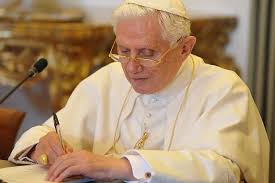
Pope Benedict and Teresa of Avila
BENEDICT XVI
GENERAL AUDIENCE
Paul VI Audience Hall
Wednesday, 2 February 2011
[Video]
Saint Teresa of Avila
Dear Brothers and Sisters,
In the course of the Catecheses that I have chosen to dedicate to the Fathers of the Church and to great theologians and women of the Middle Ages I have also had the opportunity to reflect on certain Saints proclaimed Doctors of the Church on account of the eminence of their teaching.
Today I would like to begin a brief series of meetings to complete the presentation on the Doctors of the Church and I am beginning with a Saint who is one of the peaks of Christian spirituality of all time — St Teresa of Avila [also known as St Teresa of Jesus].
St Teresa, whose name was Teresa de Cepeda y Ahumada, was born in Avila, Spain, in 1515. In her autobiography she mentions some details of her childhood: she was born into a large family, her “father and mother, who were devout and feared God”. She had three sisters and nine brothers.
While she was still a child and not yet nine years old she had the opportunity to read the lives of several Martyrs which inspired in her such a longing for martyrdom that she briefly ran away from home in order to die a Martyr’s death and to go to Heaven (cf. Vida, [Life], 1, 4); “I want to see God”, the little girl told her parents.
A few years later Teresa was to speak of her childhood reading and to state that she had discovered in it the way of truth which she sums up in two fundamental principles.
On the one hand was the fact that “all things of this world will pass away” while on the other God alone is “for ever, ever, ever”, a topic that recurs in her best known poem: “Let nothing disturb you, Let nothing frighten you, All things are passing away: God never changes. Patience obtains all things. Whoever has God lacks nothing; God alone suffices”. She was about 12 years old when her mother died and she implored the Virgin Most Holy to be her mother (cf. Vida, I, 7).
If in her adolescence the reading of profane books had led to the distractions of a worldly life, her experience as a pupil of the Augustinian nuns of Santa María de las Gracias de Avila and her reading of spiritual books, especially the classics of Franciscan spirituality, introduced her to recollection and prayer.
When she was 20 she entered the Carmelite Monastery of the Incarnation, also in Avila. In her religious life she took the name “Teresa of Jesus”. Three years later she fell seriously ill, so ill that she remained in a coma for four days, looking as if she were dead (cf. Vida, 5, 9).
In the fight against her own illnesses too the Saint saw the combat against weaknesses and the resistance to God’s call: “I wished to live”, she wrote, “but I saw clearly that I was not living, but rather wrestling with the shadow of death; there was no one to give me life, and I was not able to take it. He who could have given it to me had good reasons for not coming to my aid, seeing that he had brought me back to himself so many times, and I as often had left him” (Vida, 7, 8).
In 1543 she lost the closeness of her relatives; her father died and all her siblings, one after another, emigrated to America. In Lent 1554, when she was 39 years old, Teresa reached the climax of her struggle against her own weaknesses. The fortuitous discovery of the statue of “a Christ most grievously wounded”, left a deep mark on her life (cf. Vida, 9).
The Saint, who in that period felt deeply in tune with the St Augustine of the Confessions, thus describes the decisive day of her mystical experience: “and… a feeling of the presence of God would come over me unexpectedly, so that I could in no wise doubt either that he was within me, or that I was wholly absorbed in him” (Vida, 10, 1).
(To continue reading, please see here)

Saint Kateri , Canada’s Protectress
This was the title given to Saint Kateri Tekakwitha, by Pope Benedict XVI, when he canonized her on October 28th, 2012, along with six others, in Saint Peter’ Square (she had been beatified by Pope John Paul II back in 1980). With Saint Joseph as our protector, along with the Canadian martyrs, we seem to[…]Continue reading→

Remembering Father Alphonse de Valk
(Today marks the sixth anniversary of the death of Father Alphonse de Valk, C.S.B., a faithful, courageous and indefatigable Basilian priest, pro-life-and-family apostle, and the founder of Catholic Insight magazine. Here is what we wrote those on his entering into eternity five years ago, as we continue to remember him in our prayers and thoughts)[…]Continue reading→
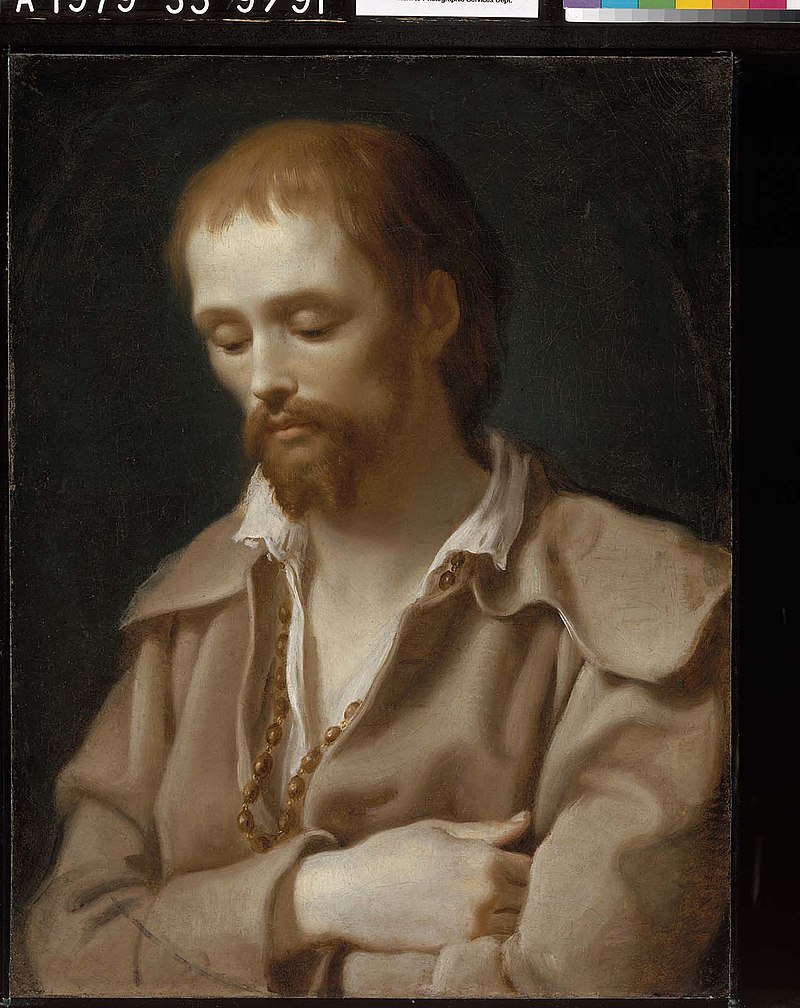
A Tale of Two Benedicts
A grace-filled Holy Week to all our readers! As we await and prepare for the Resurrection about to dawn upon us, we might keep in mind two Benedicts: Pope Emeritus Benedict XVI, requiescat in pace, elected on this day in 2005; and today’s commemoration of the mystic pilgrim, Benedict Joseph Labre, who died on this[…]Continue reading→

My Name is Bernadette
April 16th is a propitious day, for besides the anniversary of Father de Valk’s death, who founded Catholic Insight in its print form decades ago, and the commemoration of the ‘two Benedicts’, mentioned in accompanying posts, today we also recall Saint Bernadette Soubirous, the young visionary to whom the Virgin Mary appeared numerous times at[…]Continue reading→
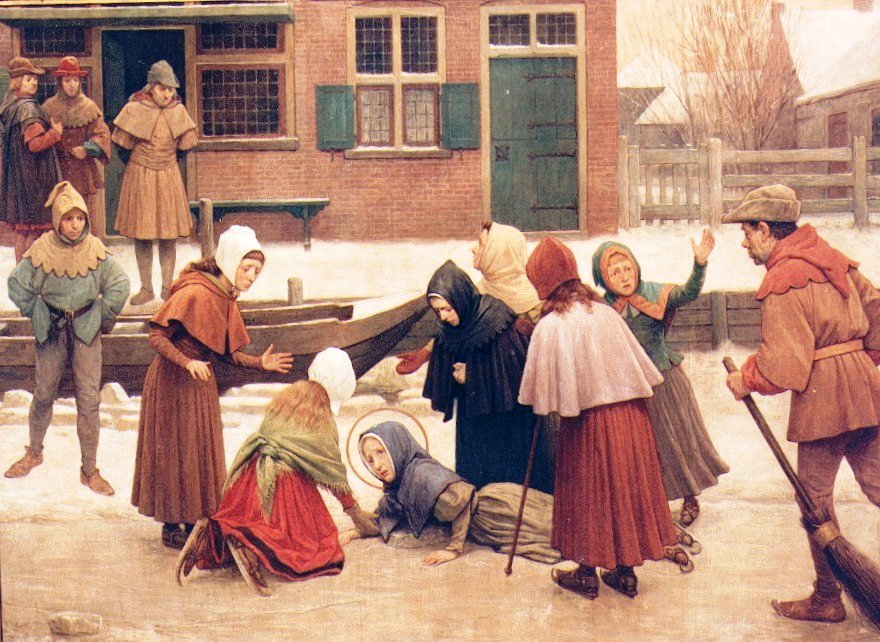
Saint Lydwina of Schiedam and Suffering Joyfully
Saint Lydwina of Schiedam (1380 – 1433) was one of the countless and glorious ‘victim souls’ in the history of the Church, those whose lives are filled with suffering, often of an unimaginable intensity, but who suffer joyfully. She was a fifteen-year old Dutch girl, out skating one day, when she fell and broke one[…]Continue reading→
The Glorious Martyrdoms of Martin and Maximus
As we enter into Eastertide, we recall on this 13th of April Pope Saint Martin I (+655), one of the noblest, if most tragic, of the successors of Saint Peter. Born in Umbria, Italy, he was of noble lineage, with great intelligence combined with charity and love of the poor and the Church. While still[…]Continue reading→
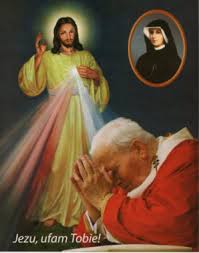
Canonizing Sister Faustina and Divine Mercy
HOMILY OF THE HOLY FATHER MASS IN ST PETER’S SQUARE FOR THE CANONIZATION OF SR MARY FAUSTINA KOWALSKA Sunday, 30 April 2000 1. “Confitemini Domino quoniam bonus, quoniam in saeculum misericordia eius”; “Give thanks to the Lord for he is good; his steadfast love endures for ever” (Ps 118: 1). So the Church sings on the Octave of[…]Continue reading→

Divine Mercy Sunday – An Echo of Every Mass
Reach out your hand and put it in my side. Do not doubt but believe’… ‘My Lord and my God!’ (Jn. 20:18)). Today is Divine Mercy Sunday, and as we celebrate the end of the Easter Octave, we contemplate the wounded side of our Saviour, the Church’s source of life. On Good Friday in the[…]Continue reading→
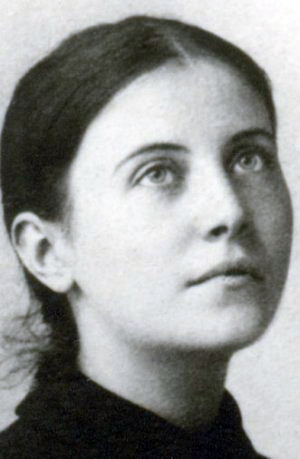
Saint Gemma Galgani
On this April 11th, in 1903 – the same year that the Italian Guiseppe Sarto was elected Pope later that summer as Pius X – a lovely, young Italian woman died, by the name of Gemma Galgani. She lived a brief life of 24 years, as did a number of other young saints, including Pier[…]Continue reading→
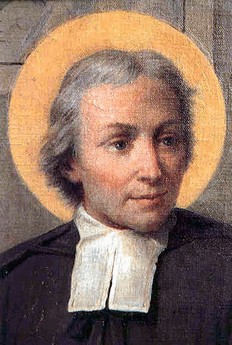
Saint Jean-Baptiste de la Salle: A Teacher for Teachers
Jean-Baptiste de la Salle (1651 – 1719), a French nobleman, ordained a priest, founded the first order in the Church’s history entirely without priests, and this came about almost by accident. I say ‘almost’, for, of course, there are no accidents with God. Destined for ordination from an early age, Jean-Baptiste never looked back, even[…]Continue reading→