
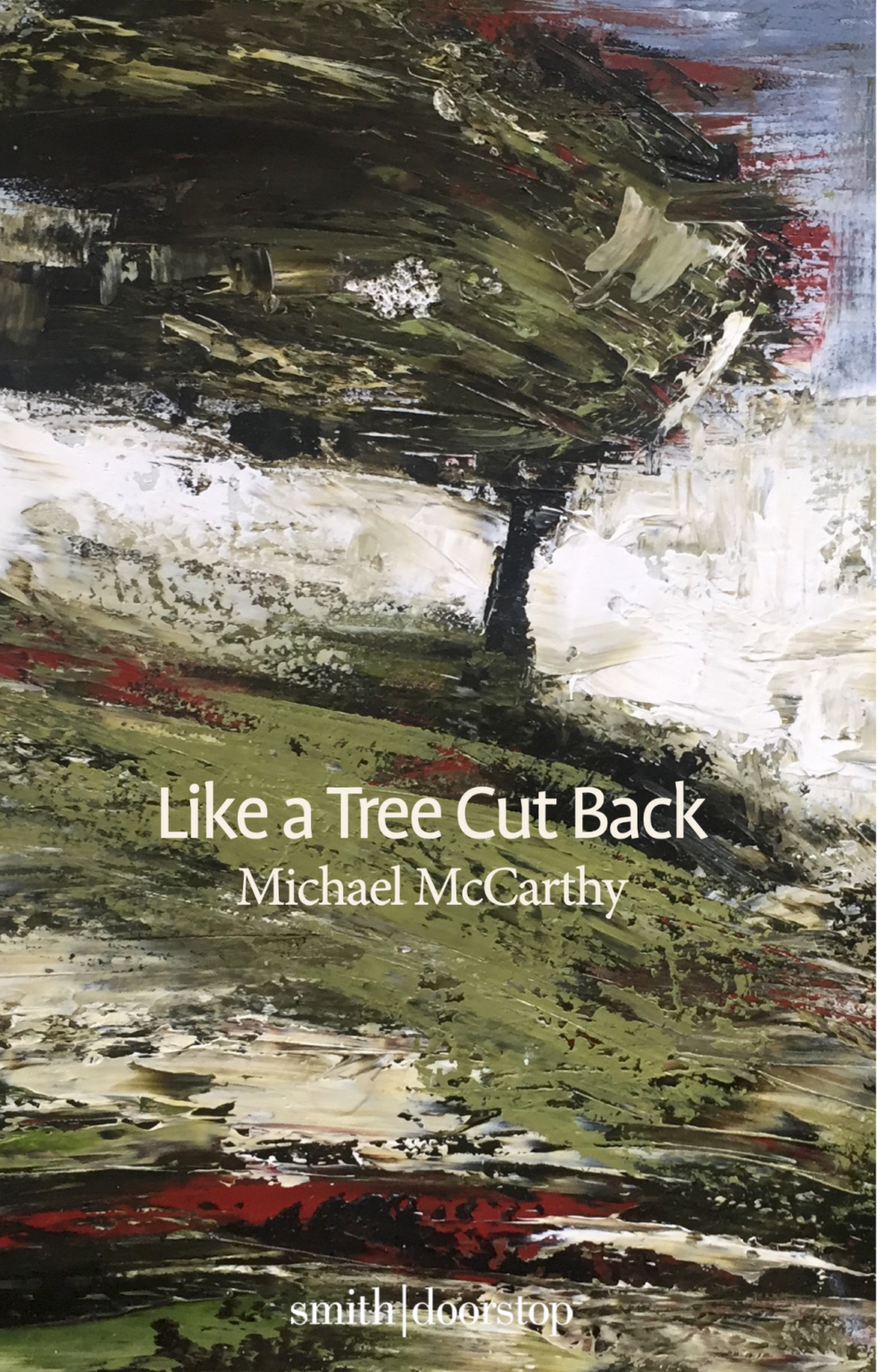
Like a Tree Cut Back: Memoir of A Lost Ireland
Like a Tree Cut Back
By Michael McCarthy
The Poetry Business, Sheffield, England
smith-doorstop, 2021
Father Michael McCarthy’s memoir, Like a Tree Cut Back, takes its title from the motto of his alma mter, Carlow College, where he prepared and studied for the priesthood. Rescissa vegetior assurgit – ‘that which is cut back burgeons forth more abundantly’. There are many meanings one may derive from this aphorism, which has Gospel allusions of pruned trees and souls bearing much fruit.
Most of the book is taken up with his childhood on the McCarthy family farm in a bucolic and faithful – and now much lost – Ireland, with large families, local private schools, leading up to his days in the seminary, which took place right in the midst of the Second Vatican Council. Michael was ordained in 1969, the year the Novus Ordo Mass was promulgated in its editio typica Latin version (almost never said, for various reasons – the English vernacular with which we are familiar was issued in 1974).
Hence, Father McCarthy’s life is a bridge between two worlds, the pre and post conciliar Church, and, as well, before and after the cultural and social revolution in Ireland (and across the world).
But he does not talk about this much, with the focus of this brief memoir (161 pages) being his own memories and reflections, in what is primarily an interior journey of his formative years. There is a brief glimpse towards the end, on his decades of priestly ministry (Father McCarthy died in July of 2018), and one sort of wishes for more of his take on the Church and her priesthood in the modern world.
His writing is engaging and descriptive, providing the reader with vivid imagery in a few words. The younger years are written from the perspective and language of a child, with the narrative maturing along with the author and narrator. Even if Father Michael does not focus on all the ecclesial and cultural transformations taking place around him, these are offered indirectly through the struggles and changes within his own soul.
Besides his priestly ministry, he is also a poet, an avocation, if you will, he chose soon after ordination, and selections of his works are provided in the final pages. They are in blank verse, but display a fine rhythm (to this layman’s ear). Like his prose, they provide colourful and insightful descriptions. Here is an excerpt from one titled ‘The Gift’ that struck me:
And love, she said, was not
waiting for what had been expected
but more like listening to the river
that ran beneath your skin
was not the silver birch
spine stiff with anticipation
but more like the shiver of its leaves
upturned in the mid-morning wind
There are others that are somewhat more prosaic:
The scores as we lined up for Vespers on Sunday night.
The lecturer, low key, sets up the equipment, introduces the class.
He shows us a video clip: Traditional, from Fiddler on the Roof.
We split into groups, discuss the layered meaning of the word.
After the break, he slips in another word: Conventional.
Compare and contrast! We’re being led deeper.
Back then theology taught us what to think.
Now it is teaching us how to think.
There seems a false contradiction between the last two lines, for theology should teach us both what and how to think – at least one’s philosophical formation should – and one wonders to what ‘conventional’ refers. There is something of a critical spirit in his memoir and poetry, with allusions to meeting a parish priest in the ‘old style’, who still prays the breviary in Latin (even though this is still the expected mode, according to canon law and Vatican II).
But all in all, Father McCarthy displays a love of Christ and His Church, to her moral precepts, and seems to have been faithful to his promises and his vocation to the end – not a mean feat in our world. His words, and his poetry, offer an invaluable and intimate glimpse into how our Church – in Ireland especially – has changed, in some ways for the better, in others for the worse.
We should, as Christ exhorts, strive to keep what is good, and reject what is not so, even if both are mixed – the wheat and tares – unto the end of time.
We would do well to walk with Father Michael McCarthy, his prose and poetry, for a while, in our own pilgrimage of life, as we journey towards that day when we all may meet merrily in heaven, where memories, song and verse unite in perfect harmony.

Carney’s Amoral Majority
After five defections – euphemistically described as ‘crossing the floor’ – and three by-elections, Mark Carney and his Liberals how have their coveted majority. One wonders what bowls of pottage were offered in back-room deals. In the archaic monarchical system that is the Dominion of Canada, this majority allows the newly-minted Prime Minister to rule[…]Continue reading→

Saint Kateri , Canada’s Protectress
This was the title given to Saint Kateri Tekakwitha, by Pope Benedict XVI, when he canonized her on October 28th, 2012, along with six others, in Saint Peter’ Square (she had been beatified by Pope John Paul II back in 1980). With Saint Joseph as our protector, along with the Canadian martyrs, we seem to[…]Continue reading→

A Tale of Two Benedicts
A grace-filled Holy Week to all our readers! As we await and prepare for the Resurrection about to dawn upon us, we might keep in mind two Benedicts: Pope Emeritus Benedict XVI, requiescat in pace, elected on this day in 2005; and today’s commemoration of the mystic pilgrim, Benedict Joseph Labre, who died on this[…]Continue reading→

My Name is Bernadette
April 16th is a propitious day, for besides the anniversary of Father de Valk’s death, who founded Catholic Insight in its print form decades ago, and the commemoration of the ‘two Benedicts’, mentioned in accompanying posts, today we also recall Saint Bernadette Soubirous, the young visionary to whom the Virgin Mary appeared numerous times at[…]Continue reading→

Saint Lydwina of Schiedam and Suffering Joyfully
Saint Lydwina of Schiedam (1380 – 1433) was one of the countless and glorious ‘victim souls’ in the history of the Church, those whose lives are filled with suffering, often of an unimaginable intensity, but who suffer joyfully. She was a fifteen-year old Dutch girl, out skating one day, when she fell and broke one[…]Continue reading→

The Glorious Martyrdoms of Martin and Maximus
As we enter into Eastertide, we recall on this 13th of April Pope Saint Martin I (+655), one of the noblest, if most tragic, of the successors of Saint Peter. Born in Umbria, Italy, he was of noble lineage, with great intelligence combined with charity and love of the poor and the Church. While still[…]Continue reading→

Saint Stanislaus of Szczepanów
We celebrate Saint Stanislaus today (+ April 11, 1079), in light of this Easter Octave, a bishop and martyr who accepted the episcopacy only at the direct order of Pope Alexander II. He proved a wise and courageous leader of his flock, put to death by his own king, Boleslaus, for rebuking the monarch’s ‘immoral[…]Continue reading→

Saint Gemma Galgani
On this April 11th, in 1903 – the same year that the Italian Guiseppe Sarto was elected Pope later that summer as Pius X – a lovely, young Italian woman died, by the name of Gemma Galgani. She lived a brief life of 24 years, as did a number of other young saints, including Pier[…]Continue reading→
An Ideological and Improper Translation
I noticed something odd with the psalm reading at Mass the other day. Our bishops’ conference here in Canada has decreed that the Mass in English – Novus Ordo – use the ‘NRSV’, the ‘New Revised Standard Version’, an ‘updated’ translation of the original RSV, first published in 1952. This ‘new translation’ has the tendency[…]Continue reading→
Saint Jean-Baptiste de la Salle: A Teacher for Teachers
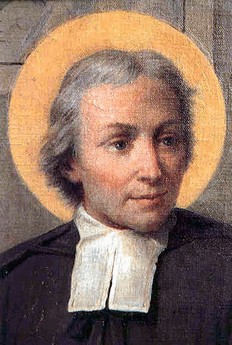
Jean-Baptiste de la Salle (1651 – 1719), a French nobleman, ordained a priest, founded the first order in the Church’s history entirely without priests, and this came about almost by accident. I say ‘almost’, for, of course, there are no accidents with God. Destined for ordination from an early age, Jean-Baptiste never looked back, even[…]Continue reading→