
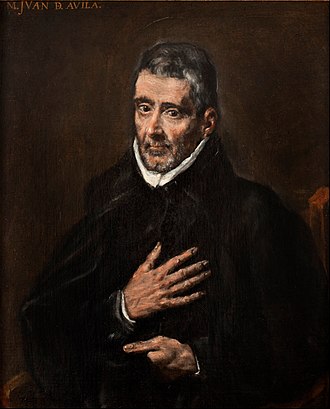
Saint John of Avila, Apostle of Andalusia
Today’s optional memorial as we continue the Easter season (alleluia!) commemorates Saint John of Avila (1499 – 1569), a contemporary of his fellow Spaniards, saints and correspondents, Teresa of Avila, Ignatius of Loyola and John of God. Like them, he was one of the primary instruments in what is (somewhat inaccurately) termed the Catholic ‘counter-reformation’. It was in fact the reinvigoration of the Catholic Church in the face of Protestant revolt. Nothing like a few good heresies and schisms to make the Church stronger, and raise up more than a few glorious saints.
John had mystical leanings from his youth, one of those souls chosen by God. At first he studied law, but left without finishing, and began his formation for the priesthood. He was ordained in 1526, just as the ‘Reformation’ was beginning, and prayed his first Mass in the church where his parents were buried, they having died during his time away at university. Given the conditions back then, John could not zip back to see them off, but spiritually-minded Catholics have always had a healthy and realistic view of the inevitability of death, realizing that we are only separated for a time, and there is never much distance in Christ’s Mystical Body.
Father John at first desired to go to Mexico as a missionary, but was persuaded to stay and evangelize Andalusia – of which he is known as ‘the Apostle’ – the southernmost portion of Spain, jutting out in the Atlantic and Mediterranean Seas, where the Faith had been severely compromised by centuries of Islamic domination and persecution. The Muslims, who forbade the Faith, had been driven out not that long before, in 1492, by Ferdinand and Isabella.
From his first sermon – propitiously on the feast of Mary Magdalene, July 22, 1529 – John preached to packed churches, his words converting untold numbers. As with all such saints, it was not so much what he said, but how he lived that did the work. He set up colleges and schools across the region; noted especially was the University of Baeza, established in 1538 by papal decree of Paul III (who also opened the Council of Trent in 1545), with Father Juan as the first rector. (Baeza closed as an official university in 1824, but still runs a summer program (revived in the 1979), a library and other courses.)
Father John of Avila helped reinvigorate the spirit of his time, working with other reformers – the aforementioned Ignatius and Teresa especially – to make Spain a powerhouse of the true Catholic reformation. He was a great supporter of the Jesuits, and, although he may have thought of beginning his own community, he advised those so called to join the new, dynamic Order (which now, alas, needs its own reformation).
But all this external work was the fruit of a deep mystical life, hours in prayer and conversation with God. He left behind six volumes of spiritual writings, his magnum opus being his Audi, filia (Listen, O Daughter), a treatise on spiritual perfection, adapted from his original letters to the nun Doña Sancha Carillo.
Father John of Avila died after a protracted illness, on this day, May 10th, 1569. His canonization took some time, and he was declared a saint by Pope Saint Paul VI on May 31st, 1970. Four decades later, he was enrolled amongst the elite Doctors of the Church by Pope Benedict XVI on the feast of the Holy Rosary, October 7th, 2012 (along with Hildegard of Bingen). During his homily, the Pope described Father John in these words (and we will keep his words on Hildegard as well, for good measure, of whom we hope to write more in the near future):
At this point, let us pause for a moment to appreciate the two saints who today have been added to the elect number of Doctors of the Church. Saint John of Avila lived in the sixteenth century. A profound expert on the sacred Scriptures, he was gifted with an ardent missionary spirit. He knew how to penetrate in a uniquely profound way the mysteries of the redemption worked by Christ for humanity. A man of God, he united constant prayer to apostolic action. He dedicated himself to preaching and to the more frequent practice of the sacraments, concentrating his commitment on improving the formation of candidates for the priesthood, of religious and of lay people, with a view to a fruitful reform of the Church.
Saint Hildegard of Bingen, an important female figure of the twelfth century, offered her precious contribution to the growth of the Church of her time, employing the gifts received from God and showing herself to be a woman of brilliant intelligence, deep sensitivity and recognized spiritual authority. The Lord granted her a prophetic spirit and fervent capacity to discern the signs of the times. Hildegard nurtured an evident love of creation, and was learned in medicine, poetry and music. Above all, she maintained a great and faithful love for Christ and his Church.
This summary of the ideal in Christian life, expressed in the call to holiness, draws us to look with humility at the fragility, even sin, of many Christians, as individuals and communities, which is a great obstacle to evangelization and to recognizing the force of God that, in faith, meets human weakness. Thus, we cannot speak about the new evangelization without a sincere desire for conversion. The best path to the new evangelization is to let ourselves be reconciled with God and with each other (cf. 2 Cor 5:20). Solemnly purified, Christians can regain a legitimate pride in their dignity as children of God, created in his image and redeemed by the precious blood of Jesus Christ, and they can experience his joy in order to share it with everyone, both near and far.
May God raise up a few more priests like Juan of Avila, rooted in Christ and His Church, and fearless in the truth.
Ora pro nobis, sancte sacerdos Dei!

Carney’s Amoral Majority
After five defections – euphemistically described as ‘crossing the floor’ – and three by-elections, Mark Carney and his Liberals how have their coveted majority. One wonders what bowls of pottage were offered in back-room deals. In the archaic monarchical system that is the Dominion of Canada, this majority allows the newly-minted Prime Minister to rule[…]Continue reading→

Saint Kateri , Canada’s Protectress
This was the title given to Saint Kateri Tekakwitha, by Pope Benedict XVI, when he canonized her on October 28th, 2012, along with six others, in Saint Peter’ Square (she had been beatified by Pope John Paul II back in 1980). With Saint Joseph as our protector, along with the Canadian martyrs, we seem to[…]Continue reading→

A Tale of Two Benedicts
A grace-filled Holy Week to all our readers! As we await and prepare for the Resurrection about to dawn upon us, we might keep in mind two Benedicts: Pope Emeritus Benedict XVI, requiescat in pace, elected on this day in 2005; and today’s commemoration of the mystic pilgrim, Benedict Joseph Labre, who died on this[…]Continue reading→

My Name is Bernadette
April 16th is a propitious day, for besides the anniversary of Father de Valk’s death, who founded Catholic Insight in its print form decades ago, and the commemoration of the ‘two Benedicts’, mentioned in accompanying posts, today we also recall Saint Bernadette Soubirous, the young visionary to whom the Virgin Mary appeared numerous times at[…]Continue reading→

Saint Lydwina of Schiedam and Suffering Joyfully
Saint Lydwina of Schiedam (1380 – 1433) was one of the countless and glorious ‘victim souls’ in the history of the Church, those whose lives are filled with suffering, often of an unimaginable intensity, but who suffer joyfully. She was a fifteen-year old Dutch girl, out skating one day, when she fell and broke one[…]Continue reading→

The Glorious Martyrdoms of Martin and Maximus
As we enter into Eastertide, we recall on this 13th of April Pope Saint Martin I (+655), one of the noblest, if most tragic, of the successors of Saint Peter. Born in Umbria, Italy, he was of noble lineage, with great intelligence combined with charity and love of the poor and the Church. While still[…]Continue reading→

Canonizing Sister Faustina and Divine Mercy
HOMILY OF THE HOLY FATHER MASS IN ST PETER’S SQUARE FOR THE CANONIZATION OF SR MARY FAUSTINA KOWALSKA Sunday, 30 April 2000 1. “Confitemini Domino quoniam bonus, quoniam in saeculum misericordia eius”; “Give thanks to the Lord for he is good; his steadfast love endures for ever” (Ps 118: 1). So the Church sings on the Octave of[…]Continue reading→

Saint Stanislaus of Szczepanów
We celebrate Saint Stanislaus today (+ April 11, 1079), in light of this Easter Octave, a bishop and martyr who accepted the episcopacy only at the direct order of Pope Alexander II. He proved a wise and courageous leader of his flock, put to death by his own king, Boleslaus, for rebuking the monarch’s ‘immoral[…]Continue reading→

Saint Gemma Galgani
On this April 11th, in 1903 – the same year that the Italian Guiseppe Sarto was elected Pope later that summer as Pius X – a lovely, young Italian woman died, by the name of Gemma Galgani. She lived a brief life of 24 years, as did a number of other young saints, including Pier[…]Continue reading→
An Ideological and Improper Translation
I noticed something odd with the psalm reading at Mass the other day. Our bishops’ conference here in Canada has decreed that the Mass in English – Novus Ordo – use the ‘NRSV’, the ‘New Revised Standard Version’, an ‘updated’ translation of the original RSV, first published in 1952. This ‘new translation’ has the tendency[…]Continue reading→