
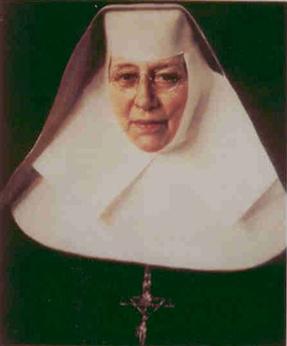
Katharine Drexel: The First All American Saint
Mother Katharine Mary Drexel (1858 – 1955) is a fitting intercessor for the racial tensions afflicting her native United States. For one thing, she is the first natural born canonized American citizen (Elizabeth Ann Seton was born in 1774, in what would become that nation a few years later). A young debutante who inherited her father’s fortune (about $7 million back then, worth many times that in today’s deflated dollars), she could have ‘had it all’. Her birth mother had died five days after Katherine’s birth, and her father re-married well, to Emma Bouvier, who was a fine example of holiness to Katherine and her two sisters, caring for the poor, and even seeking out those too ashamed to come to the door: As the new Mrs. Drexel was to say, Kindness may be unkind if it leaves a sting behind, words which all of us could take to heart.
As she pondered her vocation, Katharine was struck by the transitory nature of the world, as cancer slowly took the life of her new mother, and, with the death of her father in 1885, Katharine, who had always been devoted to helping Native Americans, empathizing with their plight, decided to enter a convent, and consecrate her life, and her fortune, to God, in helping the poor and disadvantaged. The final straw that moved her in this direction was a private meeting with Pope Leo XIII that evokes that of her near-contemporary, Therese of Lisieux. When Katherine asked the Pope for missionaries to help in their work, the Holy Father replied, ‘Why don’t you become one?’.
And so, she did, taking her first vows on February 12th, 1891 as a Sister of Mercy. Her long life was filled with setting up schools – 62 in all (!) – and missions – 145 of them (!), all of which did yeomen’s – or yeowomen’s – work for the kingdom. This work was supernaturally inspired, flowing from her devotion to the Holy Mass:
The Eucharist is a never-ending sacrifice. It is the Sacrament of love, the supreme love, the act of love.
After a life of self-giving, Mother Katharine died on this day, March 3rd, in 1955, at the noble age of 96. Good thing, we might think, that she did not live to see the tragic collapse of religious life a decade or so later. (Sadly, as a sign of our secular times and dwindling religious vocations, Katharine’s shrine closed in 2017, the convent and grounds put up for sale, and her remains transferred to the Cathedral of Saints Peter and Paul in Philadelphia). Or, perhaps, she did see, but from a heaven, which we may suppose puts all things in perspective. Katherine was canonized along with Josephine Bakhita, on the feast of the Little Flower, appropriately enough, October 1st, in the Jubilee year 2000, by fellow a saint, John Paul II. In his homily, the Pope declared:
“See what you have stored up for yourselves against the last days!” (Jas 5: 3).
In the second reading of today’s liturgy, the Apostle James rebukes the rich who trust in their wealth and treat the poor unjustly. Mother Katharine Drexel was born into wealth in Philadelphia in the United States. But from her parents she learned that her family’s possessions were not for them alone but were meant to be shared with the less fortunate. As a young woman, she was deeply distressed by the poverty and hopeless conditions endured by many Native Americans and Afro-Americans. She began to devote her fortune to missionary and educational work among the poorest members of society. Later, she understood that more was needed. With great courage and confidence in God’s grace, she chose to give not just her fortune but her whole life totally to the Lord.
To her religious community, the Sisters of the Blessed Sacrament, she taught a spirituality based on prayerful union with the Eucharistic Lord and zealous service of the poor and the victims of racial discrimination. Her apostolate helped to bring about a growing awareness of the need to combat all forms of racism through education and social services. Katharine Drexel is an excellent example of that practical charity and generous solidarity with the less fortunate which has long been the distinguishing mark of American Catholics.
May her example help young people in particular to appreciate that no greater treasure can be found in this world than in following Christ with an undivided heart and in using generously the gifts we have received for the service of others and for the building of a more just and fraternal world.
Saint Katharine leaves an outstanding, heroic legacy and example, using her many talents well, producing ten-fold more. May she intercede for the United States, that sanity and even sanctity return to a land now ravaged by the sad lack of both.
Saint Katharine Drexel, ora pro nobis!
Carney’s Amoral Majority
After five defections – euphemistically described as ‘crossing the floor’ – and three by-elections, Mark Carney and his Liberals how have their coveted majority. One wonders what bowls of pottage were offered in back-room deals. In the archaic monarchical system that is the Dominion of Canada, this majority allows the newly-minted Prime Minister to rule[…]Continue reading→

Saint Kateri , Canada’s Protectress
This was the title given to Saint Kateri Tekakwitha, by Pope Benedict XVI, when he canonized her on October 28th, 2012, along with six others, in Saint Peter’ Square (she had been beatified by Pope John Paul II back in 1980). With Saint Joseph as our protector, along with the Canadian martyrs, we seem to[…]Continue reading→
A Tale of Two Benedicts
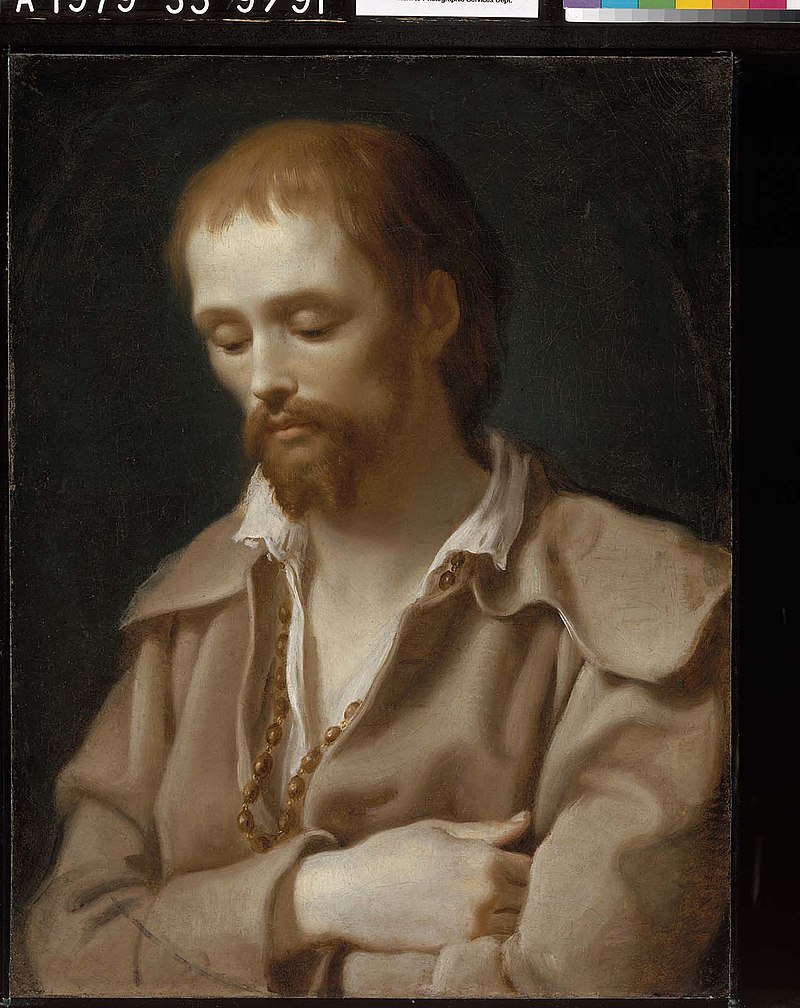
A grace-filled Holy Week to all our readers! As we await and prepare for the Resurrection about to dawn upon us, we might keep in mind two Benedicts: Pope Emeritus Benedict XVI, requiescat in pace, elected on this day in 2005; and today’s commemoration of the mystic pilgrim, Benedict Joseph Labre, who died on this[…]Continue reading→

My Name is Bernadette
April 16th is a propitious day, for besides the anniversary of Father de Valk’s death, who founded Catholic Insight in its print form decades ago, and the commemoration of the ‘two Benedicts’, mentioned in accompanying posts, today we also recall Saint Bernadette Soubirous, the young visionary to whom the Virgin Mary appeared numerous times at[…]Continue reading→
Saint Lydwina of Schiedam and Suffering Joyfully
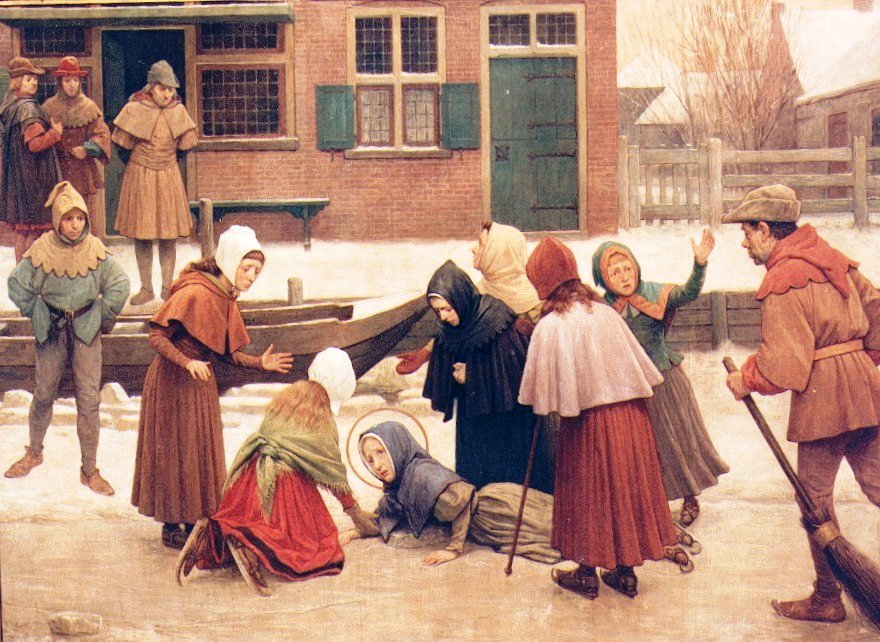
Saint Lydwina of Schiedam (1380 – 1433) was one of the countless and glorious ‘victim souls’ in the history of the Church, those whose lives are filled with suffering, often of an unimaginable intensity, but who suffer joyfully. She was a fifteen-year old Dutch girl, out skating one day, when she fell and broke one[…]Continue reading→
The Glorious Martyrdoms of Martin and Maximus
As we enter into Eastertide, we recall on this 13th of April Pope Saint Martin I (+655), one of the noblest, if most tragic, of the successors of Saint Peter. Born in Umbria, Italy, he was of noble lineage, with great intelligence combined with charity and love of the poor and the Church. While still[…]Continue reading→

Canonizing Sister Faustina and Divine Mercy
HOMILY OF THE HOLY FATHER MASS IN ST PETER’S SQUARE FOR THE CANONIZATION OF SR MARY FAUSTINA KOWALSKA Sunday, 30 April 2000 1. “Confitemini Domino quoniam bonus, quoniam in saeculum misericordia eius”; “Give thanks to the Lord for he is good; his steadfast love endures for ever” (Ps 118: 1). So the Church sings on the Octave of[…]Continue reading→

Saint Stanislaus of Szczepanów
We celebrate Saint Stanislaus today (+ April 11, 1079), in light of this Easter Octave, a bishop and martyr who accepted the episcopacy only at the direct order of Pope Alexander II. He proved a wise and courageous leader of his flock, put to death by his own king, Boleslaus, for rebuking the monarch’s ‘immoral[…]Continue reading→
Saint Gemma Galgani
On this April 11th, in 1903 – the same year that the Italian Guiseppe Sarto was elected Pope later that summer as Pius X – a lovely, young Italian woman died, by the name of Gemma Galgani. She lived a brief life of 24 years, as did a number of other young saints, including Pier[…]Continue reading→
An Ideological and Improper Translation
I noticed something odd with the psalm reading at Mass the other day. Our bishops’ conference here in Canada has decreed that the Mass in English – Novus Ordo – use the ‘NRSV’, the ‘New Revised Standard Version’, an ‘updated’ translation of the original RSV, first published in 1952. This ‘new translation’ has the tendency[…]Continue reading→