
Saints Cyril and Methodius, and, Yes, Valentine
On this fourteenth of February, in the universal calendar we celebrate the ninth-century monks and missionaries Saints Cyril and Methodius, patrons of Europe, who translated the Liturgy into Slavonic, with Cyril constructing the Glagolitic and Cyrillic alphabets for this purpose. This vernacular allowed for the conversion of untold thousands into the Church. (See Father Attard’s reflection), as people unversed in Latin could hear the Word of God and preaching in their own language.
Cyril, whose original name was Constantine, upon his making vow in the Order of Saint Basil, took the name Cyril just fifty days before his death on this February 14, 869,. Methodius continued his missionary work alone until he joined his brother in eternity in 885.
They have always been venerated as the ‘Apostles to the Slavs’, and Pope John Paul II wrote a 1985 encyclical on them, Slavorum Apostoli, declaring them co-patrons of Europe, along with the great Saint Benedict.
So let us pray for Europe, which need desperately to find its faith once again, if it is to survive. As Belloc wrote, Europe is the Faith, and the Faith is Europe. Without Catholicism, Europe is just a geographical expression run by a gnostic coterie of socialist bureaucrats in Brussels, with a very fragile economic unity, about to be overwhelmed with those who do not share her once-cherished beliefs and customs.
We also celebrate, especially in the secular culture, Saint Valentine’s day, an emotive celebration of red hearts and dark chocolate, behind which is the memorial of a rather obscure 3rd century martyr, who has been adopted as the patron saint of lovers and would-be lovers. Many legends have grown up around him of miracles and good deeds, including that he secretly married young couples in prison, and fostered courtships, which I have known priests and others to do, perhaps not with the success of Saint Valentine. He helped to get the new husbands released from military duty – a source of vexation to the emperor. It is also said that Valentine would cut out paper hearts to remind these men of their vows. He is also said to have cured his jailer’s daughter of blindness, sending her a note on the eve of his execution, signed ‘from your Valentine’.
There is the rom-com version of the saint, with romance-of-the-moment, or the month, much of which only ends in bitterness. Is it better to have loved and lost, than never to have loved at all? I suppose that depends on what one has ‘lost’, and many, sadly, have been embittered by love; but God never intended it so. As someone once lamented, divorce means buying a house for a woman who hates you (or we may invert those ‘gender roles’ in today’s humpty-dumpty world). And what are we to say of the tragedy such turmoil brings to the children? As Scripture says, God hates divorce, but He loves love. There is a fine line between love and hate, and as the expression has it, extrema se tangunt, extremes touch each other.
And on a more hopeful note, let us also pray to Saint Valentine for good and holy marriages, with lots of joyful and exuberant Catholic children to give us hope and joy unto the succeeding generations. To close again with the great Pope John Paul, as the family goes, so goes society. And families, of course, are based on that holy wedlock which provides the greatest of natural joys. As Pope Benedict pointed out in his first encyclical on the theme of human love, it is the Church that ennobled marriage, bringing the sacrament back some way to the primordial bliss that prompted Adam to cry in joy out when he beheld the bride – a helper fit for him – that God had made: This at last is bone of my bones and flesh of my flesh. And the two shall become one.
Whatever the truth of his story, Saint Valentine offers hope that love is indeed not only worth it, but worth everything. Amor vincit omnia, wrote Virgil in his Bucolics, et nos cedamus amori, and let us too yield to love. For in the end, the one true love is divine, the love God has for us, and we for God, which never fails, and which supports – or should support – all other of our loves. Only so will love really conquer all.
Saints Cyril, Methodius and Valentine, orate pro nobis!

Carney’s Amoral Majority
After five defections – euphemistically described as ‘crossing the floor’ – and three by-elections, Mark Carney and his Liberals how have their coveted majority. One wonders what bowls of pottage were offered in back-room deals. In the archaic monarchical system that is the Dominion of Canada, this majority allows the newly-minted Prime Minister to rule[…]Continue reading→

Saint Kateri , Canada’s Protectress
This was the title given to Saint Kateri Tekakwitha, by Pope Benedict XVI, when he canonized her on October 28th, 2012, along with six others, in Saint Peter’ Square (she had been beatified by Pope John Paul II back in 1980). With Saint Joseph as our protector, along with the Canadian martyrs, we seem to[…]Continue reading→

Remembering Father Alphonse de Valk
(Today marks the sixth anniversary of the death of Father Alphonse de Valk, C.S.B., a faithful, courageous and indefatigable Basilian priest, pro-life-and-family apostle, and the founder of Catholic Insight magazine. Here is what we wrote those on his entering into eternity five years ago, as we continue to remember him in our prayers and thoughts)[…]Continue reading→

A Tale of Two Benedicts
A grace-filled Holy Week to all our readers! As we await and prepare for the Resurrection about to dawn upon us, we might keep in mind two Benedicts: Pope Emeritus Benedict XVI, requiescat in pace, elected on this day in 2005; and today’s commemoration of the mystic pilgrim, Benedict Joseph Labre, who died on this[…]Continue reading→

My Name is Bernadette
April 16th is a propitious day, for besides the anniversary of Father de Valk’s death, who founded Catholic Insight in its print form decades ago, and the commemoration of the ‘two Benedicts’, mentioned in accompanying posts, today we also recall Saint Bernadette Soubirous, the young visionary to whom the Virgin Mary appeared numerous times at[…]Continue reading→

Saint Lydwina of Schiedam and Suffering Joyfully
Saint Lydwina of Schiedam (1380 – 1433) was one of the countless and glorious ‘victim souls’ in the history of the Church, those whose lives are filled with suffering, often of an unimaginable intensity, but who suffer joyfully. She was a fifteen-year old Dutch girl, out skating one day, when she fell and broke one[…]Continue reading→

The Glorious Martyrdoms of Martin and Maximus
As we enter into Eastertide, we recall on this 13th of April Pope Saint Martin I (+655), one of the noblest, if most tragic, of the successors of Saint Peter. Born in Umbria, Italy, he was of noble lineage, with great intelligence combined with charity and love of the poor and the Church. While still[…]Continue reading→

Canonizing Sister Faustina and Divine Mercy
HOMILY OF THE HOLY FATHER MASS IN ST PETER’S SQUARE FOR THE CANONIZATION OF SR MARY FAUSTINA KOWALSKA Sunday, 30 April 2000 1. “Confitemini Domino quoniam bonus, quoniam in saeculum misericordia eius”; “Give thanks to the Lord for he is good; his steadfast love endures for ever” (Ps 118: 1). So the Church sings on the Octave of[…]Continue reading→

Divine Mercy Sunday – An Echo of Every Mass
Reach out your hand and put it in my side. Do not doubt but believe’… ‘My Lord and my God!’ (Jn. 20:18)). Today is Divine Mercy Sunday, and as we celebrate the end of the Easter Octave, we contemplate the wounded side of our Saviour, the Church’s source of life. On Good Friday in the[…]Continue reading→
Saint Gemma Galgani
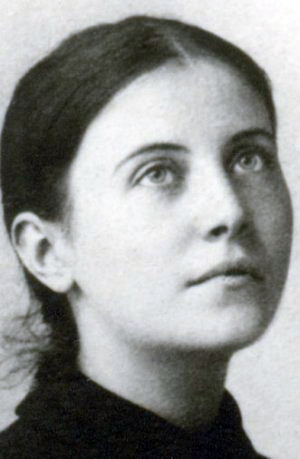
On this April 11th, in 1903 – the same year that the Italian Guiseppe Sarto was elected Pope later that summer as Pius X – a lovely, young Italian woman died, by the name of Gemma Galgani. She lived a brief life of 24 years, as did a number of other young saints, including Pier[…]Continue reading→