
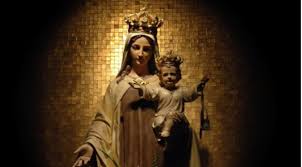
The Eschatological Message of Our Lady of Mount Carmel
Around this time of year in the Office of Readings, or Lauds, we follow the travails of the prophet Elijah from the Book of Kings, his battle with the Ahaz, the false prophets of Ba’al, the whole spiritus mundi – and the Jezebel behind the throne. He was indeed a ‘burning fire’, refusing to compromise or capitulate. His vocation began with his retreat in the cave on Mount Horeb, wherein he heard God’s voice not in the thunder and earthquakes and the rending of rocks, but in the ‘still, small voice’, a whisper, even, in the original Hebrew, ‘silence’.
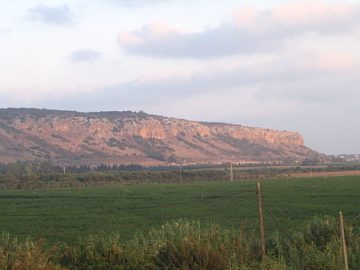
(wikipedia.org)
It was in that same Holy Land, in silence, that devotion to Our Lady of Mount Carmel, as well as the Order devoted to her, began. Carmel is the place, praised in Scripture for its breathtaking natural beauty, a very image of heaven, where Elijah was said to dwell in a grotto on its highest point, 1700 feet above the Mediterranean Sea. Here, the prophet challenged the 450 said prophets of Ba’al to a sacrificial contest, to see whose God was the true God. Tradition has it that Jewish hermits continued to live there, until the founding of the Carmelite Order in the late 12th century, during the Crusades. If the Christians could not attain ultimate victory by the sword, they could by the life of prayer and conversion. Our Catholic foothold – or, perhaps, soul-hold – in the Holy Land has been unbroken ever since.
No one knows who the human founder is – there is a reference to a ‘Brother B’ in the original rule given by Albert, the Latin Patriarch of Jerusalem in 1210. We may believe that God was the founder through His Mother, in that ‘still, small voice’, through Elijah. What we do know is that a monastery was built there in the early thirteenth century, and the Carmelite way of life – hidden, simple and beautiful, consisting of prayer, contemplation and work – spread throughout the world. That first monastery on the hill of Carmel has had a history as troubled as the land itself, becoming a mosque, then a hospital, then a mosque again, then destroyed; but, thankfully, it is now again a Carmelite monastery, and we may hope is so until Elijah returns, in fire, on that great and terrible day of the Lord. (As a point of interest to some readers, it’s at this convent that Father Elijah lives in Michael O’Brien’s novel of the same name – there is something apocalyptic about Our Lady of Mount Carmel, as there are of all Marian visions, I suppose, as Our Lady leads us from this passing world to our heavenly home. This is also the anniversary of the final vision to Saint Bernadette Soubirous at Lourdes, in 1848, and Our Lady of Fatima, in her final apparition, appeared as the Virgin of Carmel. On a less felicitous note, it’s on this day that the first atomic bomb was tested, at Alamagordo, New Mexico, in 1945. They even called the test ‘Trinity’, for reasons that, as far I have been able to discover, are unclear.
July 16th is chosen as the feast of Our Lady of Mount Carmel in commemoration of the vision given to Saint Simon Stock, an English Carmelite, in 1251, of the brown scapular. By its wearing, we share in the spiritual benefits of Carmelites throughout the world, and through which many promises are given. But the main purpose of the scapular – a sacramental version of the larger scapular worn by fully-professed members of the Order – is not a guaranteed amulet to gain us paradise. Rather, its wearing is to remind us of our own promises made in our Baptism, to share in some way in the spiritual work of the enclosed Carmelites, to keep watch, guard and live the Faith through thick and thin, to honour God, His Mother and all the saints, as we pilgrimage in our unique vocations in this life to eternity.
Our Lady of Mount Carmel, ora pro nobis!

Carney’s Amoral Majority
After five defections – euphemistically described as ‘crossing the floor’ – and three by-elections, Mark Carney and his Liberals how have their coveted majority. One wonders what bowls of pottage were offered in back-room deals. In the archaic monarchical system that is the Dominion of Canada, this majority allows the newly-minted Prime Minister to rule[…]Continue reading→

Saint Kateri , Canada’s Protectress
This was the title given to Saint Kateri Tekakwitha, by Pope Benedict XVI, when he canonized her on October 28th, 2012, along with six others, in Saint Peter’ Square (she had been beatified by Pope John Paul II back in 1980). With Saint Joseph as our protector, along with the Canadian martyrs, we seem to[…]Continue reading→

A Tale of Two Benedicts
A grace-filled Holy Week to all our readers! As we await and prepare for the Resurrection about to dawn upon us, we might keep in mind two Benedicts: Pope Emeritus Benedict XVI, requiescat in pace, elected on this day in 2005; and today’s commemoration of the mystic pilgrim, Benedict Joseph Labre, who died on this[…]Continue reading→

My Name is Bernadette
April 16th is a propitious day, for besides the anniversary of Father de Valk’s death, who founded Catholic Insight in its print form decades ago, and the commemoration of the ‘two Benedicts’, mentioned in accompanying posts, today we also recall Saint Bernadette Soubirous, the young visionary to whom the Virgin Mary appeared numerous times at[…]Continue reading→

Saint Lydwina of Schiedam and Suffering Joyfully
Saint Lydwina of Schiedam (1380 – 1433) was one of the countless and glorious ‘victim souls’ in the history of the Church, those whose lives are filled with suffering, often of an unimaginable intensity, but who suffer joyfully. She was a fifteen-year old Dutch girl, out skating one day, when she fell and broke one[…]Continue reading→

The Glorious Martyrdoms of Martin and Maximus
As we enter into Eastertide, we recall on this 13th of April Pope Saint Martin I (+655), one of the noblest, if most tragic, of the successors of Saint Peter. Born in Umbria, Italy, he was of noble lineage, with great intelligence combined with charity and love of the poor and the Church. While still[…]Continue reading→

Canonizing Sister Faustina and Divine Mercy
HOMILY OF THE HOLY FATHER MASS IN ST PETER’S SQUARE FOR THE CANONIZATION OF SR MARY FAUSTINA KOWALSKA Sunday, 30 April 2000 1. “Confitemini Domino quoniam bonus, quoniam in saeculum misericordia eius”; “Give thanks to the Lord for he is good; his steadfast love endures for ever” (Ps 118: 1). So the Church sings on the Octave of[…]Continue reading→

Saint Stanislaus of Szczepanów
We celebrate Saint Stanislaus today (+ April 11, 1079), in light of this Easter Octave, a bishop and martyr who accepted the episcopacy only at the direct order of Pope Alexander II. He proved a wise and courageous leader of his flock, put to death by his own king, Boleslaus, for rebuking the monarch’s ‘immoral[…]Continue reading→

Saint Gemma Galgani
On this April 11th, in 1903 – the same year that the Italian Guiseppe Sarto was elected Pope later that summer as Pius X – a lovely, young Italian woman died, by the name of Gemma Galgani. She lived a brief life of 24 years, as did a number of other young saints, including Pier[…]Continue reading→

An Ideological and Improper Translation
I noticed something odd with the psalm reading at Mass the other day. Our bishops’ conference here in Canada has decreed that the Mass in English – Novus Ordo – use the ‘NRSV’, the ‘New Revised Standard Version’, an ‘updated’ translation of the original RSV, first published in 1952. This ‘new translation’ has the tendency[…]Continue reading→