
One Fine Spring Day, Three Saints
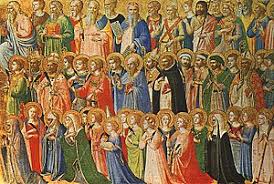
There are many saints in the Church’s history too many ever to be celebrated liturgically, and those are only the officially canonized ones. We have the ‘old’ calendar of the usus antiquior, then the saints of the liturgical revisions under Paul VI in 1969 after Vatican II – many of them the same, but with the more complex hierarchy of feasts was simplified, so that we now have solemnities, feasts, memorials and optional memorials, the last of which dot the calendar, and are, as their name implies, optional, so that we may celebrate them as our proclivity – primarily our devotion – moves us.
On that note, today we have one of those rare days where we have a choice of three (four, if we include the default ‘Easter weekday’ option).
So, here they are, in chronological order:
Saint Bede the Venerable (+735) was an English monk, sent to the monastery of Wearmouth, in Northumbria, on the northeast coast of England, as a young boy of seven as a puer oblatus, where he remained for the rest of his days, praying, reading, writing, working, chanting the Liturgy. Bede was considered the most learned man of his time, and one of the holiest, faithful to the end. At one point, as a teenager (he was about 14), the plague hit the monastery, and as the monks got sick, some dying, one by one. But they stuck to their duty, until only the Abbot and young Bede were left to chant the hours, which they did faithfully, one responding to the other across the choir pews, until some valiant monks recovered, and others joined anew.
Bede’s worked diligently and quietly his entire life, as only a monk can do, and his opus covers almost the entire gamut of knowledge then known. His Ecclesiastical History of England, a masterpiece of historical research, provides the foundation of current studies.
After a long life, well lived, Bede died peacefully, lying on the floor of his cell, surrounded by his beloved brethren. As his contemporary fellow monk described Bede’s final moments, and would that our own deaths be like his own:
And so, on the floor of his cell, he sat and sang “Glory be to the Father and to the Son and to the Holy Spirit”; and as he named the Spirit, the Breath of God, he breathed the last breath from his own body. With all the labour that he had given to the praise of God, there can be no doubt that he went into the joys of heaven that he had always longed for.
Saint Gregory VII, known also by his birth name of Hildebrand (+1085) was the Pope who instantiated one of the most substantial reforms of the Church that now goes historically by his name, the Gregorian, shoring up ancient disciplines in the episcopacy and the priesthood. In his struggles with the meddling Emperor Henry IV, Gregory helped clarify the primary spiritual authority of the papacy, which transcends any secular authority, and his personal example, prayers and witness solidified the Church herself as she emerged from so-called ‘dark ages’ into the glories of the early ‘high middle ages’, much of which would not have been possible without Gregory. He shares many in common with the first Pope of that name half a millennia before, both of them helping save civilization from rack and ruin, as well as freedom from the interference of the ‘State’, whose totalitarian tendencies must always be resisted, primarily by spiritual means. Saint Gregory taught us that the Church is the path to heaven from earth, and Christ’s vicar, whatever his human limitations, is the visible, hierarchical link between the two.
Here is how Pope Gregory summed up his own duty, one which could be written today, as the day of the Antichrist, as Saint John reminds us in today’s reading, is always with us, to be revealed fully in the last days:
Ever since by God’s providence Mother Church set me upon the apostolic throne, deeply unworthy and, as God is my witness, unwilling though I was, my greatest concern has been that holy Church, the bride of God, our lady and mother, should return to her true glory and stand free, chaste, and catholic. But because this entirely displeased the ancient enemy he has armed his members against us in order to turn everything upside down.
He has accordingly done such things against us, or rather against the apostolic see, as he has not been able to do from the time of the Emperor Constantine the Great. And truly it is no wonder, for the nearer the time of Antichrist approaches, the more violently he strives to destroy the Christian religion.
And finally, we have Mary Magdalene de’Pazzi (+1607), a Carmelite nun and mystic, who was blessed with great graces, ecstasies and visions by God in prayer from a very young age, after a chaplain taught her to pray and meditate on the Passion of Christ. She made a vow of virginity at ten years old, and resisted pressure from her rich and noble family to marry, settle down and live a ‘normal’ life. In the face of her firm decision, from which she would not waver, her father finally relented, and allowed her to enter the Carmelite monastery in Florence, which she chose since she could receive Communion daily. The description of some of her mortifications, if the contemporary accounts are not hyperbolic, are difficult to fathom, more to be admired than imitated, one might think. But as the seers of Fatima remind us, those who see what eternity really is, nothing is really ever ‘normal’ again.
In the midst of all this, her visions continued, and her spiritual director asked that they be related to her fellow Sisters and written down, producing a tome which eventually filled five volumes. Sister Mary Magdalene died on this day in 1607, and her body was found incorrupt six decades later. She was canonized in 1669. This prayer she composed describes what motivated her own progress in holiness:
Come, Holy Spirit. May the union of the Father and the will of the Son come to us. You, Spirit of truth, are the reward of the saints, the refreshment of souls, light in darkness, the riches of the poor, the treasury of lovers, the satisfaction of the hungry, the consolation of the pilgrim Church; you are he in whom all treasures are contained.
Come, you who, descending into Mary, caused the Word to take flesh: effect in us by grace what you accomplished in her by grace and nature.
Come, you who are the nourishment of all chaste thoughts, the fountain of all clemency, the summit of all purity.
Come, and take away from us all that hinders us from being absorbed in you.
And, as the great Saint Augustine puts it in a discourse on the psalms:
Because there are these two periods of time – the one that now is, beset with the trials and troubles of this life, and the other yet to come, a life of everlasting serenity and joy – we are given two liturgical seasons, one before Easter and the other after. The season before Easter signifies the troubles in which we live here and now, while the time after Easter which we are celebrating at present signifies the happiness that will be ours in the future. What we commemorate before Easter is what we experience in this life; what we celebrate after Easter points to something we do not yet possess. This is why we keep the first season with fasting and prayer; but now the fast is over and we devote the present season to praise. Such is the meaning of the Alleluia we sing.
Amen to that.
Carney’s Amoral Majority
After five defections – euphemistically described as ‘crossing the floor’ – and three by-elections, Mark Carney and his Liberals how have their coveted majority. One wonders what bowls of pottage were offered in back-room deals. In the archaic monarchical system that is the Dominion of Canada, this majority allows the newly-minted Prime Minister to rule[…]Continue reading→

Saint Kateri , Canada’s Protectress
This was the title given to Saint Kateri Tekakwitha, by Pope Benedict XVI, when he canonized her on October 28th, 2012, along with six others, in Saint Peter’ Square (she had been beatified by Pope John Paul II back in 1980). With Saint Joseph as our protector, along with the Canadian martyrs, we seem to[…]Continue reading→

A Tale of Two Benedicts
A grace-filled Holy Week to all our readers! As we await and prepare for the Resurrection about to dawn upon us, we might keep in mind two Benedicts: Pope Emeritus Benedict XVI, requiescat in pace, elected on this day in 2005; and today’s commemoration of the mystic pilgrim, Benedict Joseph Labre, who died on this[…]Continue reading→

My Name is Bernadette
April 16th is a propitious day, for besides the anniversary of Father de Valk’s death, who founded Catholic Insight in its print form decades ago, and the commemoration of the ‘two Benedicts’, mentioned in accompanying posts, today we also recall Saint Bernadette Soubirous, the young visionary to whom the Virgin Mary appeared numerous times at[…]Continue reading→

Saint Lydwina of Schiedam and Suffering Joyfully
Saint Lydwina of Schiedam (1380 – 1433) was one of the countless and glorious ‘victim souls’ in the history of the Church, those whose lives are filled with suffering, often of an unimaginable intensity, but who suffer joyfully. She was a fifteen-year old Dutch girl, out skating one day, when she fell and broke one[…]Continue reading→

The Glorious Martyrdoms of Martin and Maximus
As we enter into Eastertide, we recall on this 13th of April Pope Saint Martin I (+655), one of the noblest, if most tragic, of the successors of Saint Peter. Born in Umbria, Italy, he was of noble lineage, with great intelligence combined with charity and love of the poor and the Church. While still[…]Continue reading→

Saint Stanislaus of Szczepanów
We celebrate Saint Stanislaus today (+ April 11, 1079), in light of this Easter Octave, a bishop and martyr who accepted the episcopacy only at the direct order of Pope Alexander II. He proved a wise and courageous leader of his flock, put to death by his own king, Boleslaus, for rebuking the monarch’s ‘immoral[…]Continue reading→

Saint Gemma Galgani
On this April 11th, in 1903 – the same year that the Italian Guiseppe Sarto was elected Pope later that summer as Pius X – a lovely, young Italian woman died, by the name of Gemma Galgani. She lived a brief life of 24 years, as did a number of other young saints, including Pier[…]Continue reading→
An Ideological and Improper Translation
I noticed something odd with the psalm reading at Mass the other day. Our bishops’ conference here in Canada has decreed that the Mass in English – Novus Ordo – use the ‘NRSV’, the ‘New Revised Standard Version’, an ‘updated’ translation of the original RSV, first published in 1952. This ‘new translation’ has the tendency[…]Continue reading→
Saint Jean-Baptiste de la Salle: A Teacher for Teachers
Jean-Baptiste de la Salle (1651 – 1719), a French nobleman, ordained a priest, founded the first order in the Church’s history entirely without priests, and this came about almost by accident. I say ‘almost’, for, of course, there are no accidents with God. Destined for ordination from an early age, Jean-Baptiste never looked back, even[…]Continue reading→