
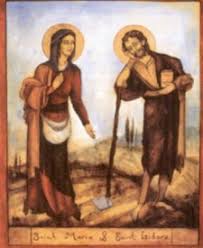
Saint Isidore the Farmer and Rerum Novarum
Saint Isidore, or, in his native Spanish, Isidro de Merlo y Quintana, was named after the other Saint Isidore, the bishop of Seville (whom we celebrated back on April 4th). This saint, known to us as Isidore the Laborer (Labrador) – or the Farmer – was born about the year 1070 in Madrid, and spent his entire, outwardly uneventful life as a farm laborer for a wealthy landowner, on the outskirts of the city. He married a certain Maria Torribia, and their happy marriage produced a son, who in childhood was miraculously rescued from a deep well, after which they vowed continence to better devote themselves to the things of the Lord (someday, we may have a separate excursus on such so-called ‘Josephite marriages’ in another post).
Isidore and Maria were known for their piety and holiness, faithful attendance at daily Mass, feeding the poor, a consistent prayer life, all in the midst of their ordinary duties, signifying that we may find great sanctity simply in doing the duty of the moment. In fact, there is no other way to achieve holiness, but by doings God’s will, in the great and the small – and almost always the small – things in life. Plowing the field, feeding the animals, preparing breakfast, a smile for each other at the end of a long, hot and bothersome day, ‘little things done well’, for the love of God. For it is love – charity – and not the ‘greatness of the work’ that is the principle of merit before God (cf., Summa, I-II. q.114). We should always be ‘working’ in some way, which is not the same thing as ‘busy’. Ora et labora, wrote Saint Benedict centuries before Isidore, and his advice for monks also applies to lay folk. How much good could be done in the world by ensuring everyone had an acre or two of land, or at least a garden, to till with their family. We may throw in, as Chesterton advised, a cow and maybe some chickens and goats. The English writer did quite well without livestock, but the idea holds, for there are many metaphorical ‘gardens’ in life which we must tend.
It is very providential and fitting that Isidore’s feast falls on the anniversary Leo XIII’s encyclical Rerum Novarum, which the Pontiff promulgated on this day in 1891 (now much in the news after being mentioned by our new Pope Leo XIV). Therein, Leo XIII outlines the right to private property, based on its ultimate purpose, connected to human work, as developing and perfecting that piece of land one can call one’s own upon which one impresses one’s personality. Just so, one shapes and perfects it, so that it produces ‘good fruit’ that will provide for one’s needs, and ultimately lead to eternal life.
Pope Saint John Paul II develops this theme in his own 1981 Laborem Exercens, (see the reflection on May 1st, Joseph the Worker) where he distinguishes the objective value of human work – the ‘good’ that the work produces in the world – from the subjective value – that which the work does to perfect the worker. It is this latter that is most important, and fundamental, and which leads the worker, if he does well, to heaven.
So it was with Saint Isidore, whose life is filled with endearing miracles of multiplying food, of angels plowing his field while he was at Mass, and of his own body being found incorrupt when washed up in a torrential rain on April 2nd, 1212, nearly a century after his death on this day in 1130.
Isidore the Farmer was canonized on March 12, 1622 by Pope Gregory XV along with four other saints: Ignatius of Loyola, Francis Xavier, Theresa of Avila and Philip Neri. Three priests, one consecrated religious and, then, Isidore, a simple, married layman. (The members of the Oratory, which Saint Philip founded, like to joke that the Pope canonized ‘four Spaniards and a Saint’. But they all shared the common theme of holiness).
His body now lies alongside his wife – also up for canonization – in the church bearing his name in Madrid, secured with nine padlocks, for which only the King of Spain has the master key, and even he can only open it in the presence of the Archbishop (the last time was back in 1985).
The example of Isidore and Maria signifies that a simple, hidden married life – in the midst of the pots and pans, as Theresa of Avila would say – is a sure path to heaven, if lived with in harmony and laughter, prayer and good works, in all the good fruits of faith, hope and abiding charity.
Saint Isidore the Farmer, ora pro nobis! +

Carney’s Amoral Majority
After five defections – euphemistically described as ‘crossing the floor’ – and three by-elections, Mark Carney and his Liberals how have their coveted majority. One wonders what bowls of pottage were offered in back-room deals. In the archaic monarchical system that is the Dominion of Canada, this majority allows the newly-minted Prime Minister to rule[…]Continue reading→

Saint Kateri , Canada’s Protectress
This was the title given to Saint Kateri Tekakwitha, by Pope Benedict XVI, when he canonized her on October 28th, 2012, along with six others, in Saint Peter’ Square (she had been beatified by Pope John Paul II back in 1980). With Saint Joseph as our protector, along with the Canadian martyrs, we seem to[…]Continue reading→

Remembering Father Alphonse de Valk
(Today marks the sixth anniversary of the death of Father Alphonse de Valk, C.S.B., a faithful, courageous and indefatigable Basilian priest, pro-life-and-family apostle, and the founder of Catholic Insight magazine. Here is what we wrote those on his entering into eternity five years ago, as we continue to remember him in our prayers and thoughts)[…]Continue reading→

A Tale of Two Benedicts
A grace-filled Holy Week to all our readers! As we await and prepare for the Resurrection about to dawn upon us, we might keep in mind two Benedicts: Pope Emeritus Benedict XVI, requiescat in pace, elected on this day in 2005; and today’s commemoration of the mystic pilgrim, Benedict Joseph Labre, who died on this[…]Continue reading→

My Name is Bernadette
April 16th is a propitious day, for besides the anniversary of Father de Valk’s death, who founded Catholic Insight in its print form decades ago, and the commemoration of the ‘two Benedicts’, mentioned in accompanying posts, today we also recall Saint Bernadette Soubirous, the young visionary to whom the Virgin Mary appeared numerous times at[…]Continue reading→

Saint Lydwina of Schiedam and Suffering Joyfully
Saint Lydwina of Schiedam (1380 – 1433) was one of the countless and glorious ‘victim souls’ in the history of the Church, those whose lives are filled with suffering, often of an unimaginable intensity, but who suffer joyfully. She was a fifteen-year old Dutch girl, out skating one day, when she fell and broke one[…]Continue reading→

The Glorious Martyrdoms of Martin and Maximus
As we enter into Eastertide, we recall on this 13th of April Pope Saint Martin I (+655), one of the noblest, if most tragic, of the successors of Saint Peter. Born in Umbria, Italy, he was of noble lineage, with great intelligence combined with charity and love of the poor and the Church. While still[…]Continue reading→

Canonizing Sister Faustina and Divine Mercy
HOMILY OF THE HOLY FATHER MASS IN ST PETER’S SQUARE FOR THE CANONIZATION OF SR MARY FAUSTINA KOWALSKA Sunday, 30 April 2000 1. “Confitemini Domino quoniam bonus, quoniam in saeculum misericordia eius”; “Give thanks to the Lord for he is good; his steadfast love endures for ever” (Ps 118: 1). So the Church sings on the Octave of[…]Continue reading→

Divine Mercy Sunday – An Echo of Every Mass
Reach out your hand and put it in my side. Do not doubt but believe’… ‘My Lord and my God!’ (Jn. 20:18)). Today is Divine Mercy Sunday, and as we celebrate the end of the Easter Octave, we contemplate the wounded side of our Saviour, the Church’s source of life. On Good Friday in the[…]Continue reading→

Saint Stanislaus of Szczepanów
We celebrate Saint Stanislaus today (+ April 11, 1079), in light of this Easter Octave, a bishop and martyr who accepted the episcopacy only at the direct order of Pope Alexander II. He proved a wise and courageous leader of his flock, put to death by his own king, Boleslaus, for rebuking the monarch’s ‘immoral[…]Continue reading→