
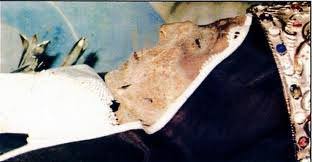
The Hidden Grateful Holiness of Margaret of Castello
Margaret of Castello (+1287 – 1320) is the patroness of the unborn, the disabled, the blind, for she herself was ‘disabled’, even if she may never have thought of herself that way – she had curvature of the spine, was blind, had a limp from legs of different length, and never grew more than four feet tall. She was born to noble parents, ‘beautiful people’: her father with the Shakespearean name of Parisio, the head of the garrison at Metula castle in Mercatello sul Metauro, in east central Italy, not far from Ancona. Parisio had married the lovely Emilia. The successful couple were embarrassed by their deformed daughter. So that no one would ever see her, her father had her locked up in a room at the back of the castle – and had it welded shut. In some small – but inadvertently large – mercy, he allowed her to attend Mass and receive the sacraments.
Eventually, in 1303, at her mother’s urging, Margaret, now a sweet sixteen, but with no coming-of-age parties, nor any friends, nor anyone really, was taken to a local church known as a place for miracles. Seeking a sign of healing, none was given, so her parents abandoned her there. Taken in by the townsfolk, they marveled at Margaret’s radiant goodness, her humility and her lack of any resentment – in fact, only gratitude – towards her parents – those who wished had wished she had never been born.
Margaret, after being expelled from a local convent, eventually, with some help, made her way to the local Dominicans, and joyfully joined their lay Third Order, spending the rest of her brief life teaching catechism to the local children in a small school she had set up, as an act of thanksgiving to the good townspeople, never saying a bad word against those who had given her life. We could use more gratitude in this world so filled with bitterness and resentment. As the parable of the ten lepers signifies, it is one of the most neglected of virtues. We should give thanks, always, in our hearts to the good God.
Known for her holiness and simplicity of life, Margaret died on April 12th, 1320, in her very Christian thirty-third year. The local people, well aware of her sanctity, wanted her buried inside the local parish, a special privilege for few that the priest wanted to deny her. It was only after a disabled girl was cured during her funeral that permission was given. When her coffin was exhumed in 1558, the wood and her clothes had all rotted, but the body of Margaret was preserved, and she performs miracles to this day. We could sure use a few. And her body at that final resurrection will, I may presume, be more radiantly beautiful than many of those who consider themselves so in this passing age.
Blessed Margaret, beatified on October 19th, 1609, by Pope Paul V, is the patroness of the unborn, since one might presume that if ultrasound had existed in the 14th century, or even child euthanasia according to the Grotingen protocol, her parents may have decided to abort her or have her ‘put to sleep’. Then again, perhaps they would not have – for they did feed and house her, even if in solitary confinement, and ‘abandoned’ her in a place where they knew she would be found. Dastardly deeds, to be sure, but we may hope that the prayers of their erstwhile daughter helped convert and save them at the end, as we may pray she does for all of us, and for all those who are even more abandoned than she – by the same act of abortion, of neglect, of lack of charity of all kinds.
We may also call upon Margaret, to intercede for all those in their own ‘confinement’ now – whether by enforced laws, by illness, by self-isolation, that they, and we all, may offer all things, pleasant and unpleasant, to the good God.
Our second drama production here at Seat of Wisdom College – way back in 2003 – was on the life of hunchbacked Margaret of Castello, and I believe the good saint has guided us ever since. She signifies love at its purest – to love those who love us not. An a propos message in the glow of the Christ’s Passion and Resurrection, who causes His rain – and His grace – to fall on the just and the unjust, so that all men have the opportunity, and the very real hope, of being saved, if we but say fiat mihi secundum verbum tuum.
Pope Francis declared Margaret a saint by equipollent canonization on 24 April 2021. Deo gratias. She is one of the most hidden, and, perhaps, one of the most glorious. Amare nesciri, Saint Philp Neri would say – love to be unknown. And known only to God.
Saint Margaret of Castello, ora pro nobis!

Carney’s Amoral Majority
After five defections – euphemistically described as ‘crossing the floor’ – and three by-elections, Mark Carney and his Liberals how have their coveted majority. One wonders what bowls of pottage were offered in back-room deals. In the archaic monarchical system that is the Dominion of Canada, this majority allows the newly-minted Prime Minister to rule[…]Continue reading→

Saint Kateri , Canada’s Protectress
This was the title given to Saint Kateri Tekakwitha, by Pope Benedict XVI, when he canonized her on October 28th, 2012, along with six others, in Saint Peter’ Square (she had been beatified by Pope John Paul II back in 1980). With Saint Joseph as our protector, along with the Canadian martyrs, we seem to[…]Continue reading→

A Tale of Two Benedicts
A grace-filled Holy Week to all our readers! As we await and prepare for the Resurrection about to dawn upon us, we might keep in mind two Benedicts: Pope Emeritus Benedict XVI, requiescat in pace, elected on this day in 2005; and today’s commemoration of the mystic pilgrim, Benedict Joseph Labre, who died on this[…]Continue reading→

My Name is Bernadette
April 16th is a propitious day, for besides the anniversary of Father de Valk’s death, who founded Catholic Insight in its print form decades ago, and the commemoration of the ‘two Benedicts’, mentioned in accompanying posts, today we also recall Saint Bernadette Soubirous, the young visionary to whom the Virgin Mary appeared numerous times at[…]Continue reading→

Saint Lydwina of Schiedam and Suffering Joyfully
Saint Lydwina of Schiedam (1380 – 1433) was one of the countless and glorious ‘victim souls’ in the history of the Church, those whose lives are filled with suffering, often of an unimaginable intensity, but who suffer joyfully. She was a fifteen-year old Dutch girl, out skating one day, when she fell and broke one[…]Continue reading→

The Glorious Martyrdoms of Martin and Maximus
As we enter into Eastertide, we recall on this 13th of April Pope Saint Martin I (+655), one of the noblest, if most tragic, of the successors of Saint Peter. Born in Umbria, Italy, he was of noble lineage, with great intelligence combined with charity and love of the poor and the Church. While still[…]Continue reading→

Canonizing Sister Faustina and Divine Mercy
HOMILY OF THE HOLY FATHER MASS IN ST PETER’S SQUARE FOR THE CANONIZATION OF SR MARY FAUSTINA KOWALSKA Sunday, 30 April 2000 1. “Confitemini Domino quoniam bonus, quoniam in saeculum misericordia eius”; “Give thanks to the Lord for he is good; his steadfast love endures for ever” (Ps 118: 1). So the Church sings on the Octave of[…]Continue reading→

Saint Stanislaus of Szczepanów
We celebrate Saint Stanislaus today (+ April 11, 1079), in light of this Easter Octave, a bishop and martyr who accepted the episcopacy only at the direct order of Pope Alexander II. He proved a wise and courageous leader of his flock, put to death by his own king, Boleslaus, for rebuking the monarch’s ‘immoral[…]Continue reading→
Saint Gemma Galgani
On this April 11th, in 1903 – the same year that the Italian Guiseppe Sarto was elected Pope later that summer as Pius X – a lovely, young Italian woman died, by the name of Gemma Galgani. She lived a brief life of 24 years, as did a number of other young saints, including Pier[…]Continue reading→
An Ideological and Improper Translation
I noticed something odd with the psalm reading at Mass the other day. Our bishops’ conference here in Canada has decreed that the Mass in English – Novus Ordo – use the ‘NRSV’, the ‘New Revised Standard Version’, an ‘updated’ translation of the original RSV, first published in 1952. This ‘new translation’ has the tendency[…]Continue reading→