
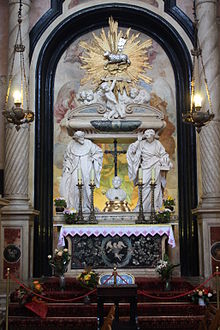
John of Kanty’s Holy Hidden Life
On this Eve of Christmas Eve, we celebrate in a subdued manner the commemoration of John of Cantius (1390 – 1473), or ‘Kanty’ in the original Polish transliteration – a scholar, teacher, gentleman, priest and, most of all, a saint, who spent his whole life as a professor at the Krakow Academy, later named the Jagiellonian, which still maintains a high standard of scholarship to this day. It was here that five centuries later, a young Karol Wojtyla – the future Pope John Paul II – would complete his undergraduate studies in philology and various languages, standing the future polyglot in good stead – he spoke eight to fifteen languages (!) with some degree of fluency – as the spiritual father to over a billion Catholics.
Father John of Kanty, although sharing Karol’s Polish heritage, did not have the well-traveled, public vocation of the future pontiff, but spent most of his life in one place, stationed at his university, teaching philosophy, beloved by all his students. He did contribute to the advance of what we now call science, helping to formulate the theory of impetus, the basis of Newton’s First Law of Motion, which undergirds all of modern physics.
Yet his guiding principle was humility, a life hidden from the wider world, following the maxim of the future Saint Philip Neri – whom he resembles in some ways – amare nesciri, ‘love to be unknown’. He always sought the lowest place, and so was brought higher. The holy priest took as his motto:
Conturbare cave: non est placare suave, Infamare cave; nam revocare grave.
(Beware not to disturb: it’s not sweetly pleasing, Beware speaking ill: for taking back words is burdensome.)
He was a model and inspiration to all, his life a round of prayer, study and teaching, all founded on his relation to the Triune God, and the Word Incarnate. As today’s Office says of him:
Every day after his round of duties he would go straight from the lecture room to church. There he would spend long hours in contemplation and prayer before the hidden Christ of the Eucharist. The God in his heart and the God on his lips were one and the same God.
Cantius lived this holy and rather quiet regime of prayer, teaching, study and charity until the ripe old age of 83.
We are again in a crisis of truth, with so many mired in, and perishing of, ignorance, as the prophet Hosea decried. Those outside the Church know little of the faith (as any perusal of atheists such as Richard Dawkins will attest); but what is more sad, most Catholics also know little of what Christ has revealed; and what is saddest of all, many do not seem to care, something I find very puzzling and, I must admit, at times disheartening.
For only the truth can set us free, and the slavery of ignorance is the worst sort, for one does not even realize that one is in bondage. We are called to pursue the truth, inasmuch as we are able in our state of life, to immerse ourselves in all the best that has been written or thought, to follow dreams, hopes and memories beyond the superficial and earthly.
As creatures made in God’s very image, which is reason, we truly transcend the prison of the present tense, to reflect upon the past, and ponder the future, to enter in some way into God’s own eternity by that scintilla, or spark, of the divine Mind itself that He has given us.
So in this season of light, on the very edge of Christmas and the birth of our Saviour, we should make a resolution to develop our minds and souls, to fan into flame that scintilla, to follow in some small way the example of Saints Peter Canisius and John Cantius and all the heavenly host. Strive to know the faith that we profess, how revealed truths complement those of reason, history, science, and how to explain and defend what we know to be true to others (cf., 1 Peter 3:15).
And, in the midst of all that we now do, may these last days of Advent bring you many graces, as we prepare for the great joyful feast of Christmas. And may it be a very merry one, for one and all. +

Carney’s Amoral Majority
After five defections – euphemistically described as ‘crossing the floor’ – and three by-elections, Mark Carney and his Liberals how have their coveted majority. One wonders what bowls of pottage were offered in back-room deals. In the archaic monarchical system that is the Dominion of Canada, this majority allows the newly-minted Prime Minister to rule[…]Continue reading→

Saint Kateri , Canada’s Protectress
This was the title given to Saint Kateri Tekakwitha, by Pope Benedict XVI, when he canonized her on October 28th, 2012, along with six others, in Saint Peter’ Square (she had been beatified by Pope John Paul II back in 1980). With Saint Joseph as our protector, along with the Canadian martyrs, we seem to[…]Continue reading→

A Tale of Two Benedicts
A grace-filled Holy Week to all our readers! As we await and prepare for the Resurrection about to dawn upon us, we might keep in mind two Benedicts: Pope Emeritus Benedict XVI, requiescat in pace, elected on this day in 2005; and today’s commemoration of the mystic pilgrim, Benedict Joseph Labre, who died on this[…]Continue reading→

My Name is Bernadette
April 16th is a propitious day, for besides the anniversary of Father de Valk’s death, who founded Catholic Insight in its print form decades ago, and the commemoration of the ‘two Benedicts’, mentioned in accompanying posts, today we also recall Saint Bernadette Soubirous, the young visionary to whom the Virgin Mary appeared numerous times at[…]Continue reading→

Saint Lydwina of Schiedam and Suffering Joyfully
Saint Lydwina of Schiedam (1380 – 1433) was one of the countless and glorious ‘victim souls’ in the history of the Church, those whose lives are filled with suffering, often of an unimaginable intensity, but who suffer joyfully. She was a fifteen-year old Dutch girl, out skating one day, when she fell and broke one[…]Continue reading→

The Glorious Martyrdoms of Martin and Maximus
As we enter into Eastertide, we recall on this 13th of April Pope Saint Martin I (+655), one of the noblest, if most tragic, of the successors of Saint Peter. Born in Umbria, Italy, he was of noble lineage, with great intelligence combined with charity and love of the poor and the Church. While still[…]Continue reading→

Canonizing Sister Faustina and Divine Mercy
HOMILY OF THE HOLY FATHER MASS IN ST PETER’S SQUARE FOR THE CANONIZATION OF SR MARY FAUSTINA KOWALSKA Sunday, 30 April 2000 1. “Confitemini Domino quoniam bonus, quoniam in saeculum misericordia eius”; “Give thanks to the Lord for he is good; his steadfast love endures for ever” (Ps 118: 1). So the Church sings on the Octave of[…]Continue reading→

Saint Stanislaus of Szczepanów
We celebrate Saint Stanislaus today (+ April 11, 1079), in light of this Easter Octave, a bishop and martyr who accepted the episcopacy only at the direct order of Pope Alexander II. He proved a wise and courageous leader of his flock, put to death by his own king, Boleslaus, for rebuking the monarch’s ‘immoral[…]Continue reading→

Saint Gemma Galgani
On this April 11th, in 1903 – the same year that the Italian Guiseppe Sarto was elected Pope later that summer as Pius X – a lovely, young Italian woman died, by the name of Gemma Galgani. She lived a brief life of 24 years, as did a number of other young saints, including Pier[…]Continue reading→

An Ideological and Improper Translation
I noticed something odd with the psalm reading at Mass the other day. Our bishops’ conference here in Canada has decreed that the Mass in English – Novus Ordo – use the ‘NRSV’, the ‘New Revised Standard Version’, an ‘updated’ translation of the original RSV, first published in 1952. This ‘new translation’ has the tendency[…]Continue reading→