
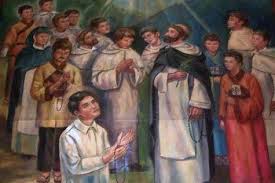
Wenceslaus and Lorenzo, Incidental Martyrs
This is not the stuff of which martyrs are made – So purportedly said Thomas More, who loved all the good things of life, his home at Chelsea, filled with his family, his books, and boon companions. The last thing he likely wanted to do was die for what was then an abstruse point of papal supremacy. But God has His designs for each one of us, and it is only in His will that our peace, and our salvation, may be found.
The two saints we celebrate today were also laymen, living their lives in the midst of the world, but who were asked to ‘go higher’, making them the ‘stuff of which martyrs are made’.
Saint Lorenzo Ruiz (+1637) was born of a Chinese father and a Filipino mother, raised piously in the Catholic Faith which had been brought to the Philippines by Dominican missionaries, whose Masses he would serve. His beautiful handwriting landed him employment as an escribano, an ecclesiastical scribe and calligrapher (would we had such jobs nowadays). He married, settled down, and was raising three children when he was mysteriously accused – falsely it seems – of killing a Spaniard, so he sought asylum aboard a ship with some Dominican priests, which was on its way to Japan.
It was thus that Lorenzo ended up being a sort of unintended missionary, bringing the Faith to the island of the Rising Sun, which had yet to accept the Son. The Shogunate was persecuting Christians – this was the era depicted in Shusako Endo’s controversial book (and eventual film) Silence – and the would-be missionaries were thrown into prison, then tortured on and off for the next two years, in an unrelenting attempt to force them to renounce their Faith.
But they all stood fast. Brought to Nagasaki, where many Catholics had witnessed for the Faith, the same city centuries later bombed by the Americans, they suffered in much the same manner as the semi-fictional protagonists in Endo’s novel. Unlike that sad, ironic story of apostasy, however, Lorenzo and his friends quite literally hung on to the end. The tsurushi – a method of execution in which the victim is strung up upside down over a sewer pit, till blood loss and asphyxiation took him – was one of the most unpleasant of deaths. The Japanese would leave one hand free, so he could signify with a simple gesture the renunciation of his Faith, and an end to the suffering. But Lorenzo refused to recant as his life blood ebbed away, a witness and example for us all, declaring before his death:
Ego Catholicus sum et animo prompto paratoque pro Deo mortem bibo. Si mille vitas haberem, cunctas ei offerrem…
I am a Catholic and with a prompt soul am prepared to taste death for God. If I had a thousand lives, I would offer them all…
The beatification of Lorenzo and his companions by Pope Saint John Paul II in 1981 was the first such ceremony held outside the Vatican, a sign of the universality of the universal Church; we truly are Catholic, in all that word means. Lorenzo was then canonized in 1987 by the same Pontiff, the first Filipino declared so, and his feast is a grand celebration in the archipelago nation.
We also celebrate on this day good King Wenceslaus (+935) the hero of the beloved Christmas song, based on an early Czech poem, the king who looked around for any of his people in need:
Good King Wencelsaus once went out, on the feast of Stephen,
As the snow lay round about, deep and crisp and even…

He was murdered by his own brother, in the era inappropriately known as the ‘Dark Ages’, but were in fact ages of great faith and learning. From what we know of Wenceslaus, he comes across as a noble and righteous ruler, and legend – which always is based on some truth – has him as the very prototype of a saintly king. His own grandfather had been converted by Saints Cyril and Methodius. When Wencelsaus’ father divided the kingdom between him and his brother, Wencelsaus, like Abraham of old, ensured his sibling got the larger half. But that did not satisfy the ambitous Boleslaus, who, with three dastardly companions, murdered Wencelsaus on the feast of Saints Cosmas and Damian, in a fit of dynastic jealousy on this day in 935, on the very steps of the church. Wenceslaus had been warned of the impending treachery and threat to his life, but he refused to stay home, and omit his usual devotions out of a vague fear of possible death. As today’s Office of Readings has Wenceslaus’ final day:
Carney’s Amoral Majority
After five defections – euphemistically described as ‘crossing the floor’ – and three by-elections, Mark Carney and his Liberals how have their coveted majority. One wonders what bowls of pottage were offered in back-room deals. In the archaic monarchical system that is the Dominion of Canada, this majority allows the newly-minted Prime Minister to rule[…]Continue reading→

Saint Kateri , Canada’s Protectress
This was the title given to Saint Kateri Tekakwitha, by Pope Benedict XVI, when he canonized her on October 28th, 2012, along with six others, in Saint Peter’ Square (she had been beatified by Pope John Paul II back in 1980). With Saint Joseph as our protector, along with the Canadian martyrs, we seem to[…]Continue reading→
A Closed, Unsustainable, Descending Loop
As a follow-up to my thoughts on Payette’s payout, here be a stark image of where are here in Canada. As the graph shows in, well, graphic terms, since 2025, the public sector has contributed to 95.5% of economic growth. The private sector – which funds the public sector, or is supposed to – has[…]Continue reading→
A Tale of Two Benedicts
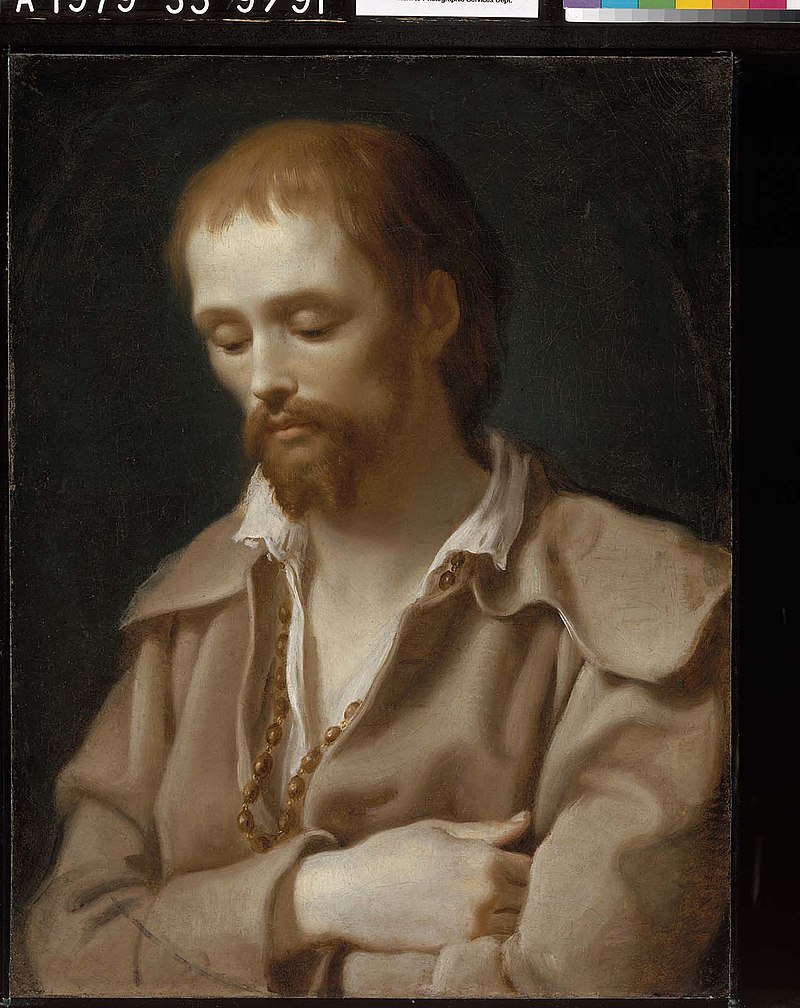
A grace-filled Holy Week to all our readers! As we await and prepare for the Resurrection about to dawn upon us, we might keep in mind two Benedicts: Pope Emeritus Benedict XVI, requiescat in pace, elected on this day in 2005; and today’s commemoration of the mystic pilgrim, Benedict Joseph Labre, who died on this[…]Continue reading→

My Name is Bernadette
April 16th is a propitious day, for besides the anniversary of Father de Valk’s death, who founded Catholic Insight in its print form decades ago, and the commemoration of the ‘two Benedicts’, mentioned in accompanying posts, today we also recall Saint Bernadette Soubirous, the young visionary to whom the Virgin Mary appeared numerous times at[…]Continue reading→
Presidential Pardon of Weronika Krawczyk
As a good news, follow-up to our story from Poland, of the persecution of Weronika Krawczyk for her pro-life views, we heard that she has been granted a presidential pardon. One might still wonder why one needs a presidential pardon for simply holding the long-held belief that the child within the womb is a child,[…]Continue reading→
Saint Lydwina of Schiedam and Suffering Joyfully
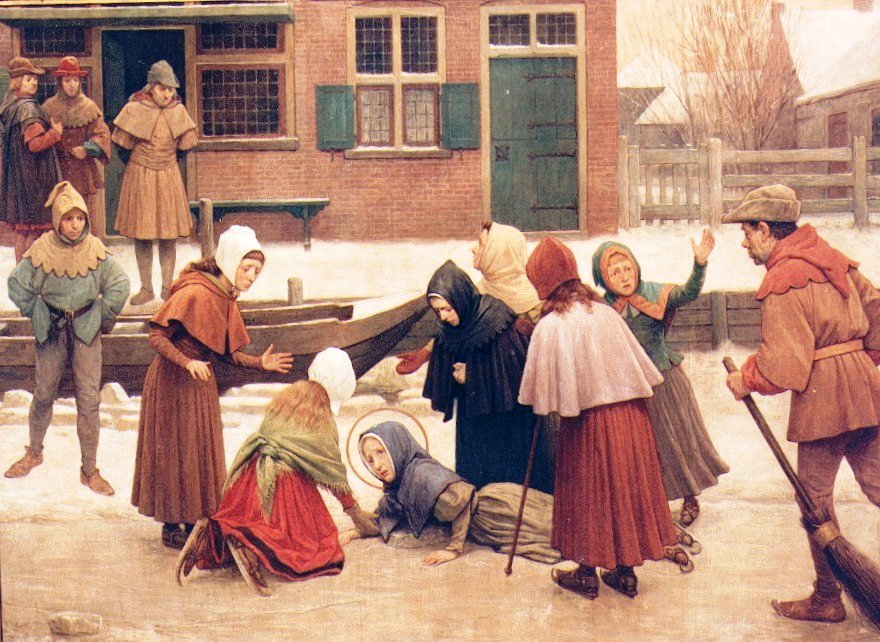
Saint Lydwina of Schiedam (1380 – 1433) was one of the countless and glorious ‘victim souls’ in the history of the Church, those whose lives are filled with suffering, often of an unimaginable intensity, but who suffer joyfully. She was a fifteen-year old Dutch girl, out skating one day, when she fell and broke one[…]Continue reading→
The Glorious Martyrdoms of Martin and Maximus
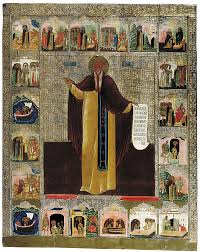
As we enter into Eastertide, we recall on this 13th of April Pope Saint Martin I (+655), one of the noblest, if most tragic, of the successors of Saint Peter. Born in Umbria, Italy, he was of noble lineage, with great intelligence combined with charity and love of the poor and the Church. While still[…]Continue reading→

Canonizing Sister Faustina and Divine Mercy
HOMILY OF THE HOLY FATHER MASS IN ST PETER’S SQUARE FOR THE CANONIZATION OF SR MARY FAUSTINA KOWALSKA Sunday, 30 April 2000 1. “Confitemini Domino quoniam bonus, quoniam in saeculum misericordia eius”; “Give thanks to the Lord for he is good; his steadfast love endures for ever” (Ps 118: 1). So the Church sings on the Octave of[…]Continue reading→
Pope Leo and a Rosary for Peace
Pope Leo XIV has asked Catholics across the world to join him in a Rosary for peace today, at 18:00 Rome time (6 pm), which would be noon from where I write (EST). If you are able, whether at that time or another, and in whatever way you pray, to join in intercession with the[…]Continue reading→