
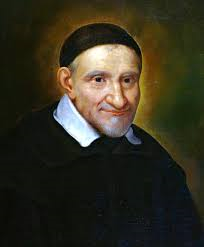
Saint Vincent de Paul and Giving our All
The life of Saint Vincent de Paul (1581 – 1660) – he always signed his name ‘Depaul’, perhaps so people would not think of him as noble – spans a fractious time in France, with the wars of religion nearing their apex, mixed up with bitter claims over land and money. The instability of the kingship in France did not help matters, with the accession of a Protestant-Huguenot, Henry of Bourbon, in 1589, after the assassination of Henry III as he was besieging Paris.
But Vincent did not worry not overmuch about the ways of the great ones of this earth, even though in 1643 he ended up as confessor and spiritual adviser to Queen Anne, the widow of King Louis XIII, and helped shape the religious policies of France, especially towards the pernicious heresy of Jansenism. His life had been a colourful one to that point: From a peasant family, his father sold their oxen to pay for his seminary education, and Vincent, bright and intelligent, if given to irascibility, was ordained in 1600 at the tender age of nineteen, expecting a relatively comfortable life of an urban, and urbane, parish priest. However, he was captured by pirates, and spent two years as a slave, moved hither and yon, even out to Istanbul, where he helped convert an apostate priest who had converted to Islam and taken three wives. (Some historians dispute this ‘slave episode’ in Vincent’s life, but it seems true).
Gradually, Vincent realized there was more to the priesthood than he had realized, not least after hearing the confession of a dying peasant in 1612, which made him aware of the plight of the innumerable poor. Yet with his profound spiritual gifts recognized, he was also ‘in demand’ with the great ones of the earth. Even so, Vincent is known for his priestly ministry to those ‘on the margins’, as it is now said; and there were many in those days, with taxes squeezed out of a bleeding people, costly nationalistic and mostly futile wars, and what wealth there was ever-more concentrated in governmental coffers in Versailles. Sounds sort of modern. Vincent founded two Orders, the Daughters of Charity and the Congregation of the Mission, which continue his work for the poor throughout the world to this day.
Charity is certainly greater than any rule. Moreover, all rules must lead to charity. Since she is a noble mistress, we must do whatever she commands. With renewed devotion, then, we must serve the poor, especially outcasts and beggars. They have been given to us as our masters and patrons.
Monsieur Vincent became renowned for his simple holiness, always giving, and ever-more forgetful of self. He died on this day, September 27th, 1660, and canonized by Pope Clement XII in 1737. His heart remains incorrupt.
One anecdote of Saint Vincent that sticks in my mind is a promise he made always to say the more simple and direct thing, rather than the obfuscatory, ambiguous circumlocutions most of us use to avoid telling someone what may be an uncomfortable truth, but to which they have a right. Providential, perhaps, that this is also the day in 1968 that the bishops of Canada released their infamous ‘Winnipeg Statement’, in response to Pope Paul VI’s encyclical Humanae Vitae, which clearly and in no uncertain terms condemned the intrinsic evil of contraception. The Canadian bishops, however, in their own words, more or less allowed Catholics to follow whatever path ‘seemed good to them in their conscience’, and we have reaped the bitter fruits ever since.
We could use more such clarity and precision as Saint Paul VI, both amongst, and to, the ‘great ones’ of this world. And a few more bold and forthright, as well as charitable and joyful, Vincent de Pauls would do the word a whole lot of good.
Ora pro nobis, Monsieur Vincent!

Carney’s Amoral Majority
After five defections – euphemistically described as ‘crossing the floor’ – and three by-elections, Mark Carney and his Liberals how have their coveted majority. One wonders what bowls of pottage were offered in back-room deals. In the archaic monarchical system that is the Dominion of Canada, this majority allows the newly-minted Prime Minister to rule[…]Continue reading→

Saint Kateri , Canada’s Protectress
This was the title given to Saint Kateri Tekakwitha, by Pope Benedict XVI, when he canonized her on October 28th, 2012, along with six others, in Saint Peter’ Square (she had been beatified by Pope John Paul II back in 1980). With Saint Joseph as our protector, along with the Canadian martyrs, we seem to[…]Continue reading→

A Tale of Two Benedicts
A grace-filled Holy Week to all our readers! As we await and prepare for the Resurrection about to dawn upon us, we might keep in mind two Benedicts: Pope Emeritus Benedict XVI, requiescat in pace, elected on this day in 2005; and today’s commemoration of the mystic pilgrim, Benedict Joseph Labre, who died on this[…]Continue reading→

My Name is Bernadette
April 16th is a propitious day, for besides the anniversary of Father de Valk’s death, who founded Catholic Insight in its print form decades ago, and the commemoration of the ‘two Benedicts’, mentioned in accompanying posts, today we also recall Saint Bernadette Soubirous, the young visionary to whom the Virgin Mary appeared numerous times at[…]Continue reading→

Saint Lydwina of Schiedam and Suffering Joyfully
Saint Lydwina of Schiedam (1380 – 1433) was one of the countless and glorious ‘victim souls’ in the history of the Church, those whose lives are filled with suffering, often of an unimaginable intensity, but who suffer joyfully. She was a fifteen-year old Dutch girl, out skating one day, when she fell and broke one[…]Continue reading→

The Glorious Martyrdoms of Martin and Maximus
As we enter into Eastertide, we recall on this 13th of April Pope Saint Martin I (+655), one of the noblest, if most tragic, of the successors of Saint Peter. Born in Umbria, Italy, he was of noble lineage, with great intelligence combined with charity and love of the poor and the Church. While still[…]Continue reading→

Canonizing Sister Faustina and Divine Mercy
HOMILY OF THE HOLY FATHER MASS IN ST PETER’S SQUARE FOR THE CANONIZATION OF SR MARY FAUSTINA KOWALSKA Sunday, 30 April 2000 1. “Confitemini Domino quoniam bonus, quoniam in saeculum misericordia eius”; “Give thanks to the Lord for he is good; his steadfast love endures for ever” (Ps 118: 1). So the Church sings on the Octave of[…]Continue reading→

Saint Stanislaus of Szczepanów
We celebrate Saint Stanislaus today (+ April 11, 1079), in light of this Easter Octave, a bishop and martyr who accepted the episcopacy only at the direct order of Pope Alexander II. He proved a wise and courageous leader of his flock, put to death by his own king, Boleslaus, for rebuking the monarch’s ‘immoral[…]Continue reading→

Saint Gemma Galgani
On this April 11th, in 1903 – the same year that the Italian Guiseppe Sarto was elected Pope later that summer as Pius X – a lovely, young Italian woman died, by the name of Gemma Galgani. She lived a brief life of 24 years, as did a number of other young saints, including Pier[…]Continue reading→

An Ideological and Improper Translation
I noticed something odd with the psalm reading at Mass the other day. Our bishops’ conference here in Canada has decreed that the Mass in English – Novus Ordo – use the ‘NRSV’, the ‘New Revised Standard Version’, an ‘updated’ translation of the original RSV, first published in 1952. This ‘new translation’ has the tendency[…]Continue reading→