
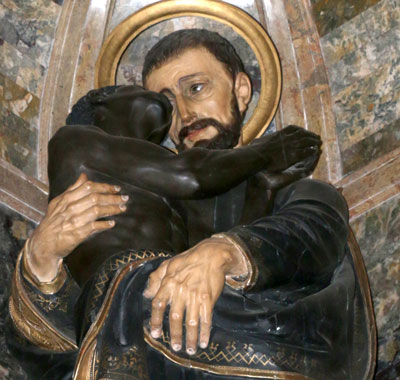
Peter Claver’s Untiring Fidelity
Saint Peter Claver (+Sept. 8, 1654), whom we celebrate on this 9th day of September, was a Jesuit priest in the first missionary fervour of Ignatius’ nascent Society, a native of Spain, but who spent most of his life evangelizing in what is now Colombia, South America, ministering with what means he could to the untold numbers of slaves brought over from Africa in conditions almost too horrible and inhuman to describe. A fellow Jesuit and saint, the holy doorkeeper Alphonsus Rodriguez, who had the gift of prophecy, told Peter that his vocation was to serve in the colonies of ‘New Spain’ overseas, advice which spoke to Claver’s own heart, and with which he corresponded with the wholeness of that same heart. As he wrote in the notebook he kept: I must dedicate myself to the service of God until death, on the understanding that I am like a slave. And on his final profession in the Order, he signed Petrus Claver, aethiopum semper servus (Peter Claver, servant of the Ethiopians [that is, the Africans] forever).
It is a sad testament that all-too many individual Christians, tacitly or not, supported the slave trade (as did many other religions, especially Muslims, the most notorious slave traders in history; see this archived article in the National Post.). But the Catholic Church in all of her official teachings condemned this abominable practice, and figures like Saint Peter Claver worked tirelessly to alleviate its evils
Read over the excerpt from his letters in today’s Office, vivid and concrete in its description of his charity, simple, direct, guileless. The slaves would arrive, crammed into cargo holds for months at sea, dirty, diseased, disrobed. Father Claver would bring them treats, oranges, lemons, drinks, what clothing he would scrabble together – he would lend anyone who asked his cloak, and it was said that those who wore it were guaranteed lifelong good health. He would give missions across the country, never staying in the fine homes of the traders and merchants, but lodging in the hovels of his beloved slaves, encouraging them in the spiritual life. And he did this, without stint, with no holidays or trips home, for four full decades.
Besides his corporal works of mercy, it is estimated that the Jesuit personally baptized over 300,000 people, and heard the confessions of untold thousands also. As the Decree on Missionary Activity, Ad Gentes, from the Second Vatican Council defines the true and full missionary:
Yet man must respond to God Who calls, and that in such a way, that without taking counsel with flesh and blood (Gal. 1:16), he devotes himself wholly to the work of the Gospel. This response, however can only be given when the Holy Spirit gives His inspiration and His power. For he who is sent enters upon the life and mission of Him Who “emptied Himself, taking the nature of a slave” (Phil. 2:7). Therefore, he must be ready to stay at his vocation for an entire lifetime, and to renounce himself and all those whom he thus far considered as his own, and instead to “make himself all things to all men” (1 Cor. 9:22). (#24)
Father Peter Claver certainly ’emptied himself’, ‘stayed at his vocation for an entire lifetime’, and, in true Pauline and Jesuit mold, made himself all things to all men. We know not how many souls he led to heaven, and how many he continues to do so by his example and intercession. Ironically, towards the end of his life, Father Claver was bedridden, scarcely able to move, and an ex-slave was tasked to care for him, but instead neglected and abused the one who had done so much good. The priest never complained, receiving such as recompense for his sins (and what might that say of us!) – but, perhaps more likely in the heavenly scales, as penance for the sins of others. He died alone, on Our Lady’s birthday, in 1654, and we may be sure the Mother of God welcomed him personally into beatitude, to join the untold numbers of those to whom he had ministered. Leo XIII, who canonized Claver on January 15, 1888, declared that no life, besides that of Christ Himself, had moved him as much as this servant of God.
And that same God is always looking for a few magnanimous souls, who can do far more good, far outweighing the evil of the pusillanimous, with which our world is filled. So do the good that we must do, and we may well be surprised at how much fruit the Almighty can produce, even with our meagre efforts. The main thing is to persevere at the task we have been given, and stay faithful to the end.
Saint Peter Claver, ora pro nobis.

Carney’s Amoral Majority
After five defections – euphemistically described as ‘crossing the floor’ – and three by-elections, Mark Carney and his Liberals how have their coveted majority. One wonders what bowls of pottage were offered in back-room deals. In the archaic monarchical system that is the Dominion of Canada, this majority allows the newly-minted Prime Minister to rule[…]Continue reading→

Saint Kateri , Canada’s Protectress
This was the title given to Saint Kateri Tekakwitha, by Pope Benedict XVI, when he canonized her on October 28th, 2012, along with six others, in Saint Peter’ Square (she had been beatified by Pope John Paul II back in 1980). With Saint Joseph as our protector, along with the Canadian martyrs, we seem to[…]Continue reading→

A Tale of Two Benedicts
A grace-filled Holy Week to all our readers! As we await and prepare for the Resurrection about to dawn upon us, we might keep in mind two Benedicts: Pope Emeritus Benedict XVI, requiescat in pace, elected on this day in 2005; and today’s commemoration of the mystic pilgrim, Benedict Joseph Labre, who died on this[…]Continue reading→

My Name is Bernadette
April 16th is a propitious day, for besides the anniversary of Father de Valk’s death, who founded Catholic Insight in its print form decades ago, and the commemoration of the ‘two Benedicts’, mentioned in accompanying posts, today we also recall Saint Bernadette Soubirous, the young visionary to whom the Virgin Mary appeared numerous times at[…]Continue reading→

Saint Lydwina of Schiedam and Suffering Joyfully
Saint Lydwina of Schiedam (1380 – 1433) was one of the countless and glorious ‘victim souls’ in the history of the Church, those whose lives are filled with suffering, often of an unimaginable intensity, but who suffer joyfully. She was a fifteen-year old Dutch girl, out skating one day, when she fell and broke one[…]Continue reading→

The Glorious Martyrdoms of Martin and Maximus
As we enter into Eastertide, we recall on this 13th of April Pope Saint Martin I (+655), one of the noblest, if most tragic, of the successors of Saint Peter. Born in Umbria, Italy, he was of noble lineage, with great intelligence combined with charity and love of the poor and the Church. While still[…]Continue reading→

Canonizing Sister Faustina and Divine Mercy
HOMILY OF THE HOLY FATHER MASS IN ST PETER’S SQUARE FOR THE CANONIZATION OF SR MARY FAUSTINA KOWALSKA Sunday, 30 April 2000 1. “Confitemini Domino quoniam bonus, quoniam in saeculum misericordia eius”; “Give thanks to the Lord for he is good; his steadfast love endures for ever” (Ps 118: 1). So the Church sings on the Octave of[…]Continue reading→

Saint Stanislaus of Szczepanów
We celebrate Saint Stanislaus today (+ April 11, 1079), in light of this Easter Octave, a bishop and martyr who accepted the episcopacy only at the direct order of Pope Alexander II. He proved a wise and courageous leader of his flock, put to death by his own king, Boleslaus, for rebuking the monarch’s ‘immoral[…]Continue reading→

Saint Gemma Galgani
On this April 11th, in 1903 – the same year that the Italian Guiseppe Sarto was elected Pope later that summer as Pius X – a lovely, young Italian woman died, by the name of Gemma Galgani. She lived a brief life of 24 years, as did a number of other young saints, including Pier[…]Continue reading→

An Ideological and Improper Translation
I noticed something odd with the psalm reading at Mass the other day. Our bishops’ conference here in Canada has decreed that the Mass in English – Novus Ordo – use the ‘NRSV’, the ‘New Revised Standard Version’, an ‘updated’ translation of the original RSV, first published in 1952. This ‘new translation’ has the tendency[…]Continue reading→