
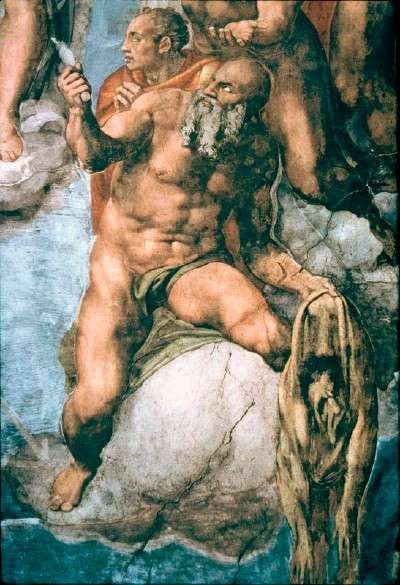
Pope Benedict and Saint Bartholomew
BENEDICT XVI
GENERAL AUDIENCE
Saint Peter’s Square
Wednesday, 4 October 2006
Bartholomew
Dear Brothers and Sisters,
In the series on the Apostles called by Jesus during his earthly life, today it is the Apostle Bartholomew who attracts our attention. In the ancient lists of the Twelve he always comes before Matthew, whereas the name of the Apostle who precedes him varies; it may be Philip (cf. Mt 10: 3; Mk 3: 18; Lk 6: 14) or Thomas (cf. Acts 1: 13).
His name is clearly a patronymic, since it is formulated with an explicit reference to his father’s name. Indeed, it is probably a name with an Aramaic stamp, bar Talmay, which means precisely: “son of Talmay”.
We have no special information about Bartholomew; indeed, his name always and only appears in the lists of the Twelve mentioned above and is therefore never central to any narrative.
However, it has traditionally been identified with Nathanael: a name that means “God has given”.
This Nathanael came from Cana (cf. Jn 21: 2) and he may therefore have witnessed the great “sign” that Jesus worked in that place (cf. Jn 2: 1-11). It is likely that the identification of the two figures stems from the fact that Nathanael is placed in the scene of his calling, recounted in John’s Gospel, next to Philip, in other words, the place that Bartholomew occupies in the lists of the Apostles mentioned in the other Gospels.
Philip told this Nathanael that he had found “him of whom Moses in the law and also the prophets wrote, Jesus of Nazareth, the son of Joseph” (Jn 1: 45). As we know, Nathanael’s retort was rather strongly prejudiced: “Can anything good come out of Nazareth?” (Jn 1: 46). In its own way, this form of protestation is important for us. Indeed, it makes us see that according to Judaic expectations the Messiah could not come from such an obscure village as, precisely, Nazareth (see also Jn 7: 42).
But at the same time Nathanael’s protest highlights God’s freedom, which baffles our expectations by causing him to be found in the very place where we least expect him. Moreover, we actually know that Jesus was not exclusively “from Nazareth” but was born in Bethlehem (cf. Mt 2: 1; Lk 2: 4) and came ultimately from Heaven, from the Father who is in Heaven.
Nathanael’s reaction suggests another thought to us: in our relationship with Jesus we must not be satisfied with words alone. In his answer, Philip offers Nathanael a meaningful invitation: “Come and see!” (Jn 1: 46). Our knowledge of Jesus needs above all a first-hand experience: someone else’s testimony is of course important, for normally the whole of our Christian life begins with the proclamation handed down to us by one or more witnesses.
(To continue reading, please see here).

Saint Kateri , Canada’s Protectress
This was the title given to Saint Kateri Tekakwitha, by Pope Benedict XVI, when he canonized her on October 28th, 2012, along with six others, in Saint Peter’ Square (she had been beatified by Pope John Paul II back in 1980). With Saint Joseph as our protector, along with the Canadian martyrs, we seem to[…]Continue reading→

Remembering Father Alphonse de Valk
(Today marks the sixth anniversary of the death of Father Alphonse de Valk, C.S.B., a faithful, courageous and indefatigable Basilian priest, pro-life-and-family apostle, and the founder of Catholic Insight magazine. Here is what we wrote those on his entering into eternity five years ago, as we continue to remember him in our prayers and thoughts)[…]Continue reading→

A Tale of Two Benedicts
A grace-filled Holy Week to all our readers! As we await and prepare for the Resurrection about to dawn upon us, we might keep in mind two Benedicts: Pope Emeritus Benedict XVI, requiescat in pace, elected on this day in 2005; and today’s commemoration of the mystic pilgrim, Benedict Joseph Labre, who died on this[…]Continue reading→

My Name is Bernadette
April 16th is a propitious day, for besides the anniversary of Father de Valk’s death, who founded Catholic Insight in its print form decades ago, and the commemoration of the ‘two Benedicts’, mentioned in accompanying posts, today we also recall Saint Bernadette Soubirous, the young visionary to whom the Virgin Mary appeared numerous times at[…]Continue reading→

Saint Lydwina of Schiedam and Suffering Joyfully
Saint Lydwina of Schiedam (1380 – 1433) was one of the countless and glorious ‘victim souls’ in the history of the Church, those whose lives are filled with suffering, often of an unimaginable intensity, but who suffer joyfully. She was a fifteen-year old Dutch girl, out skating one day, when she fell and broke one[…]Continue reading→

The Glorious Martyrdoms of Martin and Maximus
As we enter into Eastertide, we recall on this 13th of April Pope Saint Martin I (+655), one of the noblest, if most tragic, of the successors of Saint Peter. Born in Umbria, Italy, he was of noble lineage, with great intelligence combined with charity and love of the poor and the Church. While still[…]Continue reading→

Canonizing Sister Faustina and Divine Mercy
HOMILY OF THE HOLY FATHER MASS IN ST PETER’S SQUARE FOR THE CANONIZATION OF SR MARY FAUSTINA KOWALSKA Sunday, 30 April 2000 1. “Confitemini Domino quoniam bonus, quoniam in saeculum misericordia eius”; “Give thanks to the Lord for he is good; his steadfast love endures for ever” (Ps 118: 1). So the Church sings on the Octave of[…]Continue reading→

Divine Mercy Sunday – An Echo of Every Mass
Reach out your hand and put it in my side. Do not doubt but believe’… ‘My Lord and my God!’ (Jn. 20:18)). Today is Divine Mercy Sunday, and as we celebrate the end of the Easter Octave, we contemplate the wounded side of our Saviour, the Church’s source of life. On Good Friday in the[…]Continue reading→

Saint Stanislaus of Szczepanów
We celebrate Saint Stanislaus today (+ April 11, 1079), in light of this Easter Octave, a bishop and martyr who accepted the episcopacy only at the direct order of Pope Alexander II. He proved a wise and courageous leader of his flock, put to death by his own king, Boleslaus, for rebuking the monarch’s ‘immoral[…]Continue reading→

Saint Gemma Galgani
On this April 11th, in 1903 – the same year that the Italian Guiseppe Sarto was elected Pope later that summer as Pius X – a lovely, young Italian woman died, by the name of Gemma Galgani. She lived a brief life of 24 years, as did a number of other young saints, including Pier[…]Continue reading→