
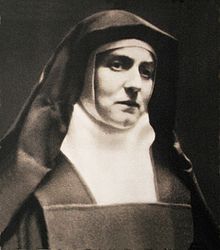
Saint Edith Stein’s Witness to the Cross
Edith Stein (+ 1942) was a brilliant philosopher, earning her doctorate summa cum laude in August of 1916 on the problem of empathy – understanding the suffering of others. Fitting, for she came into in the world in 1891 on Yom Kippur, the high holy Jewish Day of Atonement. Brought up in an observant Judaic household of eleven children, bright and inquisitive, she was always her her mother’s favourite. Lapsing into atheism in early youth, her inquisitive mind and expansive, generous soul never rested easy with such a hope-less philosophy.
Two things prompted her conversion to Catholicism in young adulthood: The first was seeing someone go into a church to kneel, pray and converse with God:
This was something totally new to me. In the synagogues and Protestant churches I had visited, people simply went to the services. Here, however, I saw someone coming straight from the busy marketplace into this empty church, as if going to have an intimate conversation. It was something I never forgot.
Of course, as she was later to realize, the church was not empty, but filled with a Presence beyond her imagining or any philosophy.
The second was finding the autobiography of Saint Teresa of Avila upon a visit to a Catholic home, which she picked up, and read in one night, and said to herself ‘this is the truth’, resolving then and there to become Catholic, and, eventually, like Teresa, a Carmelite nun.
When I had finished the book, I said to myself: This is the truth…My longing for truth was a single prayer.
She followed through on the conversion to Catholicism. When she approached the priest, he said she would have to be instructed, but he soon discovered that Edith, who had already read whatever she could get her hands on, was more than instructed enough, and was received into the Church on January 1, 1922. She felt a call also to ‘go higher’, but was asked by her bishop and her spiritual director to hold off on entrance to religious life, and dedicate her refined mind,, considerable energy and work ethic to teaching, writing, translating, leaving behind a remarkable body of work still being studied and bearing fruit.
As the Nazi persecution increased in fury, in 1933 the Bishop allowed Edith to enter the Carmel at Cologne, where she took the name Teresa Benedicta a Cruce – Theresa Blessed by the Cross – and where she spent the remainder of her life, except for the final few days. The last time she saw her mother – who had taken her conversion rather hard – was October 12th of that year, Edith’s birthday and the last day of the Jewish feast of tabernacles. Three years before, she had written the mysterious and prophetic words,
Every time I feel my powerlessness and inability to influence people directly, I become more keenly aware of the necessity of my own holocaust.
Sure enough, God honoured her willingness to suffer for her people, the Church, the world. She and her sister Rosa – who had followed Edith into the Faith and then into the Carmel – were smuggled across the border into Holland for their safety. But in a direct response to the Dutch bishops speaking out forcefully against the Nazi persecution, the Nazis decreed that Catholics, especially those of ‘non-Aryan’ lineage, would suffer and pay the price (which is what Pope Pius XII had feared). Sister Theresa and her sister were arrested in their own chapel and, with 987 others, taken to Auschwitz, where they were sent to eternity in the horrors of the gas chambers, likely on this day, August 9th, in 1942. There are reports of Sister Teresa’s equanimity, walking calmly through the death camp in her Carmelite habit, comforting mothers and their daughters in those few days of horror, and we may trust that Sister Benedicta took many with her to heaven.
Teresa Benedicta was canonized as a martyr for the Faith by Pope Saint John Paul II on October 11, 1998, after a remarkable miraculous cure, and was declared also one of the primary patrons of Europe. Her remarkable life and spiritual pilgrimage provide a ‘sign’ for all of us, that the path to paradise is through the Christ and His Church – and the Cross. Even if the graces therefrom flow into those souls outside the Church’s visible confines, once one becomes aware of this necessity, this is the road they must trod – the Way, the Truth and the Life. After all, once you discover, like Teresa, that ‘this is the truth‘, why would you not?
To paraphrase Pope Saint John Paul, may Europe rediscover the joy, beauty and grace of her own Baptism, before her disintegration and dissolution – inevitable outside of Christ -become irrevocable.
Saint Teresa Benedicta of the Cross, ora pro nobis!

Carney’s Amoral Majority
After five defections – euphemistically described as ‘crossing the floor’ – and three by-elections, Mark Carney and his Liberals how have their coveted majority. One wonders what bowls of pottage were offered in back-room deals. In the archaic monarchical system that is the Dominion of Canada, this majority allows the newly-minted Prime Minister to rule[…]Continue reading→

Saint Kateri , Canada’s Protectress
This was the title given to Saint Kateri Tekakwitha, by Pope Benedict XVI, when he canonized her on October 28th, 2012, along with six others, in Saint Peter’ Square (she had been beatified by Pope John Paul II back in 1980). With Saint Joseph as our protector, along with the Canadian martyrs, we seem to[…]Continue reading→

A Tale of Two Benedicts
A grace-filled Holy Week to all our readers! As we await and prepare for the Resurrection about to dawn upon us, we might keep in mind two Benedicts: Pope Emeritus Benedict XVI, requiescat in pace, elected on this day in 2005; and today’s commemoration of the mystic pilgrim, Benedict Joseph Labre, who died on this[…]Continue reading→

My Name is Bernadette
April 16th is a propitious day, for besides the anniversary of Father de Valk’s death, who founded Catholic Insight in its print form decades ago, and the commemoration of the ‘two Benedicts’, mentioned in accompanying posts, today we also recall Saint Bernadette Soubirous, the young visionary to whom the Virgin Mary appeared numerous times at[…]Continue reading→

Saint Lydwina of Schiedam and Suffering Joyfully
Saint Lydwina of Schiedam (1380 – 1433) was one of the countless and glorious ‘victim souls’ in the history of the Church, those whose lives are filled with suffering, often of an unimaginable intensity, but who suffer joyfully. She was a fifteen-year old Dutch girl, out skating one day, when she fell and broke one[…]Continue reading→

The Glorious Martyrdoms of Martin and Maximus
As we enter into Eastertide, we recall on this 13th of April Pope Saint Martin I (+655), one of the noblest, if most tragic, of the successors of Saint Peter. Born in Umbria, Italy, he was of noble lineage, with great intelligence combined with charity and love of the poor and the Church. While still[…]Continue reading→

Canonizing Sister Faustina and Divine Mercy
HOMILY OF THE HOLY FATHER MASS IN ST PETER’S SQUARE FOR THE CANONIZATION OF SR MARY FAUSTINA KOWALSKA Sunday, 30 April 2000 1. “Confitemini Domino quoniam bonus, quoniam in saeculum misericordia eius”; “Give thanks to the Lord for he is good; his steadfast love endures for ever” (Ps 118: 1). So the Church sings on the Octave of[…]Continue reading→

Saint Stanislaus of Szczepanów
We celebrate Saint Stanislaus today (+ April 11, 1079), in light of this Easter Octave, a bishop and martyr who accepted the episcopacy only at the direct order of Pope Alexander II. He proved a wise and courageous leader of his flock, put to death by his own king, Boleslaus, for rebuking the monarch’s ‘immoral[…]Continue reading→

Saint Gemma Galgani
On this April 11th, in 1903 – the same year that the Italian Guiseppe Sarto was elected Pope later that summer as Pius X – a lovely, young Italian woman died, by the name of Gemma Galgani. She lived a brief life of 24 years, as did a number of other young saints, including Pier[…]Continue reading→
An Ideological and Improper Translation
I noticed something odd with the psalm reading at Mass the other day. Our bishops’ conference here in Canada has decreed that the Mass in English – Novus Ordo – use the ‘NRSV’, the ‘New Revised Standard Version’, an ‘updated’ translation of the original RSV, first published in 1952. This ‘new translation’ has the tendency[…]Continue reading→