
Can Popes be Heretics?
Is the Pope a heretic? should sound like the beginning of a bad joke, but is a charge that has been made by a group of level-headed theologians. I was a bit taken aback by the claim, and thought a good place to find an answer is the current Code of Canon Law, which describes heresy as the obstinate denial or obstinate doubt after the reception of baptism of some truth which is to be believed by divine and Catholic faith.
Heresy, at its root, is an interior disposition of the mind and will, the holding of a false proposition, one contrary to revealed doctrine. At this level, only the person himself and God know who is and who is not a heretic.
The only way we – that is, any human court – can know for certain who is and is not, a heretic, is by what someone says or writes, but even here, distinctions must be made. There are those who hold a heretical proposition, not knowing that it is heresy. In one of my introductory classes, I ask the students whether Christ was, or is, a human person. Almost all reply in the affirmative – some quite zealously so – thereby unwittingly professing the ‘heresy’ of Nestorius – who held that Christ was both a divine and a human person, with Mary giving birth only to the latter. Nestorianism, as it came to be called, was condemned at the Council of Ephesus in 431, teaching for all time that Christ is one Person (hypostasis), divine, in Whom are united the two natures, divine and human; hence, the ‘hypostatic union’.
The students are in a state of what we might term ‘material’ heresy, for when they are apprised of their error, they conform their thought to the teaching of the Church (at least, I hope they do). They hold not the heresy with their ‘obstinate’ will, which would make them ‘formal’ heretics.
This is why, as the Second Vatican Council taught, we do not charge with the crime of heresy our ‘separated brethren’, for they have been brought up with their minds and souls formed in incomplete and imperfect revelation. They have not – or we may presume they have not – rejected any divinely revealed truth. The same cannot be said of the founders of their religion, say, Luther and Calvin, both apostate priests who professed any number of heresies.
So, in sum, to be charged with the actual crime of heresy, in a canonical-legal sense, one must propound and obstinately hold a heretical proposition.
Ponder an analogy: To be convicted of theft requires that one must actually commit a theft. It is not enough to foster a milieu in which theft, or other evils ancillary to thievery, might flourish; or to praise certain people who have muddled thoughts about the morality of stealing; or to write ambiguous things that may be interpreted as supporting such unlawful usurpation of another’s property. These may all be wrong and even immoral, but conviction of theft requires commission of an actual theft.
For the Pope to be convicted of heresy – beyond what we may surmise of his interior dispositions, or the confusing Magisterial milieu he has fostered – he must be shown to definitively and obstinately ‘deny or doubt’ a truth to be believed with divine and Catholic faith. And this, as far as I and any number of others have discerned, the Holy Father has not done.
In terms of Francis’ misleading and ambiguous statements, Edward Peters has a valid point, that we should interpret these with the ‘principle of benignity’, that is, in as favourable – and orthodox – an interpretation as we might. And this not just for the Holy Father’s benefit, but for ours.
There is no easy solution to the present crisis in the Catholic Church, which is a crisis of faith, of doctrine, of morals and metaphysics, of soteriology and eschatology, all of which transcend Pope Francis, along with his cardinals, confidants and counsellors. One need only look at the near-total rejection of Humanae Vitae and other core moral principles, at least in practise, as well as the scale of sacerdotal scandals in the Western hemisphere – to take but two examples amongst many – to see that the morass in which we find ourselves has deep roots, whose bitter fruit is now being borne.
A note of caution, in giving Pope Francis too much credit for our current ecclesiastical crisis, and seeing all of this from too limited a perspective. The truth is all there to find, for those with eyes to see and ears to hear. We must keep in mind that the Church is not just a human institution, subject to internecine conflict and power struggles, but a divine one, transcending the vagaries, even the Popes and potentates, of this world. For what it is worth, I hold the traditional and pious belief that the Holy Spirit protects the successor of Saint Peter from ever propounding explicit heresy.
Sure enough, there have been some close calls: Pope Honorius (+638) being a prime canard. Under pressure from the emperor, he dabbled with monothelitism, and issued ambiguous, compromising statements on how many wills there were in Christ. The orthodox view is two, divine and human, in accordance with the fullness of human nature He assumed. This, the ‘monothelites’ (literally, ‘one will-ers’) denied, in their attempt to maintain the purity of Christ’s intentions and actions, and the possibility of His human will contravening His divine one (and, hence, sinning). But without a human will, Christ would not have had a full human nature, and would not have been fully human. And as Saint Irenaeus put it, what was not assumed, was not redeemed.
Forty years after his death, the Third Council of Constantinople (680-81) condemned Honorius as a ‘heretic’, but Pope Leo II, in approving the conciliar decrees, amended this text to say that Honorius was to be anathematized not for heresy, but for an ‘imprudent economy of silence’, which allowed heresy to flourish. Honorius’ opinion on Christ’s one or two wills (or, His ‘energies’) was indeed ambiguous, but even here, he may be exonerated, for Saint Maximus interpreted the Pope’s words as denying two contrary wills in Christ. Regardless of whatever failure he displayed in teaching the truth, Honorius was Pope until God took him by death.
One may sift through all the other scandalous examples – and many have done so, with fine theological and historical toothcombs – but never has a Vicar of Christ actually taught a specific heresy in any official capacity. And, theological speculation on contingent scenarios of heretical Popes aside aside, I further believe this divine protection will last unto the consummation of all things.
That said, we should not fall into some sort of quietistic passivity, but rather do all we can to clarify ambiguities and errors, even resist, if need be, misuses of the papal prerogative, so that the truth may not be distorted, muted, or misunderstood by the faithful. The Pope is not above the Word of God – that is, Scripture and Tradition – but its most humble servant. He must be reminded of that at times, and the truth defended with all the might and means at our lawful disposal.
I concur with Edward Peters and Father Thomas Weinandy that the formal charge of heresy is over-reach -and wish the letter had not done so, for its worthy and carefully-considered concerns may have borne more good fruit and gained more support without this claim. I am all for its call for a Pauline-Petrine confrontation, and bringing all the doubts, obfuscations and ambiguities into the bright light of day. If this verbal gauntlet does that, so be it, and may it do what good it might. The question implicit in this imbroglio, however, is what if the Holy Father continues to ignore such a call for clarity? How far may one lawfully coerce a Pope, who holds ‘full, supreme and universal’ power (potestas) in the Church? Who is to put him on trial, and against what judge or jury would he defend himself? For that matter, what authority supersedes the Vicar of Christ, but Christ Himself?
While we work and pray, dialogue and debate, fret not, and have faith. Popes come and go, and they all have their allotted time. Ponder the reply of the same Lord, fast asleep in the midst of the storm-tossed sea, when His apostles awoke him in their deadly fear and anxiety. The barque of Peter will survive this crisis – a punitive one, perhaps – which may be calmed and clarified with one divine word. In some way beyond our human and worldly perspective, Christ knows what He is about, and His truth will win out in the end.
Carney’s Amoral Majority
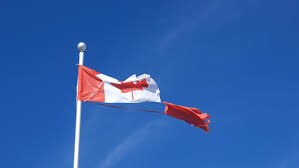
After five defections – euphemistically described as ‘crossing the floor’ – and three by-elections, Mark Carney and his Liberals how have their coveted majority. One wonders what bowls of pottage were offered in back-room deals. In the archaic monarchical system that is the Dominion of Canada, this majority allows the newly-minted Prime Minister to rule[…]Continue reading→

Saint Kateri , Canada’s Protectress
This was the title given to Saint Kateri Tekakwitha, by Pope Benedict XVI, when he canonized her on October 28th, 2012, along with six others, in Saint Peter’ Square (she had been beatified by Pope John Paul II back in 1980). With Saint Joseph as our protector, along with the Canadian martyrs, we seem to[…]Continue reading→

Remembering Father Alphonse de Valk
(Today marks the sixth anniversary of the death of Father Alphonse de Valk, C.S.B., a faithful, courageous and indefatigable Basilian priest, pro-life-and-family apostle, and the founder of Catholic Insight magazine. Here is what we wrote those on his entering into eternity five years ago, as we continue to remember him in our prayers and thoughts)[…]Continue reading→
A Tale of Two Benedicts
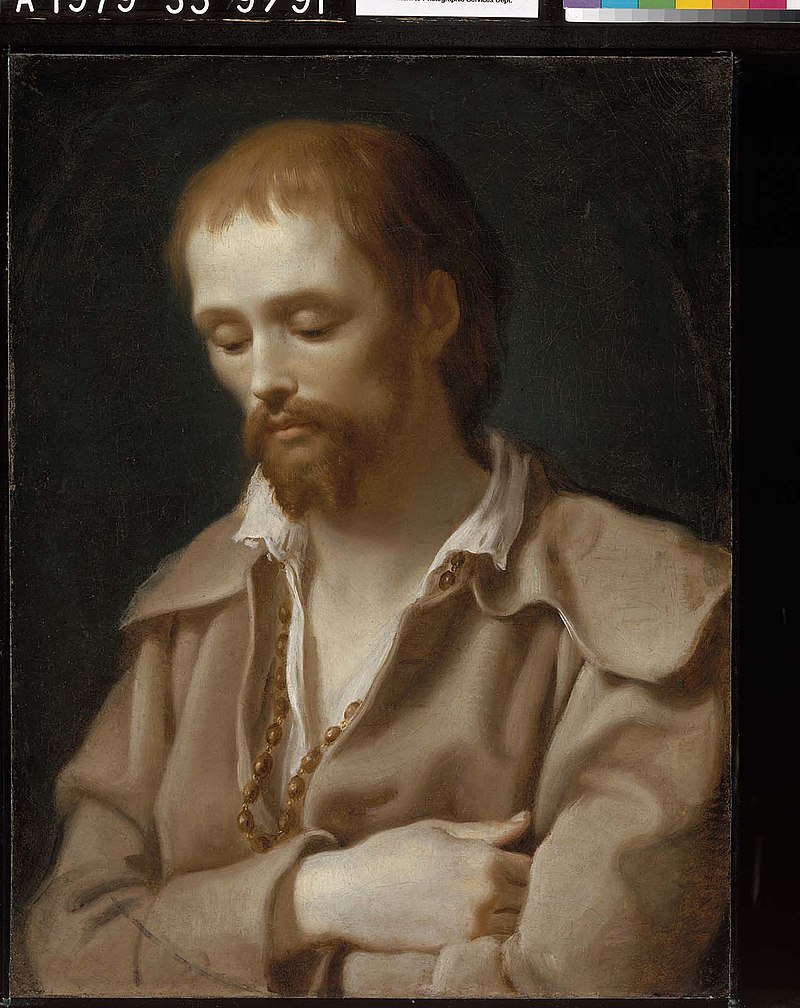
A grace-filled Holy Week to all our readers! As we await and prepare for the Resurrection about to dawn upon us, we might keep in mind two Benedicts: Pope Emeritus Benedict XVI, requiescat in pace, elected on this day in 2005; and today’s commemoration of the mystic pilgrim, Benedict Joseph Labre, who died on this[…]Continue reading→

My Name is Bernadette
April 16th is a propitious day, for besides the anniversary of Father de Valk’s death, who founded Catholic Insight in its print form decades ago, and the commemoration of the ‘two Benedicts’, mentioned in accompanying posts, today we also recall Saint Bernadette Soubirous, the young visionary to whom the Virgin Mary appeared numerous times at[…]Continue reading→
Saint Lydwina of Schiedam and Suffering Joyfully
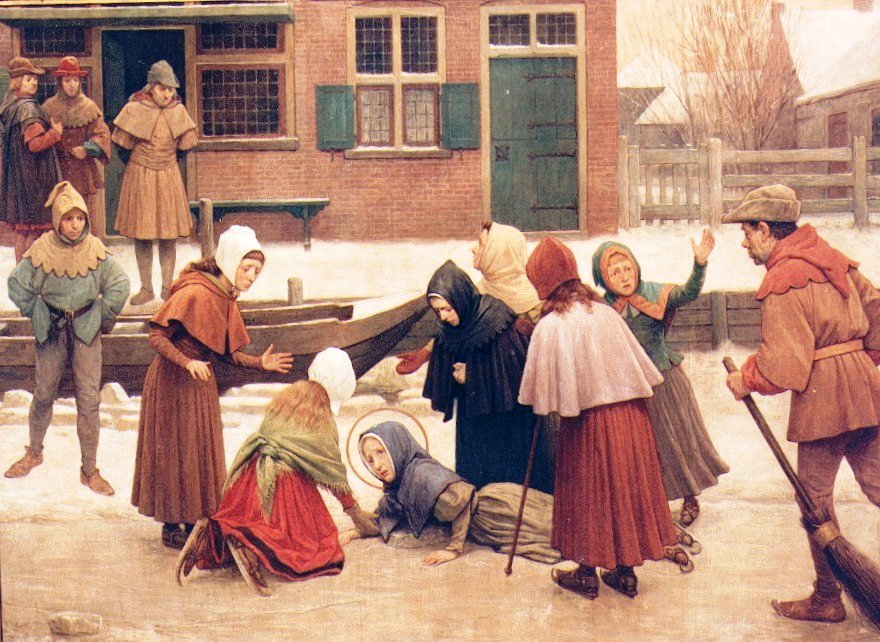
Saint Lydwina of Schiedam (1380 – 1433) was one of the countless and glorious ‘victim souls’ in the history of the Church, those whose lives are filled with suffering, often of an unimaginable intensity, but who suffer joyfully. She was a fifteen-year old Dutch girl, out skating one day, when she fell and broke one[…]Continue reading→
The Glorious Martyrdoms of Martin and Maximus
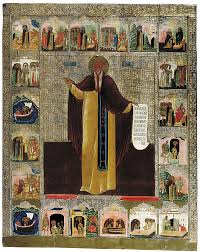
As we enter into Eastertide, we recall on this 13th of April Pope Saint Martin I (+655), one of the noblest, if most tragic, of the successors of Saint Peter. Born in Umbria, Italy, he was of noble lineage, with great intelligence combined with charity and love of the poor and the Church. While still[…]Continue reading→

Divine Mercy Sunday – An Echo of Every Mass
Reach out your hand and put it in my side. Do not doubt but believe’… ‘My Lord and my God!’ (Jn. 20:18)). Today is Divine Mercy Sunday, and as we celebrate the end of the Easter Octave, we contemplate the wounded side of our Saviour, the Church’s source of life. On Good Friday in the[…]Continue reading→

Saint Stanislaus of Szczepanów
We celebrate Saint Stanislaus today (+ April 11, 1079), in light of this Easter Octave, a bishop and martyr who accepted the episcopacy only at the direct order of Pope Alexander II. He proved a wise and courageous leader of his flock, put to death by his own king, Boleslaus, for rebuking the monarch’s ‘immoral[…]Continue reading→
Saint Gemma Galgani
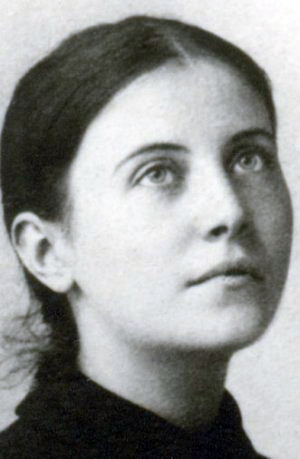
On this April 11th, in 1903 – the same year that the Italian Guiseppe Sarto was elected Pope later that summer as Pius X – a lovely, young Italian woman died, by the name of Gemma Galgani. She lived a brief life of 24 years, as did a number of other young saints, including Pier[…]Continue reading→