
Laughter and Weeping, Riches and Wealth
Occasionally, in hearing confessions, I encounter a penitent who has been away from the sacraments for a number of years. When it comes time to assign a penance, I pause, for “Say ten Hail Mary’s” seems to trivialize the significance of someone’s being reconciled to God and to the Church after so long a time. Instead, then, I ask him to read one of the Gospels in its entirety, not all at once, but reflectively, over the next week or two. And invariably, I assign the Gospel of Luke. And why? because it combines what C.S. Lewis termed an “irresistible tenderness” with an “intolerable severity.”[1] What could be more comforting to a repentant sinner than the parables of the prodigal son and the good Samaritan? For he can identify with the prodigal son—in that he, as a sinner, has abused and wasted his inheritance—and with the man who had fallen among thieves—for he has experienced the care of Jesus, the good Samaritan. But, granted all this, what shall we make of Jesus’s severity, condemnations, really, a sample of which we have just now heard: “Woe to you who are rich, . . . woe to you who are full now, . . . woe to you who are laughing now, for you will mourn and weep”?[2]
In what time I have, I would like to explore the first of the blessings—“Blessed are you who are poor”—and its parallel in the first of the woes—“Woe to you who are rich.” Strange as it may seem in our materialistic age, the Bible is replete with favourable references to poverty and the poor. In the Old Testament, God’s concern for the poor is found in the many references to widows and orphans: “Leave your fatherless children; I [the Lord] will keep them alive; and let your widows trust in me.”[3] Why this should be so is clear once one notes that a widow or an orphan was not a member of a family. In the tribal society of ancient Israel, their condition left them without social status or even means of livelihood, as we see in the book of Ruth when she was reduced to gleaning in the fields of Boaz to feed herself and her mother-in-law, Naomi. As a result, the worth of society in God’s eyes was determined by its treatment of its most needy members, of which widows and orphans were paradigmatic. A similarly disadvantaged person was the barren wife, who by her plight attracted the compassion of God. Such a woman is presented as the ideal recipient of God’s loving intervention: Sarah, who bore Isaac the son of the promise; Rachel, the mother of Joseph; Hannah, whose son was Samuel. In her paean of praise after his birth Hannah proclaimed, “He raises the poor from the dust . . . and makes them sit with princes,”[4] a sentiment echoed by Our Lady in her Magnificat: “He has exalted those of low degree, . . .but the rich he has sent empty away.”[5] What quality of these various outcasts makes them admirable and models for us even today? It was their utter reliance on God as their only helper. Furthermore, by this trust, they encapsulated the destiny of the whole nation, for the people, too, learned that God alone could restore the fortunes of Israel that had suffered one crushing defeat after another under her human leaders: “Give us help from trouble [Lord], for vain is the help of man.”[6]
The startling and literal accomplishment of these expectations is found in the person of Jesus, the Word Incarnate, who confirmed and extended the call to place all our trust in God alone. The poverty of Jesus, who had nowhere to lay his head, was, it seems, the necessary means for him to accomplish the great work of man’s salvation, for it was to no human agency that Jesus turned. He spoke and he worked wonders, but never once used money, prestige or power—much less violence—in his ministry. His poverty was perfect when he hung naked on the cross, the greatest moment in human history. Saint Paul gloried in this fact: “[I preached] nothing among you but Jesus Christ, and him crucified,”[7] for “though he was rich, for your sake he became poor, so that by his poverty you might become rich.”[8] The root and flower of his salvific work are located in his total dependence on his heavenly Father, a dependence in which we as his disciples are summoned to share: “This is eternal life, that they may know thee, the only true God, and Jesus Christ whom you have sent.”[9]
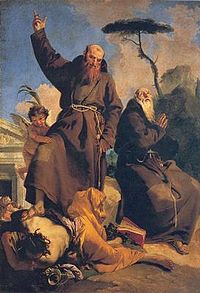
Christians down the centuries have in a variety of ways imitated Jesus’s subservience to the will of his Father. On entry into a monastery, for instance, a would-be monk or nun surrendered everything, even his name, in order to anticipate, by a life of prayer, the very mode of existence in heaven, when “God will be all in all.”[10] Christian fascination with Jesus’s poverty reached its climax in Saint Francis of Assisi, who not only put aside worldly allurements, but actually embraced destitution and want. He remains a popular saint; I often wonder why, given the austerity of his way life and that of his immediate followers, such as Saint Clare.
What, one may ask, have such extravagant notions to do with us? To begin with, they should make us uneasy, for by any standard we are well off and thus to be classified among those to whom Jesus said, “Woe to you who are rich.” For the fact is that everyone here has clothing, shelter and food, with means of hygiene and physical comfort that would have made people of bygone ages green with envy, with their frigid palaces, unwashed bodies and inadequate diet. What, then, are we to do? Is there no way out for us? There is, on condition that we discover what money is for. Simply this: money is to be spent, as anyone can see who recalls the pitiful existence of Scrooge, who had accumulated a fortune that brought him no pleasure, physical or moral. The woeful target of Jesus’s remark is the man who spends his fortune on himself, which, when you think about it, is as bad as the miser who hoards it for himself. On the other hand, imagine a pair of devoted parents who spend their money, and themselves, in love for their children. Money is incidental to their real wealth, which is the mutual affection that obtains in a well-ordered family. Money, and all our possessions, for that matter, are given to us in trust, to be dispersed as quickly and effectively as possible; and a trustee even of great wealth will not be the target of Jesus’s stricture, “Woe to you rich.”
Money proverbially represents power: “Time is money”; “Money talks”; “Every man has his price.” Saint James describes a scene that has been repeated over and over again. A rich man—or woman—appears and is smothered with attention, all in the hope of squeezing a few shekels out of him. But to a poor man we are tempted to say, as James has it, “‘Stand there’ or ‘Sit at my feet.’”[11] Back when I was in a parish, it pleased me when a beggar rang the bell and and was conducted to my office. I gave him my time and full attention freely, even though I knew that nine times out of ten he would finish by expressing a desperate need for ten or twenty dollars. Very occasionally, I gave him the cash, but usually he went away satisfied with a sandwich and a bus token. The notion that money and other things that we own are not really ours, but held in trust for the Lord, should eliminate that seemingly irresistible tendency to think that the adulation a fortune excites is directed to our personal worth and not to what we possess.
Thomas Merton, I believe it was, said that the saddest words in the New Testament are those Jesus address to the rich as we find them in the Gospel: “You have received your consolation.” God is just, and every good deed will receive its recompense, including an occasional act of generosity by a rich man. But on judgment day we shall recognize how meagre this temporal reward was when we hear Jesus say to the poor—including, as Saint Matthew says, the poor in spirit—“Come, O blessed of my Father; receive the kingdom prepared for you from the foundation of the world,”[12] while the rich will have to be satisfied with the fading memory of those pallid consolations they had received during their lifetime.
[1] C.S. Lewis, “Fern Seeds and Elephants,” available at http://orthodox-web.tripod.com/papers/fern_seed.html; accessed 16 February 2019.
[2] Lk 6.24-25. Cf. 11.44: “Woe to you [Pharisees]! for you are like graves which are not seen, and men walk over them without knowing it.”
[3] Jer 49.11. Cf. Is 41.17: “The poor and needy search for water, but there is none; their tongues are parched with thirst. But I the Lord will answer them; I, the God of Israel, will not forsake them.”
[4] 1 Sam 2.8.
[5] Lk 1.52-53.
[6] Ps 107/108.12.
[7] 1 Cor 2.1-2.
[8] 2 Cor 8.9.
[9] Jn 1.3.
[10] 1 Cor 15.28.
[11] Jas 2.3.
[12] Matt 25.34.

Saint Kateri , Canada’s Protectress
This was the title given to Saint Kateri Tekakwitha, by Pope Benedict XVI, when he canonized her on October 28th, 2012, along with six others, in Saint Peter’ Square (she had been beatified by Pope John Paul II back in 1980). With Saint Joseph as our protector, along with the Canadian martyrs, we seem to[…]Continue reading→

Remembering Father Alphonse de Valk
(Today marks the sixth anniversary of the death of Father Alphonse de Valk, C.S.B., a faithful, courageous and indefatigable Basilian priest, pro-life-and-family apostle, and the founder of Catholic Insight magazine. Here is what we wrote those on his entering into eternity five years ago, as we continue to remember him in our prayers and thoughts)[…]Continue reading→

My Name is Bernadette
April 16th is a propitious day, for besides the anniversary of Father de Valk’s death, who founded Catholic Insight in its print form decades ago, and the commemoration of the ‘two Benedicts’, mentioned in accompanying posts, today we also recall Saint Bernadette Soubirous, the young visionary to whom the Virgin Mary appeared numerous times at[…]Continue reading→
Canonizing Sister Faustina and Divine Mercy
HOMILY OF THE HOLY FATHER MASS IN ST PETER’S SQUARE FOR THE CANONIZATION OF SR MARY FAUSTINA KOWALSKA Sunday, 30 April 2000 1. “Confitemini Domino quoniam bonus, quoniam in saeculum misericordia eius”; “Give thanks to the Lord for he is good; his steadfast love endures for ever” (Ps 118: 1). So the Church sings on the Octave of[…]Continue reading→

Divine Mercy Sunday – An Echo of Every Mass
Reach out your hand and put it in my side. Do not doubt but believe’… ‘My Lord and my God!’ (Jn. 20:18)). Today is Divine Mercy Sunday, and as we celebrate the end of the Easter Octave, we contemplate the wounded side of our Saviour, the Church’s source of life. On Good Friday in the[…]Continue reading→

Saint Stanislaus of Szczepanów
We celebrate Saint Stanislaus today (+ April 11, 1079), in light of this Easter Octave, a bishop and martyr who accepted the episcopacy only at the direct order of Pope Alexander II. He proved a wise and courageous leader of his flock, put to death by his own king, Boleslaus, for rebuking the monarch’s ‘immoral[…]Continue reading→
First Holy Communion: Sermon from May 16, 1943
Here is a sermon from the good old days by +Rev. Msgr. Vincent Nicholas Foy (August 14, 1915 – March 13, 2017), from 1943. Readers may recall that Pope Saint Pius X, by the decree Quam Singulari in 1910, lowered the customary age of reception of Holy Communion – after the rigours of the plague[…]Continue reading→

In the Glorious Light of Easter, Alleluia!
Set your minds on things that are above, not on things that are on earth, for you have died, and your life is hidden with Christ in God. When Christ who is your life is revealed, then you also will be revealed with him in glory (Col. 3:3-4). The Resurrection of Our Lord and Saviour[…]Continue reading→

An Ancient Homily for Holy Saturday
The time between Good Friday and Easter Sunday is one of waiting, in silence, as the world wonders – anticipates – what will happen, after the death of Christ. We re-live this time each year in the anamnesis of our liturgy, and in turn look forward to the glorious re-creation of all things at the[…]Continue reading→
Europe’s Long Descent
(As we meditate on this day on Christ’s burial, and His descent into hell, it is fitting to ponder here with contributor Peter Marcus how the world seems to be heading there as well. The difference is that, although God cannot ‘redeem’ hell, nor those therein, He can and did redeem the world. There is[…]Continue reading→