
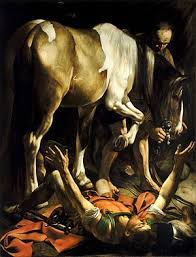
Saint Paul’s Marvelous Metanoia
Metanoia is the original Greek term for ‘conversion’, which opens the Gospel of Saint Mark with Christ’s exhortation: ‘Repent and believe in the Gospel!‘. Literally, a ‘turning around’ of one’s mind and heart from one point of view to another. One may be converted from country music to classical, or, more importantly, and in the most direct meaning of the term, from a more aberrant religion to the one, true Faith. In that process, we undergo an aversio a creatura – a turning away from disordered attachment to created things – and undertake a conversio ad Deum – turning towards the one, true God through the Faith He offers.
We have just moved on from the Christmas season, with the fictional Scrooge ‘turning around’ on a Dickensian Christmas morning, to the heartening, if all-too-little known, stories of ‘Jane Roe’ and Bernard Nathanson, to today’s Saul, zealous persecutor of Christians, falling to the ground – perhaps off a horse, as Caravaggio depicts him, but not mentioned in Scripture – on that road to Damascus, blinded by the light of Christ, realizing then and there that He really was – and is – the Way, the Truth and the Life. The stories of journeys to the Faith – all unique – warm the heart, and provide a bit of a comforting reminder to cradle Catholics that what we believe it all really is true. Sometimes, like a journey there and back again, we have to see familiar things from a different perspective.
Repent and believe in the Gospel: Metanoia. For only in the light of heaven and, for that matter, the potential dark self-enclosure of hell, does this transient existence make any sense at all. And it is that light that burst upon the zealous Pharisee, transforming the egotistic Saul into the humble Paul, the ‘little one’, the least amongst the Apostles, but who, by grace, did immeasurable work for God and His kingdom.
Faith, in a definition by Thomas Aquinas adopted by the Catechism (#155), is an act of the intellect, assenting to the Divine truth, by command of the will moved by God through grace. Faith is both a gift – a grace from God on high, evident in the Damascus story of Saint Paul. But this also includes our response to that grace, with the once proud and arrogant Paul’s humble response, what would you have me do, O Lord?
After we make this ‘assent of our intellect’, we must continue to do so daily, moment by moment, commanded by our own will, even when the Faith seems darkest, as we see the will of God manifest in all the providential occurrences impinging upon us. Every decision is really its own ‘Damascus’ moment, whereby we respond to that grace of God flowing forth from His throne on high, leading all souls to heaven, if we must offer that fiat, ‘let it be done to me according to Thy will’.
Saint John Chrysostom in today’s Office:
Each day he aimed ever higher; each day he rose up with greater ardour and faced with new eagerness the dangers that threatened him. He summed up his attitude in the words: I forget what is behind me and push on to what lies ahead.
This is not always easy, and as the now Risen Christ was to say of his servant Paul, I will show him how much he must suffer for my name. But for all that, God is also a God of consolation, fully manifest at the end, in that heavenly glory, where no eye has seen, nor ear heard, the things which God has prepared for those that love Him.
As Pope Benedict XVI clarifies in his own meditation, Saint Paul’s metanoia was more than a one-time ‘conversion’, which is really just the beginning:
This turning point in his life, this transformation of his whole being was not the fruit of a psychological process, of a maturation or intellectual and moral development. Rather it came from the outside: it was not the fruit of his thought but of his encounter with Jesus Christ. In this sense it was not simply a conversion, a development of his “ego”, but rather a death and a resurrection for Paul himself. One existence died and another, new one was born with the Risen Christ.
We cannot love nor live well without the intellectual structure of our Faith, without which love becomes an emotionalist sentimentalism, capable of great evil. But at the same time faith without love – without willing God’s will and the true good of our neighbour, all those ‘works’ of which James speaks – is itself but sterile intellectualism. We must ally faith with love, and this love must endure unto the end, like Paul, poured out as a libation, a sacrifice offered to God. Only so will we find true joy, and true fulfilment.
A blessed feast to one and all.

Carney’s Amoral Majority
After five defections – euphemistically described as ‘crossing the floor’ – and three by-elections, Mark Carney and his Liberals how have their coveted majority. One wonders what bowls of pottage were offered in back-room deals. In the archaic monarchical system that is the Dominion of Canada, this majority allows the newly-minted Prime Minister to rule[…]Continue reading→

Saint Kateri , Canada’s Protectress
This was the title given to Saint Kateri Tekakwitha, by Pope Benedict XVI, when he canonized her on October 28th, 2012, along with six others, in Saint Peter’ Square (she had been beatified by Pope John Paul II back in 1980). With Saint Joseph as our protector, along with the Canadian martyrs, we seem to[…]Continue reading→

A Tale of Two Benedicts
A grace-filled Holy Week to all our readers! As we await and prepare for the Resurrection about to dawn upon us, we might keep in mind two Benedicts: Pope Emeritus Benedict XVI, requiescat in pace, elected on this day in 2005; and today’s commemoration of the mystic pilgrim, Benedict Joseph Labre, who died on this[…]Continue reading→

My Name is Bernadette
April 16th is a propitious day, for besides the anniversary of Father de Valk’s death, who founded Catholic Insight in its print form decades ago, and the commemoration of the ‘two Benedicts’, mentioned in accompanying posts, today we also recall Saint Bernadette Soubirous, the young visionary to whom the Virgin Mary appeared numerous times at[…]Continue reading→

Saint Lydwina of Schiedam and Suffering Joyfully
Saint Lydwina of Schiedam (1380 – 1433) was one of the countless and glorious ‘victim souls’ in the history of the Church, those whose lives are filled with suffering, often of an unimaginable intensity, but who suffer joyfully. She was a fifteen-year old Dutch girl, out skating one day, when she fell and broke one[…]Continue reading→

The Glorious Martyrdoms of Martin and Maximus
As we enter into Eastertide, we recall on this 13th of April Pope Saint Martin I (+655), one of the noblest, if most tragic, of the successors of Saint Peter. Born in Umbria, Italy, he was of noble lineage, with great intelligence combined with charity and love of the poor and the Church. While still[…]Continue reading→

Canonizing Sister Faustina and Divine Mercy
HOMILY OF THE HOLY FATHER MASS IN ST PETER’S SQUARE FOR THE CANONIZATION OF SR MARY FAUSTINA KOWALSKA Sunday, 30 April 2000 1. “Confitemini Domino quoniam bonus, quoniam in saeculum misericordia eius”; “Give thanks to the Lord for he is good; his steadfast love endures for ever” (Ps 118: 1). So the Church sings on the Octave of[…]Continue reading→

Saint Stanislaus of Szczepanów
We celebrate Saint Stanislaus today (+ April 11, 1079), in light of this Easter Octave, a bishop and martyr who accepted the episcopacy only at the direct order of Pope Alexander II. He proved a wise and courageous leader of his flock, put to death by his own king, Boleslaus, for rebuking the monarch’s ‘immoral[…]Continue reading→

Saint Gemma Galgani
On this April 11th, in 1903 – the same year that the Italian Guiseppe Sarto was elected Pope later that summer as Pius X – a lovely, young Italian woman died, by the name of Gemma Galgani. She lived a brief life of 24 years, as did a number of other young saints, including Pier[…]Continue reading→
An Ideological and Improper Translation
I noticed something odd with the psalm reading at Mass the other day. Our bishops’ conference here in Canada has decreed that the Mass in English – Novus Ordo – use the ‘NRSV’, the ‘New Revised Standard Version’, an ‘updated’ translation of the original RSV, first published in 1952. This ‘new translation’ has the tendency[…]Continue reading→