
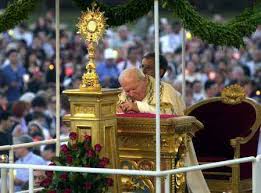
Corpus Christ: A Feast for the Ages
A blessed and grace-filled solemnity of Corpus Christi to one and all, a feast that has a long and varied history dating back to the early Middle Ages, with Saint Juliana of Liege (+1258), who, based on private revelations from God, advocated for a day outside of Lent (for on Holy Thursday, we also commemorate the Eucharist, in its inauguration at the Last Super) to celebrate devotion to this Sacrament of Sacraments, the source and summit of the Christian life, as our faith has it. A fruitful read is Pope John Paul II’s 1996 meditation on this feast on the 750th anniversary of its inauguration.
It is not as though the Church began ‘believing’ in the Eucharist in the 12th century, as any perusal of the early Fathers of the Church will evince, to say nothing of the sixth chapter of the Gospel of Saint John chapter 6, and the Bread of Life discourse. We have always believed that Christ, the Word made flesh, has left us his very ‘body, blood, soul and divinity’ present under the species, that is, the appearance or accidents, of simple bread and wine. It was Saint Thomas Aquinas who described with unsurpassed clarity the metaphysical reality of the ‘Real Presence’, that the Second Person of the Trinity, Who presented Himself to us in true human nature, now continues to ‘present’ Himself to us in the Eucharist. Behind the veil of the accidents of bread and wine, there is present the substance, the reality, of Christ, which we adore, and whom we receive in Holy Communion. As the Church teaches, unlike regular food, which we turn into our substance, by consuming the Host, we are transformed, if you will, into His divine Being.
Hence, the necessity of receiving the Eucharist, weekly, even daily as possible and as we are able. Also, the necessity of accompanying worship, adoration and prayer before the Real Presence, which I sort of think of like divine ‘radiation’ that energizes and spiritualizes us, even just by being quiet before God.
Just prior to the establishment of the universal Solemnity of Corpus Christi on the Thursday after Pentecost by Pope Urban IV, Thomas Aquinas had been deputed to write the divine office the feast, and the theologian-philosopher demonstrated himself to be also a poet of divine inspiration. The Dominican retreated to the cathedral at Orvieto, a town that stands on top of a cliff, about an hour’s drive north of Rome, accessible by gondola. It was there sometime between 1259 and 1265 that Thomas wrote the words to the now ubiquitous Pange Lingua and the Verbum Supernum (the last two verses of each are the Tantum Ergo and the O Salutaris, respectively), along with other prayers and hymns still sung throughout the Church (although not nearly as often as they should).
There are, of course, an untold other number of hymns, motets, prayers, litanies, all praising God present in the Holy Eucharist, by which we lift up our own minds and hearts, and solidify our faith in this most august of mysteries, unproveable by science, hidden from the eyes of this world, but all the more perfect a sign and sacrament for being so.
As Thomas wrote in Adoro te devote:
Visus, tactus, gustus in te fallitur,
Sed auditu solo tuto creditur.
Credo quidquid dixit Dei Filius;
Nil hoc verbo veritátis verius.
Which we might roughly translate:
Sight, touch and taste are fallible in you, but is believed only by hearing alone; I believe whatever the Son of God has spoken; there is nothing more true than this word
That last line is in one version rendered as: ‘Truth Himself speaks truly, or there’s nothing true‘ which, although a little less faithful to the original Latin, rings true. We believe, for, as said Saint Peter so truly, where else do we go, O Lord?
Amen.

Carney’s Amoral Majority
After five defections – euphemistically described as ‘crossing the floor’ – and three by-elections, Mark Carney and his Liberals how have their coveted majority. One wonders what bowls of pottage were offered in back-room deals. In the archaic monarchical system that is the Dominion of Canada, this majority allows the newly-minted Prime Minister to rule[…]Continue reading→

Saint Kateri , Canada’s Protectress
This was the title given to Saint Kateri Tekakwitha, by Pope Benedict XVI, when he canonized her on October 28th, 2012, along with six others, in Saint Peter’ Square (she had been beatified by Pope John Paul II back in 1980). With Saint Joseph as our protector, along with the Canadian martyrs, we seem to[…]Continue reading→
A Closed, Unsustainable, Descending Loop
As a follow-up to my thoughts on Payette’s payout, here be a stark image of where are here in Canada. As the graph shows in, well, graphic terms, since 2025, the public sector has contributed to 95.5% of economic growth. The private sector – which funds the public sector, or is supposed to – has[…]Continue reading→

Remembering Father Alphonse de Valk
(Today marks the sixth anniversary of the death of Father Alphonse de Valk, C.S.B., a faithful, courageous and indefatigable Basilian priest, pro-life-and-family apostle, and the founder of Catholic Insight magazine. Here is what we wrote those on his entering into eternity five years ago, as we continue to remember him in our prayers and thoughts)[…]Continue reading→

A Tale of Two Benedicts
A grace-filled Holy Week to all our readers! As we await and prepare for the Resurrection about to dawn upon us, we might keep in mind two Benedicts: Pope Emeritus Benedict XVI, requiescat in pace, elected on this day in 2005; and today’s commemoration of the mystic pilgrim, Benedict Joseph Labre, who died on this[…]Continue reading→

My Name is Bernadette
April 16th is a propitious day, for besides the anniversary of Father de Valk’s death, who founded Catholic Insight in its print form decades ago, and the commemoration of the ‘two Benedicts’, mentioned in accompanying posts, today we also recall Saint Bernadette Soubirous, the young visionary to whom the Virgin Mary appeared numerous times at[…]Continue reading→

Saint Lydwina of Schiedam and Suffering Joyfully
Saint Lydwina of Schiedam (1380 – 1433) was one of the countless and glorious ‘victim souls’ in the history of the Church, those whose lives are filled with suffering, often of an unimaginable intensity, but who suffer joyfully. She was a fifteen-year old Dutch girl, out skating one day, when she fell and broke one[…]Continue reading→

The Glorious Martyrdoms of Martin and Maximus
As we enter into Eastertide, we recall on this 13th of April Pope Saint Martin I (+655), one of the noblest, if most tragic, of the successors of Saint Peter. Born in Umbria, Italy, he was of noble lineage, with great intelligence combined with charity and love of the poor and the Church. While still[…]Continue reading→

Divine Mercy Sunday – An Echo of Every Mass
Reach out your hand and put it in my side. Do not doubt but believe’… ‘My Lord and my God!’ (Jn. 20:18)). Today is Divine Mercy Sunday, and as we celebrate the end of the Easter Octave, we contemplate the wounded side of our Saviour, the Church’s source of life. On Good Friday in the[…]Continue reading→
Pope Leo and a Rosary for Peace
Pope Leo XIV has asked Catholics across the world to join him in a Rosary for peace today, at 18:00 Rome time (6 pm), which would be noon from where I write (EST). If you are able, whether at that time or another, and in whatever way you pray, to join in intercession with the[…]Continue reading→