
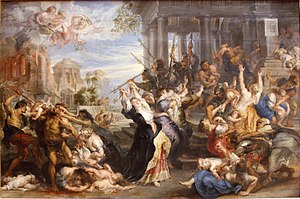
The Hope of the Holy Innocents
The feast of the Holy Innocents, which we celebrate appropriately enough within the octave of Christmas, might seem a troubling commemoration at first glance. Remembering the wholesale slaughter of all the male children two years and under, in and around Bethlehem? Why would God permit such a sacrifice? Yet this feast signifies certain theological principles of which the Church does good to remind us.
The story is recounted by Saint Matthew at the beginning of his Gospel, when the Magi returned to their country ‘by another route’, to avoid revealing to Herod the identity and location of the Messiah, whom he wanted to destroy as a rival to his kingship. Herod, realizing he had been deceived, in his rage decided to have every male child under two years old in Bethlehem killed, just to be on the safe side. One sees an echo of this in the original Terminator film, when the Arnold-android-assassin goes back in time to kill the mother of the future hero, John Connor, who would go on to defeat him and the rest of the ‘machines’. Not knowing who the ‘real’ Sarah Connor was, the implacable terminating assassin decides to kill all the ‘Sarah Connors’ in the Los Angeles phonebook, one by one…
Sci-fi buffs of a certain age may recall that the Terminator was not successful, and neither was Herod, for Joseph was warned in a dream to take the child and His mother to Egypt, until after the death of heinous Herod.
What may puzzle, even scandalize, our secular minds is that the children had to suffer in the place of the Christ child, whose own far greater suffering lay three decades in the future.
Yet it was this vicarious suffering which made these Jewish innocents, martyrs. To be given that title, one must suffer in odium fidei, ‘in hatred of the faith’, which suffices in this case, with Herod’s hatred of the Christ whom he knew not. Every murder of a martyr is an attempt to suppress the truth, and quell the troubled conscience of a tyrant.
These Holy Innocents were not old enough to know this, and knew not, this side of their brief earthly lives, why they were being killed. Nor were they ‘Christians’ in any canonical sense of that term. They were not baptised, except by the blood of their offering, and the mark of their circumcision, which gave them a share in God’s covenant. Yet in heaven they are, now enjoying the beatific vision; we know not how many. Some exegetes say twenty; others, hundreds. (Some revisionists even deny their existence, with the whole story a myth, but that, dear reader, is a modernist heresy, for the Church has always taught that the Gospel stories convey the real historical truth).
What these Innocents also teach, without words, is that salvation is a gratuitous gift, one that God wills for all men. Although we do merit eternity congruently – that is, in some proportionate way – by our good works, we should keep in mind that even this ‘merit’ itself is itself a gift, and it is Christ Who pays almost all of the ‘price’ of our redemption. Beatitude far exceeds anything we can do, and is not something earned in strict justice, with the proviso that we who are of the age of reason must use what talents we are given well, and do nothing to block or obviate this gift by a grave and mortal sin, either of commission or even of omission (recall the rather sobering parable of the sheep and goats Matthew recounts towards the end of his Gospel).
As such, these youngest of saints also give us hope for the salvation of all those who shuffle off this mortal coil before the age of reason, and before they can make a moral choice. Such was the opinion of the International Theological Commission, an advisory body to the Magisterium, which in 2007 discussed the fate of unbaptized infants, ending on a note that we may indeed hope and trust in their salvation by ways known only to God, Who is not bound by His sacraments.
This is a necessary query, for we now have millions upon millions of children snuffed out by abortion – surgical, but, more so, the untold hidden numbers of chemical abortions in early pregnancy. Pope Saint John Paul II offers his thoughts on this tragedy in his 1995 encyclical Evangelium Vitae, writing to mothers who have had their children aborted, that after asking forgiveness of the Father through the ministry of the Church in the sacrament of Confession, “to the same Father and his mercy you can with sure hope entrust your child” (par. 99). (This is corroborated by the vision given to the abortionist Stojan Adasevic, who saw in his ‘dream’ Saint Thomas Aquinas in heaven, surrounded by all the children he had killed. Needless to say, Dr. Adasevic converted, and became an ardent pro-lifer).
We should not mitigate the pain in the death of the very young, which is a suffering, a deep privation, and, in the case of deliberate abortion and infanticide, a grave moral evil. God will demand an account of us all, for what we have done to His ‘little ones’. We should pray and repent for an end to the culture of death in all its forms. But the same God brings the greatest good out of even the greatest evil and suffering, for from the darkness, light shines forth.
So rejoice and be merrie this day in this festive season with these heavenly Holy Innocents, as we hope in the salvation of all infants, babies, children who have gone to the Father. It is we, grown old in our various sins and bad habits, who must regain and maintain some of their innocence. For as Someone once said, unless we become like children, we shall not inherit the kingdom of God. (Mt. 18:3)
And may all those children intercede for us. +

Carney’s Amoral Majority
After five defections – euphemistically described as ‘crossing the floor’ – and three by-elections, Mark Carney and his Liberals how have their coveted majority. One wonders what bowls of pottage were offered in back-room deals. In the archaic monarchical system that is the Dominion of Canada, this majority allows the newly-minted Prime Minister to rule[…]Continue reading→

Saint Kateri , Canada’s Protectress
This was the title given to Saint Kateri Tekakwitha, by Pope Benedict XVI, when he canonized her on October 28th, 2012, along with six others, in Saint Peter’ Square (she had been beatified by Pope John Paul II back in 1980). With Saint Joseph as our protector, along with the Canadian martyrs, we seem to[…]Continue reading→

Remembering Father Alphonse de Valk
(Today marks the sixth anniversary of the death of Father Alphonse de Valk, C.S.B., a faithful, courageous and indefatigable Basilian priest, pro-life-and-family apostle, and the founder of Catholic Insight magazine. Here is what we wrote those on his entering into eternity five years ago, as we continue to remember him in our prayers and thoughts)[…]Continue reading→

A Tale of Two Benedicts
A grace-filled Holy Week to all our readers! As we await and prepare for the Resurrection about to dawn upon us, we might keep in mind two Benedicts: Pope Emeritus Benedict XVI, requiescat in pace, elected on this day in 2005; and today’s commemoration of the mystic pilgrim, Benedict Joseph Labre, who died on this[…]Continue reading→

My Name is Bernadette
April 16th is a propitious day, for besides the anniversary of Father de Valk’s death, who founded Catholic Insight in its print form decades ago, and the commemoration of the ‘two Benedicts’, mentioned in accompanying posts, today we also recall Saint Bernadette Soubirous, the young visionary to whom the Virgin Mary appeared numerous times at[…]Continue reading→

Saint Lydwina of Schiedam and Suffering Joyfully
Saint Lydwina of Schiedam (1380 – 1433) was one of the countless and glorious ‘victim souls’ in the history of the Church, those whose lives are filled with suffering, often of an unimaginable intensity, but who suffer joyfully. She was a fifteen-year old Dutch girl, out skating one day, when she fell and broke one[…]Continue reading→

The Glorious Martyrdoms of Martin and Maximus
As we enter into Eastertide, we recall on this 13th of April Pope Saint Martin I (+655), one of the noblest, if most tragic, of the successors of Saint Peter. Born in Umbria, Italy, he was of noble lineage, with great intelligence combined with charity and love of the poor and the Church. While still[…]Continue reading→

Canonizing Sister Faustina and Divine Mercy
HOMILY OF THE HOLY FATHER MASS IN ST PETER’S SQUARE FOR THE CANONIZATION OF SR MARY FAUSTINA KOWALSKA Sunday, 30 April 2000 1. “Confitemini Domino quoniam bonus, quoniam in saeculum misericordia eius”; “Give thanks to the Lord for he is good; his steadfast love endures for ever” (Ps 118: 1). So the Church sings on the Octave of[…]Continue reading→

Divine Mercy Sunday – An Echo of Every Mass
Reach out your hand and put it in my side. Do not doubt but believe’… ‘My Lord and my God!’ (Jn. 20:18)). Today is Divine Mercy Sunday, and as we celebrate the end of the Easter Octave, we contemplate the wounded side of our Saviour, the Church’s source of life. On Good Friday in the[…]Continue reading→

Saint Gemma Galgani
On this April 11th, in 1903 – the same year that the Italian Guiseppe Sarto was elected Pope later that summer as Pius X – a lovely, young Italian woman died, by the name of Gemma Galgani. She lived a brief life of 24 years, as did a number of other young saints, including Pier[…]Continue reading→