
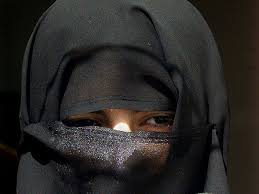
The Faceless Niqab
The recent ban in the province of Quebec on the niqab, the Islamic face-covering, when receiving ‘public services’ (reserved, of course, only for females) has raised a number of questions. Is the State interfering in religious freedom? Should Muslims, and Muslim women in particular, have the right to cover their face? (The underlying and, for various reasons, unspoken question is whether Muslim men are coercing their women to wear the face covering, and whether they have the right to do so).
Trudeau and his Liberal mannequins are dutifully touting the notion of ‘religious freedom’, as though this mantra solved all difficulties. Au contraire: In a multicultural and pluralistic society such as Canada, the whole notion of ‘religious freedom’, its scope and limits, is in reality a rather complex topic, filled with nuances and distinctions, requiring deep thought, prudence, counsel, experience, a wide reading, and most definitely not the emotive, knee-jerk complaisant reactions too often seen in our purported elites.
The State does have the right, and often the duty, to moderate, even restrict, things done in the name of ‘religion’, however broadly defined. The general principle offered in Dignitatis Humanae, the Vatican II declaration on religious freedom, is that people should in general be left free from coercion by the State (something I heartily endorse), unless, and here is the rub, their practices violate ‘just public order‘.
What this means is that we give to others what we ‘owe’ them, as the Latin term ‘ius‘ implies, at the very least those things without which ‘public order’ cannot be preserved. We cannot withhold our taxes, nor walk around el fresco, nor cast various victims into the caldera of volcanoes, because our religions tells us so.
These seem obvious. But there are many intermediate cases that require some thought. Can a blood transfusion be forced upon a Jehova’s Witness, or indeed any apparently ‘immoral’ treatment given to an unwilling patient, to save their life? Should children be taught the principles of jihad, that all people should and must eventually submit to Islam? Can a mosque be built next door to a Catholic church? Might an imam be permitted to preach in public schools, as I recently read is now done?
Before we drift off topic, back to the question before us, which is whether ‘just public order’ can be preserved if a certain segment of the population is determined to permanently hide their faces in public?
The answer is, of course, no. People are and should be free to hide their faces, don a mask, wear a scarf, wrap a bandana, or cake oneself with Hallowe’en make-up, as they see fit, at least on their own private property and various other locales.
However, in those cases wherein one’s identity must be known, as in getting a driver’s licence, or using a transit pass, or entering a controlled area, like a bank or hospital or the parliament building itself, then one’s face must be shown. Ponder: Although I don’t look particularly like a woman (although I suppose some women might look like me) what’s to stop people from impersonating others? Even that very verb, impersonate: For the face is the key aspect of our identity, our personhood, the primary visible thing that shows forth who we are. Permanently hiding that identifying characteristic, with its concomitant anonymity, order, whether public or even private, cannot be preserved.
Yet already in its very infancy the law is being eviscerated: Just yesterday, the Quebec Justice Minister decided that transit officers, that is, bus drivers, will not be asked to enforce the law, requiring niqabbed women to reveal their faces, and in turn potentially face the Shariac wrath of their husbands, whether immediate or, what is likely worse, delayed. As the union of bus drivers rightly argued, they are not police officers, and I’m not sure even the latter will want to enforce this decree.
What we are facing here, pardon the pun, is the clash of cultures, predicted as inevitable when Islam reaches a certain proportion and power in a once-Christian society, be it Quebec or Belgium or France or Sweden.
I will leave aside for now the deeper implications of the niqab, and whether it is right and fitting for the male segment of a given religion to deny its fairer sex, to paraphrase what the Irish band U2 sang what now seems so long ago, the right to feel the sunlight on their face, and the cool wind in their hair. Even the most strict religious Orders in the Catholic church, back in the pre-Vatican II days of voluminous habits and head coverings, left the faces of such consecrated women uncovered, just so they could pray, converse, walk and talk as free persons.
On that note, the Greek philosophical term, prosopon, which originally meant a ‘face’, was taken up in the early Church’s theological tradition by synecdoche, to mean the person himself.
It would be a sad irony that Quebec’s revolution tranquil, which began on the note of female emancipation from the bogeyman of ‘patriarchy’, should end on the discordant key of this all-too-real subjugation, however ‘voluntary’ it purports to be.
For the face of a woman, and a man for that matter, is that which shows forth their very dignity and beauty as persons, made in God’s image; and it is that same face that will see God’s own face one day. Like the proverbial lamp under a bushel, let it not be hid ’til then.
Carney’s Amoral Majority
After five defections – euphemistically described as ‘crossing the floor’ – and three by-elections, Mark Carney and his Liberals how have their coveted majority. One wonders what bowls of pottage were offered in back-room deals. In the archaic monarchical system that is the Dominion of Canada, this majority allows the newly-minted Prime Minister to rule[…]Continue reading→

Saint Kateri , Canada’s Protectress
This was the title given to Saint Kateri Tekakwitha, by Pope Benedict XVI, when he canonized her on October 28th, 2012, along with six others, in Saint Peter’ Square (she had been beatified by Pope John Paul II back in 1980). With Saint Joseph as our protector, along with the Canadian martyrs, we seem to[…]Continue reading→
A Closed, Unsustainable, Descending Loop
As a follow-up to my thoughts on Payette’s payout, here be a stark image of where are here in Canada. As the graph shows in, well, graphic terms, since 2025, the public sector has contributed to 95.5% of economic growth. The private sector – which funds the public sector, or is supposed to – has[…]Continue reading→

Remembering Father Alphonse de Valk
(Today marks the sixth anniversary of the death of Father Alphonse de Valk, C.S.B., a faithful, courageous and indefatigable Basilian priest, pro-life-and-family apostle, and the founder of Catholic Insight magazine. Here is what we wrote those on his entering into eternity five years ago, as we continue to remember him in our prayers and thoughts)[…]Continue reading→

A Tale of Two Benedicts
A grace-filled Holy Week to all our readers! As we await and prepare for the Resurrection about to dawn upon us, we might keep in mind two Benedicts: Pope Emeritus Benedict XVI, requiescat in pace, elected on this day in 2005; and today’s commemoration of the mystic pilgrim, Benedict Joseph Labre, who died on this[…]Continue reading→

My Name is Bernadette
April 16th is a propitious day, for besides the anniversary of Father de Valk’s death, who founded Catholic Insight in its print form decades ago, and the commemoration of the ‘two Benedicts’, mentioned in accompanying posts, today we also recall Saint Bernadette Soubirous, the young visionary to whom the Virgin Mary appeared numerous times at[…]Continue reading→

Saint Lydwina of Schiedam and Suffering Joyfully
Saint Lydwina of Schiedam (1380 – 1433) was one of the countless and glorious ‘victim souls’ in the history of the Church, those whose lives are filled with suffering, often of an unimaginable intensity, but who suffer joyfully. She was a fifteen-year old Dutch girl, out skating one day, when she fell and broke one[…]Continue reading→

The Glorious Martyrdoms of Martin and Maximus
As we enter into Eastertide, we recall on this 13th of April Pope Saint Martin I (+655), one of the noblest, if most tragic, of the successors of Saint Peter. Born in Umbria, Italy, he was of noble lineage, with great intelligence combined with charity and love of the poor and the Church. While still[…]Continue reading→

Divine Mercy Sunday – An Echo of Every Mass
Reach out your hand and put it in my side. Do not doubt but believe’… ‘My Lord and my God!’ (Jn. 20:18)). Today is Divine Mercy Sunday, and as we celebrate the end of the Easter Octave, we contemplate the wounded side of our Saviour, the Church’s source of life. On Good Friday in the[…]Continue reading→
Pope Leo and a Rosary for Peace
Pope Leo XIV has asked Catholics across the world to join him in a Rosary for peace today, at 18:00 Rome time (6 pm), which would be noon from where I write (EST). If you are able, whether at that time or another, and in whatever way you pray, to join in intercession with the[…]Continue reading→