
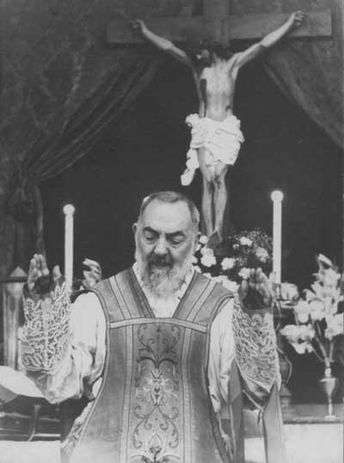
The Miraculous Friar, Pio of Pietrelcina
While we’re on the topic of signs, the life of today’s saint, Padre Pio of Pietrelcina, was filled with them. His long life as a Capuchin friar (he died at 81) ended on this 23rd day of September in 1968, holding his Rosary (rarely ever out of his hands), declaring that he saw ‘two mothers’ (presumably his own, and the Virgin Mary), and, with the name ‘Maria‘, breathed his last.
Francesco Forgione, born on May 25, 1887 to Grazia and Maria – providential names! – knew he wanted to be a Franciscan from five years of age. His own father, a peasant farmer, traveled to the United States to raise enough money for his son’s education, a sacrifice his son never forgot. He joined the Capuchins at the age of 16, taking the name Pio (Pius), by which he would ever after be known.
The life of the Friar was filled with controversy: His ill-health, requiring him to stay at home for long periods of time during his early formation while still a Franciscan; his ecstasies, levitations, and bilocations that defied any regular notion of space and time; the untold number of correspondents; the founding of the hospital near Pietrelcina, where he spent most of his priestly and Franciscan life, which required a controversial (to some) use of funds by the poverty-bound friar; the myriads of pilgrims and those seeking confession (including a young Father Karol Wojtyla, whose elevation to the papacy, according to one legend, Saint Pius revealed to him); the unending crowds of desperate people seeking spiritual and physical healing, or some glimpse of his gift of prophecy and his reading of souls, revealing forgotten or hidden sins to penitents he had never met; and, not least, the stigmata which stayed with the priest for fifty years, examined by numerous physicians, who could find no natural explanation for the wounds which would not heal, but gave off a heavenly fragrance (while at times causing Pius indescribable suffering), visible to everyone as he said his daily Mass at 5 a.m. (always in what we now know as the usus antiquior), throngs of pilgrims. The good friar always seemed to live liminally, on the very threshold between earth and heaven, and people said his only pastime, what little time he had outside of his pastoral duties, was prayer.
Padre Pio himself did not give outlandish advice, and was always humble and discreet about his spiritual charisms and gifts, shrugging them off if they ever came up in conversation, or if anyone ever witnessed anything supernatural. He would spend long hours of the night in prayer, and a good part of his day in the confessional, offering up his many physical and spiritual sufferings quietly. For his penitents and spiritual directees, he simply recommended weekly confession, daily Communion, spiritual reading, meditation, and examination of conscience as the best ways to grown in holiness, day by day.
There were fans, and there were foes, even amongst the Popes, and all those simply curious. Some claimed his wounds were faked with carbolic acid, and accused him of all sorts of misdeeds; there were reports that his enemies even wiretapped his confessional. Others saw in him a saint evocative of the thaumaturges of the first years of the Church, a veritable new desert father, Abbot Anthony redivivus, in direct communication with God, tormented spiritually and physically by the devil for his good work.
Early in his priesthood, Padre Pio was ordered into seclusion, and later, he was banned for a time from saying Mass publicly, hearing confessions and even writing letters. Padre Pio took all this in spiritual stride, never complaining, and always obeying, even at great cost. These restrictions were eventually lifted by Pius XII, who claimed that he had been seriously misinformed about the friar. Soon his fame spread far and wide, with millions flocking to the once-small and hidden town of Pietrelcina. The good friar would give what time he could to one and all. His own final Eucharist was a Solemn High Mass on September 22nd, 1968 (a year before the promulgation of the Novus Ordo, and I wonder what the saint would have thought of the later radical revision of the Liturgy). Padre Pio had asked to say a Low Mass, but his superior, seeing all the people, decided otherwise. The saint, as he had always done, obeyed. The long service left him weak and exhausted (as one might see in the video below); he took to his bed, and died the next day. Over 100,000 attending the requiem Mass of his funeral.
Like Saint Therese a century before, the miraculous Friar predicted that he would do far more good after his death than before, and numerous devotees can attest to his ongoing miraculous intercession. So hit him up for whatever is on your own heart and mind today.
The charisms of Padre Pio are what the Church calls motiva credibilitatis, (CCC, #159), ‘motives of credibility’, those things that may move us into faith, or bolster what faith we have. We could use a lot more conversion in today’s world, from unbelief to belief, and from tottering belief to a faith that is unshaken and unshakeable. Lord, increase our faith!, the Apostles cried. If we had faith but the size of a mustard seed, we could move mountains, Christ replied. Or, less metaphorically, like Padre Pio, help convert the world, beginning with our own souls.
Saint Padre Pio, ora pro nobis!
(source: wikipedia, amongst others)

Carney’s Amoral Majority
After five defections – euphemistically described as ‘crossing the floor’ – and three by-elections, Mark Carney and his Liberals how have their coveted majority. One wonders what bowls of pottage were offered in back-room deals. In the archaic monarchical system that is the Dominion of Canada, this majority allows the newly-minted Prime Minister to rule[…]Continue reading→

Saint Kateri , Canada’s Protectress
This was the title given to Saint Kateri Tekakwitha, by Pope Benedict XVI, when he canonized her on October 28th, 2012, along with six others, in Saint Peter’ Square (she had been beatified by Pope John Paul II back in 1980). With Saint Joseph as our protector, along with the Canadian martyrs, we seem to[…]Continue reading→

A Tale of Two Benedicts
A grace-filled Holy Week to all our readers! As we await and prepare for the Resurrection about to dawn upon us, we might keep in mind two Benedicts: Pope Emeritus Benedict XVI, requiescat in pace, elected on this day in 2005; and today’s commemoration of the mystic pilgrim, Benedict Joseph Labre, who died on this[…]Continue reading→

My Name is Bernadette
April 16th is a propitious day, for besides the anniversary of Father de Valk’s death, who founded Catholic Insight in its print form decades ago, and the commemoration of the ‘two Benedicts’, mentioned in accompanying posts, today we also recall Saint Bernadette Soubirous, the young visionary to whom the Virgin Mary appeared numerous times at[…]Continue reading→

Saint Lydwina of Schiedam and Suffering Joyfully
Saint Lydwina of Schiedam (1380 – 1433) was one of the countless and glorious ‘victim souls’ in the history of the Church, those whose lives are filled with suffering, often of an unimaginable intensity, but who suffer joyfully. She was a fifteen-year old Dutch girl, out skating one day, when she fell and broke one[…]Continue reading→

The Glorious Martyrdoms of Martin and Maximus
As we enter into Eastertide, we recall on this 13th of April Pope Saint Martin I (+655), one of the noblest, if most tragic, of the successors of Saint Peter. Born in Umbria, Italy, he was of noble lineage, with great intelligence combined with charity and love of the poor and the Church. While still[…]Continue reading→

Canonizing Sister Faustina and Divine Mercy
HOMILY OF THE HOLY FATHER MASS IN ST PETER’S SQUARE FOR THE CANONIZATION OF SR MARY FAUSTINA KOWALSKA Sunday, 30 April 2000 1. “Confitemini Domino quoniam bonus, quoniam in saeculum misericordia eius”; “Give thanks to the Lord for he is good; his steadfast love endures for ever” (Ps 118: 1). So the Church sings on the Octave of[…]Continue reading→

Saint Stanislaus of Szczepanów
We celebrate Saint Stanislaus today (+ April 11, 1079), in light of this Easter Octave, a bishop and martyr who accepted the episcopacy only at the direct order of Pope Alexander II. He proved a wise and courageous leader of his flock, put to death by his own king, Boleslaus, for rebuking the monarch’s ‘immoral[…]Continue reading→

Saint Gemma Galgani
On this April 11th, in 1903 – the same year that the Italian Guiseppe Sarto was elected Pope later that summer as Pius X – a lovely, young Italian woman died, by the name of Gemma Galgani. She lived a brief life of 24 years, as did a number of other young saints, including Pier[…]Continue reading→
An Ideological and Improper Translation
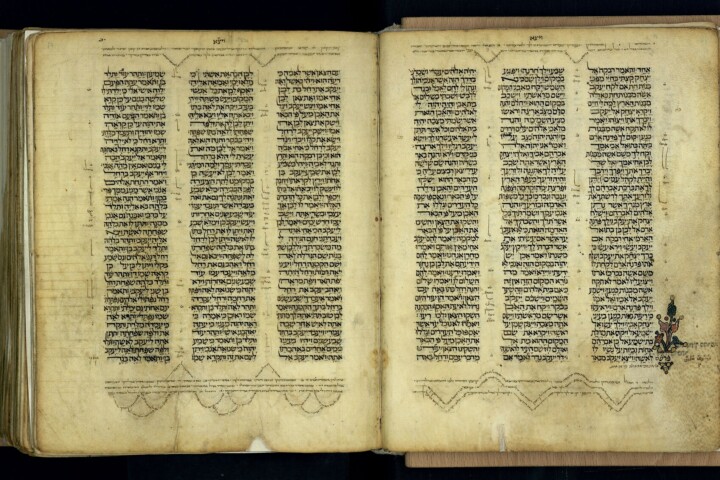
I noticed something odd with the psalm reading at Mass the other day. Our bishops’ conference here in Canada has decreed that the Mass in English – Novus Ordo – use the ‘NRSV’, the ‘New Revised Standard Version’, an ‘updated’ translation of the original RSV, first published in 1952. This ‘new translation’ has the tendency[…]Continue reading→