
The Pope, Trump and Climate Change
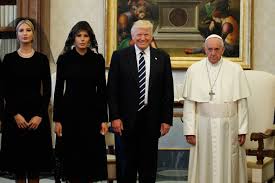
The Holy Father and President Donald Trump finally had a face to face meeting yesterday which, as accounts have it, began rather awkwardly, but soon warmed up (although the Pope still looks rather stony-faced in the group shot afterward) as the two discussed various topics for half an hour, snippets of which were revealed, striving for peace at the top of the agenda. I hope this is the beginning of an ongoing and fruitful dialogue and cooperation, in the vein of Pope John Paul and Ronald Reagan. There are, of course, deep differences and divisions, but one can always hope. Trump certainly seemed elated as he left, effusing many thank you’s, calling the meeting one of the great honours of his life. Furthermore, his womenfolk, Melania and Ivanka, wore black and were veiled, something they did not do for the Islamic king of Saudi Arabia. Good for them. Also, Melania, a Catholic, when the Pope gave her a Rosary, asked if he could bless it. Perhaps she will in turn use it to pray, even, who knows, with her husband. A nightly Rosary in the White House chapel would do wonders for the world, not least in this Fatima year.
All well and good. But I cannot leave this theme without mentioning that the Holy Father, along with his Secretary of State, also emphasized in the meeting the importance of ‘climate change’, especially in light of the upcoming Paris talks on this never-ending theme, gifting Trump with an signed copy of Laudato Si, his encyclical on ecology and the environment. Pope Francis is likely aware of Trump’s denial of the reality of climate change, or at least its full surety, which I for one share.
Of course, the Holy Father is free to think what he wants, but his magisterial authority, limited to the realm of revealed doctrine of faith and morals, does not extend to the scientific hypothesis of ‘climate change’. Come to think of it, neither does the authority of scientists, for, as I have written before, there is no way to prove nor, more importantly, disprove, climate ‘change’, which is claimed as responsible for flooding and for drought, for its being too hot and too cold (as Katy Perry might sing), for wind and for rain (a la James Taylor), for too many hurricanes and the curious lack thereof, for the extinction of some species and the proliferation of others, even for climate-change-induced depression and anxiety amongst suburban scientists, frustrated by all the denying they must face.
At least the hypothesis of ‘global warming’ had some semblance, however remote, inchoate and largely unproveable, of a scientific basis. It is by and large, in practice, impossible to measure the changing temperature of something as large and as old as planet Earth. More to the point, even if one could, it is in practice nearly impossible to determine and distinguish the multiplicity of causes of such warming or cooling, but one could at least in theory try.
Now the boogeyman of ‘climate change’ is posited as a cause for nearly every, well, let’s just put that at every, ecological phenomenon. There was our own Prime Minister the other day invoking this spectre in his comment on the recent flooding in Quebec and around Ottawa. How does one ever disprove a hypothesis which is a truism, for the climate is always changing? A simple question I might posit is: Does carbon dioxide cause global warming, cooling, neither, or either? How does it produce the purported violent and fluctuating weather systems? Can anyone trace the causal link, which any science worth its name must do? We should recall that CO2 is not a pollutant, and is the stuff which plants breathe, and plants in turn produce our oxygen. Of course, too much of a good thing is always too much (except for charity and grace), but how much is too much, and why?
There are many things in life than men nor Man can ever change, and one of them is the weather, which will come and go, here on Earth and on planets and stars throughout the universe, little affected by our activity. The primary (natural) determinant of our weather (besides the occasional divine intervention) is, of course, the Sun, and just try modifying that immense and imperturbable object.
As the serenity prayer, attributed to the 20th century American theologian Reinhold Niebuhr, would have it:
God grant me the serenity
to accept the things I cannot change;
courage to change the things I can;
and wisdom to know the difference.
Yes, there are many things that we can change, and it is best, I would gently posit, to focus our limited time and energy on those.

Carney’s Amoral Majority
After five defections – euphemistically described as ‘crossing the floor’ – and three by-elections, Mark Carney and his Liberals how have their coveted majority. One wonders what bowls of pottage were offered in back-room deals. In the archaic monarchical system that is the Dominion of Canada, this majority allows the newly-minted Prime Minister to rule[…]Continue reading→

Saint Kateri , Canada’s Protectress
This was the title given to Saint Kateri Tekakwitha, by Pope Benedict XVI, when he canonized her on October 28th, 2012, along with six others, in Saint Peter’ Square (she had been beatified by Pope John Paul II back in 1980). With Saint Joseph as our protector, along with the Canadian martyrs, we seem to[…]Continue reading→

A Tale of Two Benedicts
A grace-filled Holy Week to all our readers! As we await and prepare for the Resurrection about to dawn upon us, we might keep in mind two Benedicts: Pope Emeritus Benedict XVI, requiescat in pace, elected on this day in 2005; and today’s commemoration of the mystic pilgrim, Benedict Joseph Labre, who died on this[…]Continue reading→

My Name is Bernadette
April 16th is a propitious day, for besides the anniversary of Father de Valk’s death, who founded Catholic Insight in its print form decades ago, and the commemoration of the ‘two Benedicts’, mentioned in accompanying posts, today we also recall Saint Bernadette Soubirous, the young visionary to whom the Virgin Mary appeared numerous times at[…]Continue reading→

Saint Lydwina of Schiedam and Suffering Joyfully
Saint Lydwina of Schiedam (1380 – 1433) was one of the countless and glorious ‘victim souls’ in the history of the Church, those whose lives are filled with suffering, often of an unimaginable intensity, but who suffer joyfully. She was a fifteen-year old Dutch girl, out skating one day, when she fell and broke one[…]Continue reading→

The Glorious Martyrdoms of Martin and Maximus
As we enter into Eastertide, we recall on this 13th of April Pope Saint Martin I (+655), one of the noblest, if most tragic, of the successors of Saint Peter. Born in Umbria, Italy, he was of noble lineage, with great intelligence combined with charity and love of the poor and the Church. While still[…]Continue reading→

Saint Stanislaus of Szczepanów
We celebrate Saint Stanislaus today (+ April 11, 1079), in light of this Easter Octave, a bishop and martyr who accepted the episcopacy only at the direct order of Pope Alexander II. He proved a wise and courageous leader of his flock, put to death by his own king, Boleslaus, for rebuking the monarch’s ‘immoral[…]Continue reading→

Saint Gemma Galgani
On this April 11th, in 1903 – the same year that the Italian Guiseppe Sarto was elected Pope later that summer as Pius X – a lovely, young Italian woman died, by the name of Gemma Galgani. She lived a brief life of 24 years, as did a number of other young saints, including Pier[…]Continue reading→

An Ideological and Improper Translation
I noticed something odd with the psalm reading at Mass the other day. Our bishops’ conference here in Canada has decreed that the Mass in English – Novus Ordo – use the ‘NRSV’, the ‘New Revised Standard Version’, an ‘updated’ translation of the original RSV, first published in 1952. This ‘new translation’ has the tendency[…]Continue reading→
Saint Jean-Baptiste de la Salle: A Teacher for Teachers
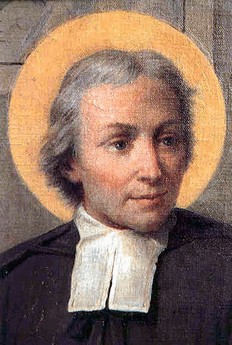
Jean-Baptiste de la Salle (1651 – 1719), a French nobleman, ordained a priest, founded the first order in the Church’s history entirely without priests, and this came about almost by accident. I say ‘almost’, for, of course, there are no accidents with God. Destined for ordination from an early age, Jean-Baptiste never looked back, even[…]Continue reading→