
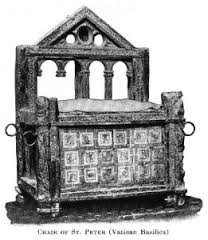
Leaning on Peter’s Chair
The Chair of Saint Peter, is a comforting one, a symbol of the ‘pillar and bulwark’ of the truth, which is the Church, signifying by synecdoche the office of the papacy, instituted by Christ, as recounted in today’s Gospel from the sixteenth chapter of Saint Matthew:
Simon Peter replied, “You are the Christ, the Son of the living God.” And Jesus answered him, “Blessed are you, Simon Bar-Jona! For flesh and blood has not revealed this to you, but my Father who is in heaven. And I tell you, you are Peter, and on this rock I will build my church, and the powers of death shall not prevail against it. I will give you the keys of the kingdom of heaven, and whatever you bind on earth shall be bound in heaven, and whatever you loose on earth shall be loosed in heaven.”
This ancient feast reminds us of the authority bestowed on the office of the papacy, his task to shepherd the universal Church, and is a reminder for us to pray for the one holding the office, remembering that its duties and burdens, the most significant authority that can be wielded on this Earth, weigh heavy even upon the best of men. There is a reason why the first room the Pope enters to vest after his election is called ‘the chamber of tears’. The Oval Office of the President has nothing on the Chair of Saint Peter, as Stalin’s ironic quip ‘how many divisions has the Pope?’ soon made clear.
Saint Peter himself was a flawed man, as is every Pope, more or less – sinners and saints, the worldly and the mystics. Right after Christ praises Peter’s confession of faith, and promises the papacy to him, our Lord in almost His next breath rebukes Peter ‘Get behind me, Satan!’, after Peter tempts Him against the Passion He must undergo, with whatever good and compassionate intentions on the part of the soon-to-be first Pope. For although the Church gives ‘comfort’ in one sense – in its original etymology of ‘giving strength’ – the life of comfort and ease is not God’s way, as Peter was soon to understand. As Thomas More, who went to the chopping block defending the papacy, put it, ‘we get not to heaven on feather beds‘. And as Christ later reveals to Peter at the end of Saint John’s Gospel:
Truly, truly, I say to you, when you were young, you girded yourself and walked where you would; but when you are old, you will stretch out your hands, and another will gird you and carry you where you do not wish to go.” (This he said to show by what death he was to glorify God.) And after this he said to him, “Follow me.”
In our day, we must learn to distinguish, with the wisdom Christ offers, even more clearly between the ‘man’ and the ‘Pope’, for the full authority of the papacy, including the divine authority to ‘bind and loose’, is only exercised under certain conditions (cf., The Dogmatic Constitution on the Church, Lumen Gentium, 25, a very essential paragraph for all Catholics to read). There are truths and decrees to which we must give either the assent of faith (fidei obsequium, to that which is contained in divine revelation). To others, not so defined, we give religious submission of mind and will (obsequium religiosi animi) to that which is at least authoritative).
This is our response to the official Magisterium, and not to impromptu interviews and replies to reporters’ queries.
The Holy Father says many things, and our faith does not call for blind obedience nor conformity to each of his opinions and musings. Rather, while leaning on the ‘rock of Peter’, we must also exercise our reason – the ‘tangle of our wits’, to return to More – to discern how to apply the teachings of the Church given us through the papacy, as well as what does bind our conscience, and what does not. Only so may we be formed, with the help of the true Magisterium, more and more into the image and likeness of Christ. As Cardinal Newman quipped in his Letter to the Duke of Norfolk, if he had to toast to the Pope or conscience, he would toast conscience first, for the Pope and the Magisterium are not a replacement for, but rather a support and guide to, our conscience, the ‘aboriginal vicar of Christ’ and the ‘proximate norm of morality’. Yes, there are many truths to which we are bound, but even here, this ‘binding and loosing’ are offered and chosen in freedom and peace, suaviter et fortiter, sweetly, yet strongly.
We should pray for wisdom, strength and discernment on the part of the Pope, that he continue to grow in holiness and truth, discerning what is prudent and good, and what is not, and so lead many souls to heaven. At the same time, we should also pray the same for ourselves.
Sancte Petre, ora pro nobis!
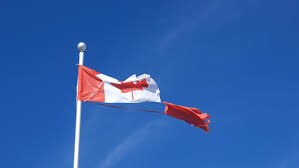
Carney’s Amoral Majority
After five defections – euphemistically described as ‘crossing the floor’ – and three by-elections, Mark Carney and his Liberals how have their coveted majority. One wonders what bowls of pottage were offered in back-room deals. In the archaic monarchical system that is the Dominion of Canada, this majority allows the newly-minted Prime Minister to rule[…]Continue reading→

Saint Kateri , Canada’s Protectress
This was the title given to Saint Kateri Tekakwitha, by Pope Benedict XVI, when he canonized her on October 28th, 2012, along with six others, in Saint Peter’ Square (she had been beatified by Pope John Paul II back in 1980). With Saint Joseph as our protector, along with the Canadian martyrs, we seem to[…]Continue reading→

A Tale of Two Benedicts
A grace-filled Holy Week to all our readers! As we await and prepare for the Resurrection about to dawn upon us, we might keep in mind two Benedicts: Pope Emeritus Benedict XVI, requiescat in pace, elected on this day in 2005; and today’s commemoration of the mystic pilgrim, Benedict Joseph Labre, who died on this[…]Continue reading→

My Name is Bernadette
April 16th is a propitious day, for besides the anniversary of Father de Valk’s death, who founded Catholic Insight in its print form decades ago, and the commemoration of the ‘two Benedicts’, mentioned in accompanying posts, today we also recall Saint Bernadette Soubirous, the young visionary to whom the Virgin Mary appeared numerous times at[…]Continue reading→

Saint Lydwina of Schiedam and Suffering Joyfully
Saint Lydwina of Schiedam (1380 – 1433) was one of the countless and glorious ‘victim souls’ in the history of the Church, those whose lives are filled with suffering, often of an unimaginable intensity, but who suffer joyfully. She was a fifteen-year old Dutch girl, out skating one day, when she fell and broke one[…]Continue reading→

The Glorious Martyrdoms of Martin and Maximus
As we enter into Eastertide, we recall on this 13th of April Pope Saint Martin I (+655), one of the noblest, if most tragic, of the successors of Saint Peter. Born in Umbria, Italy, he was of noble lineage, with great intelligence combined with charity and love of the poor and the Church. While still[…]Continue reading→

Saint Stanislaus of Szczepanów
We celebrate Saint Stanislaus today (+ April 11, 1079), in light of this Easter Octave, a bishop and martyr who accepted the episcopacy only at the direct order of Pope Alexander II. He proved a wise and courageous leader of his flock, put to death by his own king, Boleslaus, for rebuking the monarch’s ‘immoral[…]Continue reading→

Saint Gemma Galgani
On this April 11th, in 1903 – the same year that the Italian Guiseppe Sarto was elected Pope later that summer as Pius X – a lovely, young Italian woman died, by the name of Gemma Galgani. She lived a brief life of 24 years, as did a number of other young saints, including Pier[…]Continue reading→
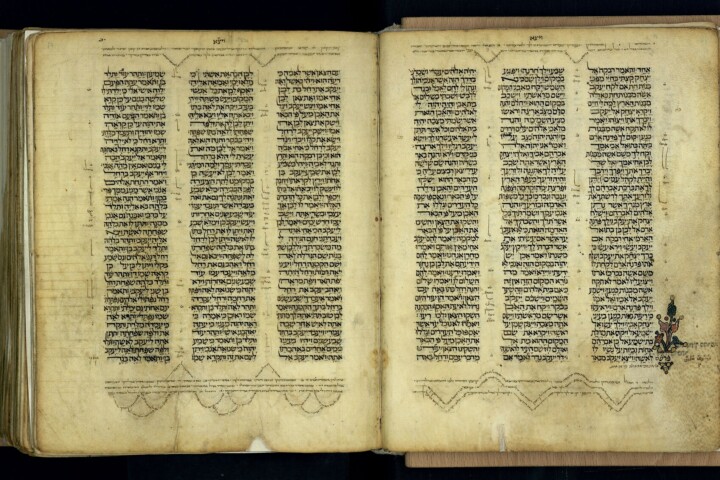
An Ideological and Improper Translation
I noticed something odd with the psalm reading at Mass the other day. Our bishops’ conference here in Canada has decreed that the Mass in English – Novus Ordo – use the ‘NRSV’, the ‘New Revised Standard Version’, an ‘updated’ translation of the original RSV, first published in 1952. This ‘new translation’ has the tendency[…]Continue reading→
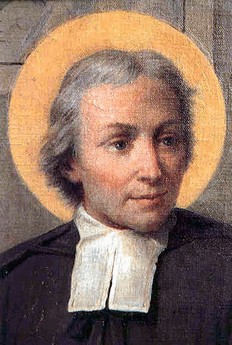
Saint Jean-Baptiste de la Salle: A Teacher for Teachers
Jean-Baptiste de la Salle (1651 – 1719), a French nobleman, ordained a priest, founded the first order in the Church’s history entirely without priests, and this came about almost by accident. I say ‘almost’, for, of course, there are no accidents with God. Destined for ordination from an early age, Jean-Baptiste never looked back, even[…]Continue reading→