
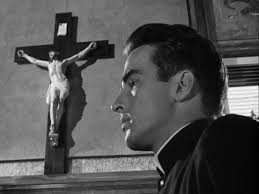
Bound by a Seal: A Movie Review of “I Confess”
Year: 1953
Filming: Black & White
Length: 95 minutes
Genre: Drama/Inspirational/Religious/Suspense
Maturity: PG (for intense thematic elements)
Cast: Montgomery Clift (Fr. Michael Logan), Anne Baxter (Ruth Grandfort), O.E. Hass (Otto Keller), Dolly Haas (Alma Keller), Roger Dann (Pierre Grandfort), Karl Malden (Inspector Larrue), Ovila Legare (Monsieur Villette), Brian Aherne (Willy Robertson)
Director: Alfred Hitchcock
Personal Rating: 5 Stars
***
“Technically one of Hitchcock’s best”, I Confess is not your run-of-the-mill murder mystery. Instead, it reveals a little-known aspect of The Master of Suspense: his lingering fascination with and devotion to the Catholic Faith. Being a member of the endangered species of British Cradle Catholics, Hitchcock rarely revealed his religious allegiances in his productions, but this is a noteworthy exception, and his only film that can truly fit into the noble genre of “inspirational.”
Montgomery Clift stars as Father Michael Logan, a Canadian Catholic priest serving in Quebec. But his routine life takes a turn when the sacristan, Otto Keller, confesses to having murdered a prominent businessman, Monsieur Villette, and Logan is sworn to secrecy under the Seal of Confession. He tries to convince the Keller to turn himself over the authorities, but instead the penitent sets out to frame the priest as the real killer.
Meanwhile, Ruth Grandfort, the beautiful wife of a prominent Canadian lawyer, sets out to clear Fr. Logan by exposing a complex web of rumor, scandal, and blackmail that connects them both with the murdered Villette. But by bringing old secrets and new struggles to light, she only adds to the mounting suspicions that Logan was carrying on a romantic affair with her, and that he did indeed have a motive to silence Villette.
As the net closes, Logan must make a decision whether to flee the city and the false accusations or turn himself over to the police to be tried for murder. Even though he knows all the evidence is pointing against him and he has little hope of acquittal unless he reveals what he heard in Confession, he will not disgrace his priesthood by running away, and decides to stay and face his fate head-on.
Once he is brought to trial, the prosecution relies heavily on the emotionally distraught testimony of lovelorn Ruth and the blood-stained cassock found among Logan’s possessions. In a twist of irony, Otto Keller, the real murderer, is also brought forward to testify against the priest. Now Fr. Logan must wrestle with the decision whether to seize his last chance to save his own life before it is too late, or to abide by the Seal of Confession.
This movie is one of those vintage gems that leaves one speechless by the sheer impact of the story and artful depiction of the setting. The black-and-white scenes filmed on location in old Quebec are deliciously dark and foreboding, and there are some glorious scenes of church interiors with soaring altars that seem to speak of hope in the midst of desolation. All this combines to create a seamless movement from one mood to another.
There are also a lot of typical “Hitchcockian” bits involving doing weird things with dinnerware (like trying to balance a penny between two forks or a glass of water on one’s chin) and his trade-mark “walk-ons” as a parishioner coming out of church and a pedestrian meandering down a dark alleyway. There are also loads of suspenseful, dialogue-driven encounters and a big chase sequence with a lot of shooting. As I said, that’s Hitchcock.
Thanks to an excellent cast, the intensity of the characters wrestling with their inner demons is palpable. Montgomery Clift portrays Fr. Logan in a deeply human way, yet makes his devotion to his priesthood the keystone of his character. There are any number of really engrossing sequences in this film dealing with Logan’s inner turmoil and the battle that rages within him between his identity as a priest and a man, comparing his own crosses to the Cross of Christ.
The scene where he walks through Quebec, uncertain whether to run away or stay to face an unfair trial, is paralleled by the beautiful life-sized Stations of the Cross he walks past in the park. His anguished journey finally draws him back inside a church, his eyes uplifted towards the altar, before finally turning himself over to authorities. Again, in the court itself, there is a shot of Logan sitting in the interrogation box, which fades out on the face of the priest and brings into focus the crucifix hanging on the wall behind him, reminding the viewer of Christ’s own unjust trial and punishment.
One burning question remains: Is Anne Baxter always doomed to be type-cast as a somewhat pathetic, generally annoying former flame, fading enchantress, trying to reclaim the affections of her ex-boyfriend at his expense? After a while, it gets nothing short of monotonous knowing exactly what sort of character she is bound to be! That having been said, I think she grew sufficiently comfortable with these parts to pull them off quite well.
As Ruth Grandfort, she effectively makes you want to shout, “Shut up!” when she starts spilling her past indiscriminately and making things worse and worse for her Logan who she just won’t give up, even though he has clearly given her up for his calling to the priesthood. Happily, he is much more understanding towards her than Moses was in The Ten Commandments!
O.E. Hass and Dolly Haas also do an excellent job as Otto and Alma Keller. The way Otto verbally pins Fr. Logan into a corner, testing him to see if he will reveal what was said in Confession, and taunting him with the fact that he is framing him for the murder, is so blood-boiling, heightened by the look of disbelief and horror on Montgomery Clift’s face. Alma is also a wonderfully complex character, caught between her loyalty to her husband and her own guilt for helping to destroy the priest who has been so kind to them as immigrants. In the end, she will choose to do the right thing, saving Fr. Logan by sacrificing herself.
Interestingly, I Confess was initially not very well received because non-Catholic viewers had a hard time understanding the rationale behind The Seal of Confession and why it would so noble, instead of just stupid, for a priest to conceal the identity of the murderer. That is why the very sparse “romance” element in the film is often played up to the hilt, with movie covers displaying smooching sequences that never, ever occurred! There was also a move to exploit the murder mystery angle, introducing smothering sequences on the cover that also never, ever occurred!
But all this beating around the bush is silly, and it belies the fact that the storyline cannot be accurately called a “romance” since one party is no longer involved in the would-be relationship, and it cannot be accurately called a “mystery” since we already know who the murderer is from the start. The truth is that Alfred Hitchcock, in spite of his other ghoulish and risqué pictures, had molded a boldly spiritual, deeply inspirational testimony to his own Catholic Faith and the priests who had educated him. It makes me want to shout, “Hitchcock, why couldn’t you have made more movies like this instead of that other weird, dumb stuff you made?”
In spite of hang-ups in the non-Catholic world, the undeniable quality of I Confess caused it to come into its own in later years, and it has come to be accepted as an excellent example of suspense cinema, complete with unusual conundrum and powerful resolution. For me, the most poignant scene of all has to be the conclusion in which Fr. Logan once again gives absolution to his tormenter, Otto Keller, after Keller is mortally wounded.
The first time I watched this, my jaw just hung open for a long time, and I knew I would have to watch it again before long. For once agreeing with the general consensus of critics, I would definitely rate this intricate study of human weakness and strength as the best film the Master of Suspense ever directed or produced.

Saint Kateri , Canada’s Protectress
This was the title given to Saint Kateri Tekakwitha, by Pope Benedict XVI, when he canonized her on October 28th, 2012, along with six others, in Saint Peter’ Square (she had been beatified by Pope John Paul II back in 1980). With Saint Joseph as our protector, along with the Canadian martyrs, we seem to[…]Continue reading→

Remembering Father Alphonse de Valk
(Today marks the sixth anniversary of the death of Father Alphonse de Valk, C.S.B., a faithful, courageous and indefatigable Basilian priest, pro-life-and-family apostle, and the founder of Catholic Insight magazine. Here is what we wrote those on his entering into eternity five years ago, as we continue to remember him in our prayers and thoughts)[…]Continue reading→

My Name is Bernadette
April 16th is a propitious day, for besides the anniversary of Father de Valk’s death, who founded Catholic Insight in its print form decades ago, and the commemoration of the ‘two Benedicts’, mentioned in accompanying posts, today we also recall Saint Bernadette Soubirous, the young visionary to whom the Virgin Mary appeared numerous times at[…]Continue reading→
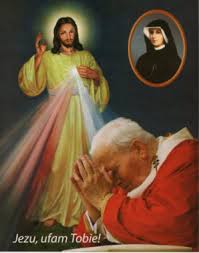
Canonizing Sister Faustina and Divine Mercy
HOMILY OF THE HOLY FATHER MASS IN ST PETER’S SQUARE FOR THE CANONIZATION OF SR MARY FAUSTINA KOWALSKA Sunday, 30 April 2000 1. “Confitemini Domino quoniam bonus, quoniam in saeculum misericordia eius”; “Give thanks to the Lord for he is good; his steadfast love endures for ever” (Ps 118: 1). So the Church sings on the Octave of[…]Continue reading→

Divine Mercy Sunday – An Echo of Every Mass
Reach out your hand and put it in my side. Do not doubt but believe’… ‘My Lord and my God!’ (Jn. 20:18)). Today is Divine Mercy Sunday, and as we celebrate the end of the Easter Octave, we contemplate the wounded side of our Saviour, the Church’s source of life. On Good Friday in the[…]Continue reading→

Saint Stanislaus of Szczepanów
We celebrate Saint Stanislaus today (+ April 11, 1079), in light of this Easter Octave, a bishop and martyr who accepted the episcopacy only at the direct order of Pope Alexander II. He proved a wise and courageous leader of his flock, put to death by his own king, Boleslaus, for rebuking the monarch’s ‘immoral[…]Continue reading→
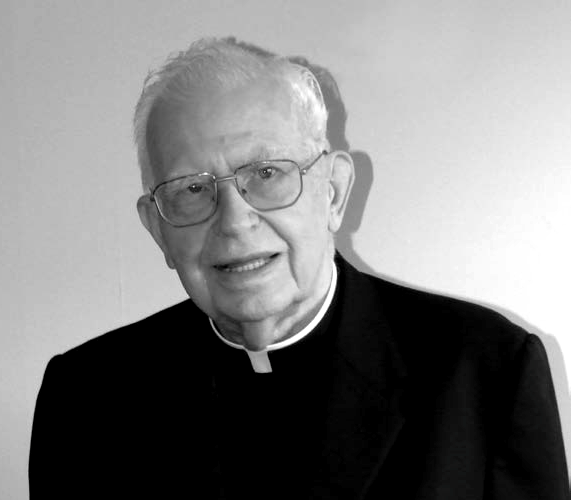
First Holy Communion: Sermon from May 16, 1943
Here is a sermon from the good old days by +Rev. Msgr. Vincent Nicholas Foy (August 14, 1915 – March 13, 2017), from 1943. Readers may recall that Pope Saint Pius X, by the decree Quam Singulari in 1910, lowered the customary age of reception of Holy Communion – after the rigours of the plague[…]Continue reading→
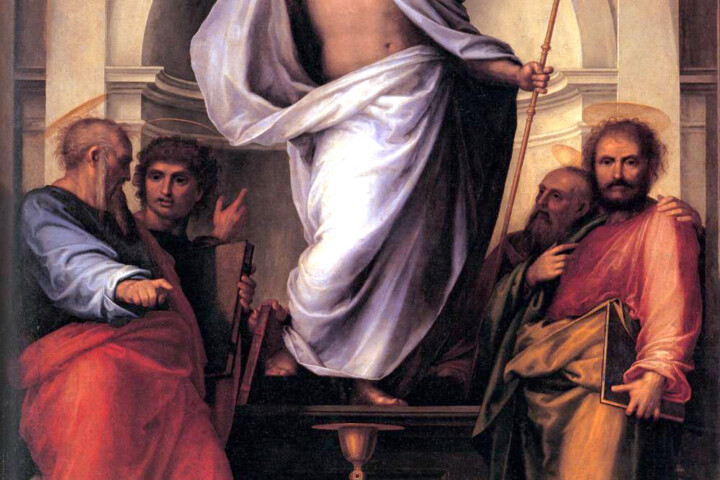
In the Glorious Light of Easter, Alleluia!
Set your minds on things that are above, not on things that are on earth, for you have died, and your life is hidden with Christ in God. When Christ who is your life is revealed, then you also will be revealed with him in glory (Col. 3:3-4). The Resurrection of Our Lord and Saviour[…]Continue reading→
An Ancient Homily for Holy Saturday
The time between Good Friday and Easter Sunday is one of waiting, in silence, as the world wonders – anticipates – what will happen, after the death of Christ. We re-live this time each year in the anamnesis of our liturgy, and in turn look forward to the glorious re-creation of all things at the[…]Continue reading→

Europe’s Long Descent
(As we meditate on this day on Christ’s burial, and His descent into hell, it is fitting to ponder here with contributor Peter Marcus how the world seems to be heading there as well. The difference is that, although God cannot ‘redeem’ hell, nor those therein, He can and did redeem the world. There is[…]Continue reading→