
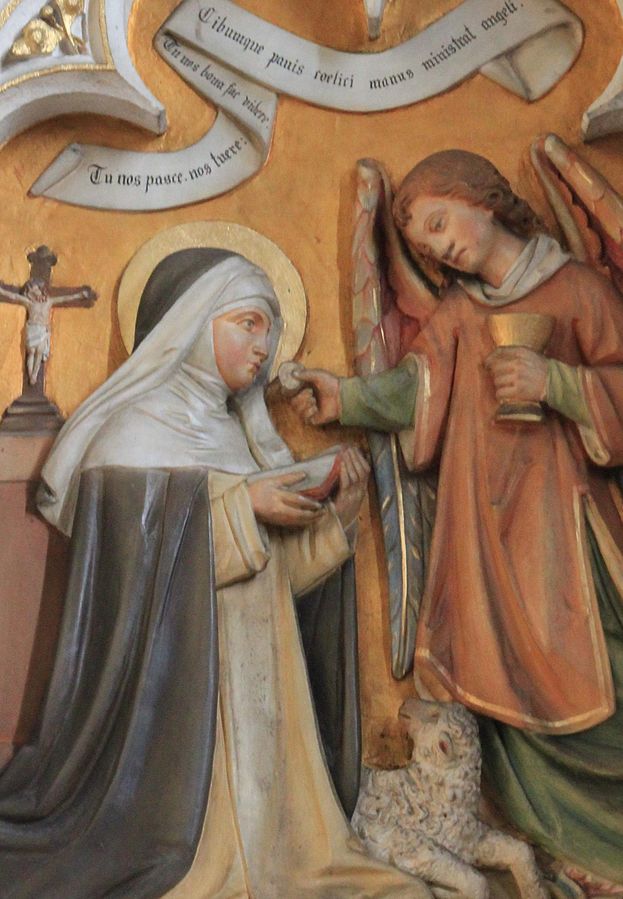
Healing Effects of the Holy Eucharist
Sadly, the majority of Catholics do not believe in the Real Presence of Christ in the Eucharist. Nearly seven in ten Catholics (69%) say they personally believe that during the Holy Sacrifice of the Mass, the bread and wine used in Communion are merely symbols of the Body and Blood of Jesus Christ (Pew Research Center 2019). There has been very little research done examining the association between belief in the Real Presence of Christ and healing. Our belief systems can significantly impact the healing process in psychological disorders and physical ailments with a strong psychological component, such as chronic pain. As a physician, I have been privileged to take care of hundreds of patients and accompany them through cancer, mental health struggles, and complex illnesses, to name a few. I have also witnessed firsthand the limitations of modern medicine, which divorces faith from medicine, leaving a psychospiritual void with profound crises of meaning and purpose. Such a Pelagian approach disregards the need for divine grace and sees healing as the product of our sole efforts. What if the beginning of healing our wounded humanity is restoring belief in the Real Presence of Christ in the Blessed Sacrament?
In the Traditional Latin Mass, the following prayer is repeated three times before Holy Communion: Dómine, non sum dignus, ut intres sub tectum meum: sed tantum dic verbo, et sanábitur ánima mea. Lord, I am not worthy that Thou shouldst enter under my roof; but only say the word, and my soul shall be healed.
This prayer is taken from Matthew 8:5-9 where Jesus heals a Centurion’s servant:
When he entered Capernaum, a centurion came to him, appealing to him and saying, ‘Lord, my servant is lying at home paralysed, in terrible distress. And he said to him, ‘I will come and cure him.’ The centurion answered, ‘Lord, I am not worthy to have you come under my roof; but only speak the word, and my servant will be healed.’
Repetition has long been established as a powerful mechanism for internalizing beliefs. The sacred liturgy therefore has a crucial role to play in the healing process, as it helps us believe that healing is possible through Christ’s divine power. Our faith increases with acts of faith: “I believe; help my unbelief!” (Mark 9:24) To obtain healing, we must not only desire it but also believe that it is possible. Furthermore, a distinction has to be made between Eucharistic healing and Hippocratic healing. The latter is oriented towards the preservation of life. The former makes us capable of sacrificing our lives. The great paradox of our faith is that the more we die to ourselves and offer ourselves to God, the more we begin to truly live and be healed from the wages of sin (Romans 6:23). The collapse of sacrifice is responsible for so much of the crisis that we are seeing in the Church today.
The Holy Sacrifice of the Mass is the highest expression of love from man to God, for it seeks to honour Him as He deserves. When we worship God in spirit and in truth, we deepen our understanding and experience of these sacred mysteries. As we worship with humility and reverence, we deepen our trust in Christ’s power to heal. Moreover, when the liturgy is truly centered on sacrifice, as opposed to a meal for our own fulfillment, we learn to offer up our sufferings, uniting them to the redemptive sacrifice of Christ. This is central to the healing process. The beginning of healing is learning to hold our pain with Christ, without feeling the need to run away from or react to it. We can turn to the beautiful example of Our Lady, who stood faithfully at the foot of the Cross, in total union with her Son’s sorrowful Passion.
In the offertory during Mass, Christ unites our desires and prayers to His own offering of Himself to the Father. The offertory is an oblation, through which we bring ourselves to enter into the sacrifice of Christ. In the Old Rite, the priest prays at the end of the offertory: “Receive, O Holy Trinity, this offering which we make to Thee in remembrance of the Passion, Resurrection, and Ascension of Our Lord Jesus Christ.” There is an intimate connection between healing and sharing in Christ’s passion, death, and resurrection. As St. Gregory the Great noted, “The Mass will be a sacrifice for us to God when we have made an offering of ourselves.” Let us not overlook the importance of the sacred liturgy in healing our woundedness. The healing power of the Holy Eucharist resides in the way it incorporates us into the mystery of Christ. When we truly believe in the Real Presence of Christ, our healing can be profound and help us attain union with God.
Dómine, non sum dignus, ut intres sub tectum meum: sed tantum dic verbo, et sanábitur ánima mea.
Lord, I am not worthy that Thou shouldst enter under my roof; but only say the word, and my soul shall be healed.
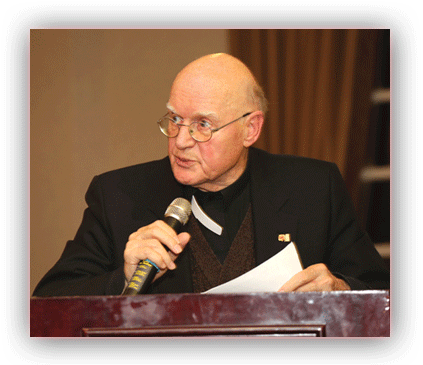
Remembering Father Alphonse de Valk
(Today marks the sixth anniversary of the death of Father Alphonse de Valk, C.S.B., a faithful, courageous and indefatigable Basilian priest, pro-life-and-family apostle, and the founder of Catholic Insight magazine. Here is what we wrote those on his entering into eternity five years ago, as we continue to remember him in our prayers and thoughts)[…]Continue reading→
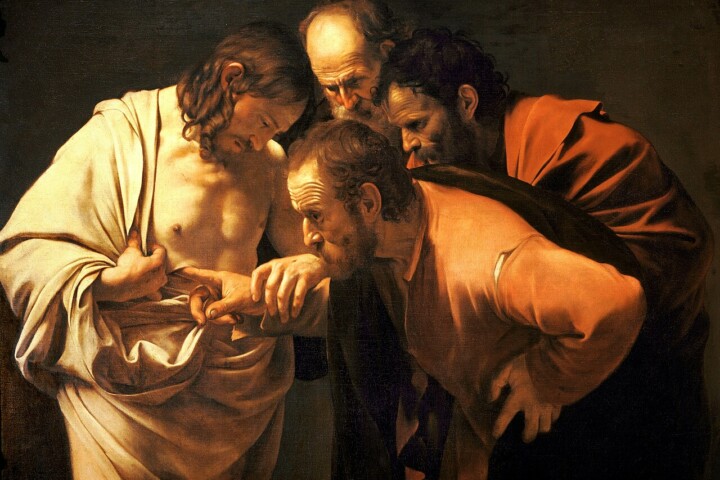
Divine Mercy Sunday – An Echo of Every Mass
Reach out your hand and put it in my side. Do not doubt but believe’… ‘My Lord and my God!’ (Jn. 20:18)). Today is Divine Mercy Sunday, and as we celebrate the end of the Easter Octave, we contemplate the wounded side of our Saviour, the Church’s source of life. On Good Friday in the[…]Continue reading→

Saint Stanislaus of Szczepanów
We celebrate Saint Stanislaus today (+ April 11, 1079), in light of this Easter Octave, a bishop and martyr who accepted the episcopacy only at the direct order of Pope Alexander II. He proved a wise and courageous leader of his flock, put to death by his own king, Boleslaus, for rebuking the monarch’s ‘immoral[…]Continue reading→
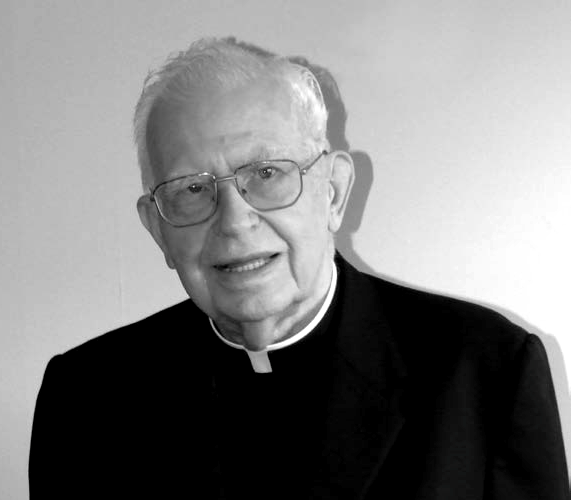
First Holy Communion: Sermon from May 16, 1943
Here is a sermon from the good old days by +Rev. Msgr. Vincent Nicholas Foy (August 14, 1915 – March 13, 2017), from 1943. Readers may recall that Pope Saint Pius X, by the decree Quam Singulari in 1910, lowered the customary age of reception of Holy Communion – after the rigours of the plague[…]Continue reading→
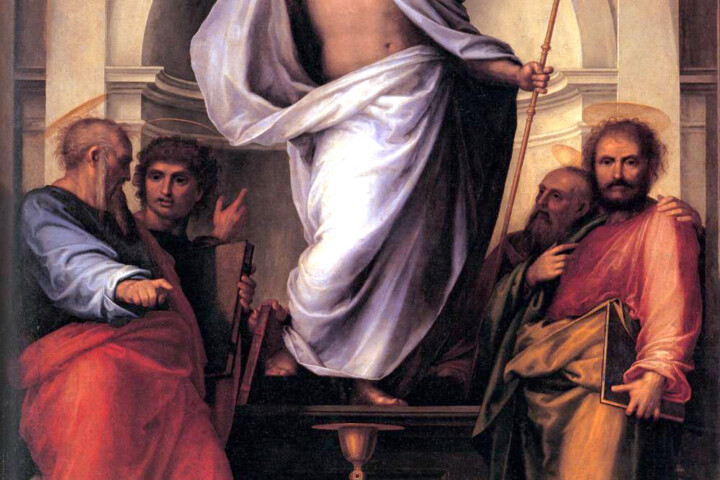
In the Glorious Light of Easter, Alleluia!
Set your minds on things that are above, not on things that are on earth, for you have died, and your life is hidden with Christ in God. When Christ who is your life is revealed, then you also will be revealed with him in glory (Col. 3:3-4). The Resurrection of Our Lord and Saviour[…]Continue reading→
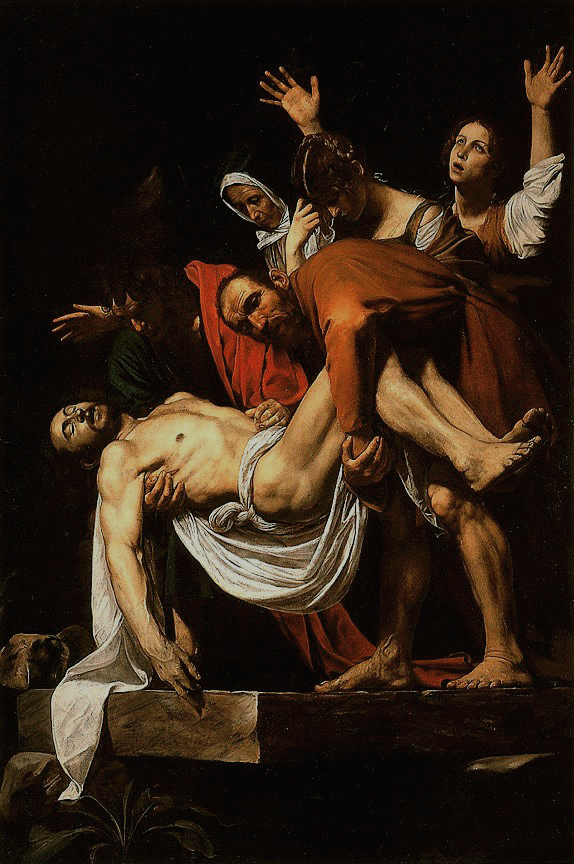
An Ancient Homily for Holy Saturday
The time between Good Friday and Easter Sunday is one of waiting, in silence, as the world wonders – anticipates – what will happen, after the death of Christ. We re-live this time each year in the anamnesis of our liturgy, and in turn look forward to the glorious re-creation of all things at the[…]Continue reading→
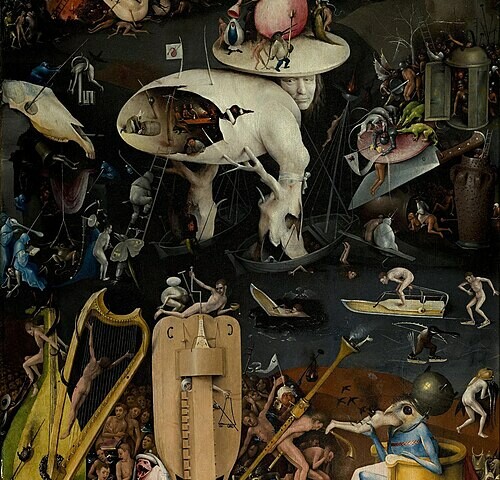
Europe’s Long Descent
(As we meditate on this day on Christ’s burial, and His descent into hell, it is fitting to ponder here with contributor Peter Marcus how the world seems to be heading there as well. The difference is that, although God cannot ‘redeem’ hell, nor those therein, He can and did redeem the world. There is[…]Continue reading→
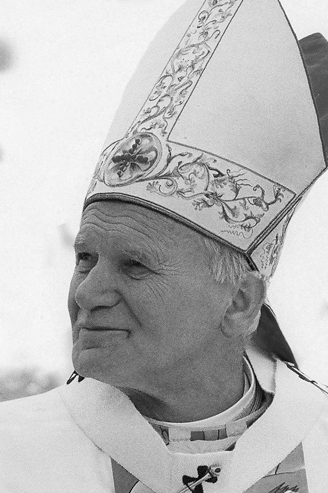
Pope Saint John Paul II’s First Good Friday Homily
ADDRESS OF HIS HOLINESS JOHN PAUL II AT THE CONCLUSION OF THE STATIONS OF THE CROSS AT THE COLOSSEUM Good Friday, 13 April 1979 When we make the Way of the Cross from one station to the next, in spirit we are always at the spot wherethis journey had its “historical” place: where it[…]Continue reading→
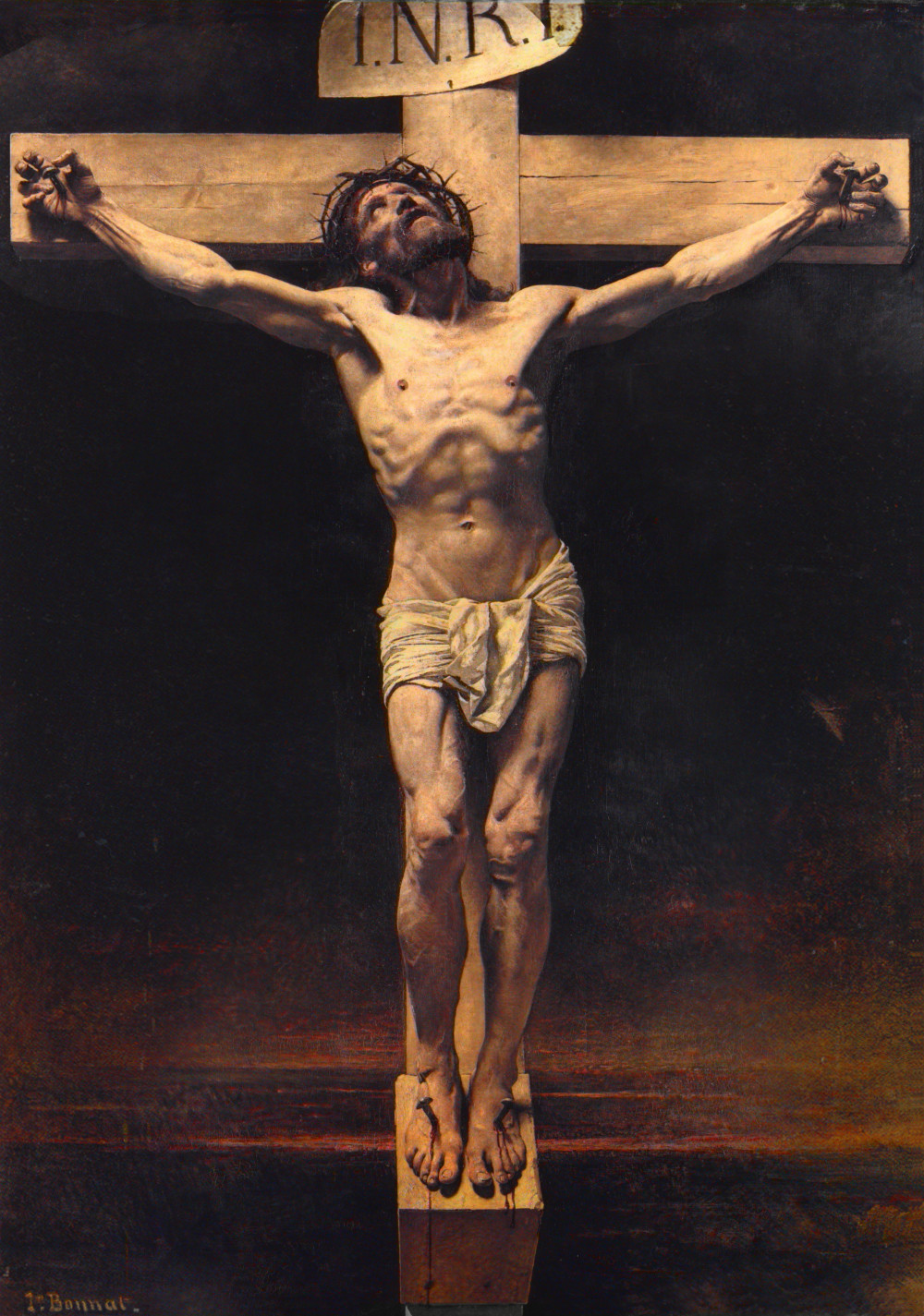
A Meditation for Good Friday: How To Undo the Effects of Sin?
Cardinal Newman, now Saint John Henry Newman, was a towering figure of nineteenth-century Catholicism who is almost universally admired. I say “almost” because not everyone likes him. I knew a priest once, Arthur Caulkins, who has become disenchanted with Newman. As an undergraduate Arthur had been enamoured of Newman, and this interest continued when he[…]Continue reading→
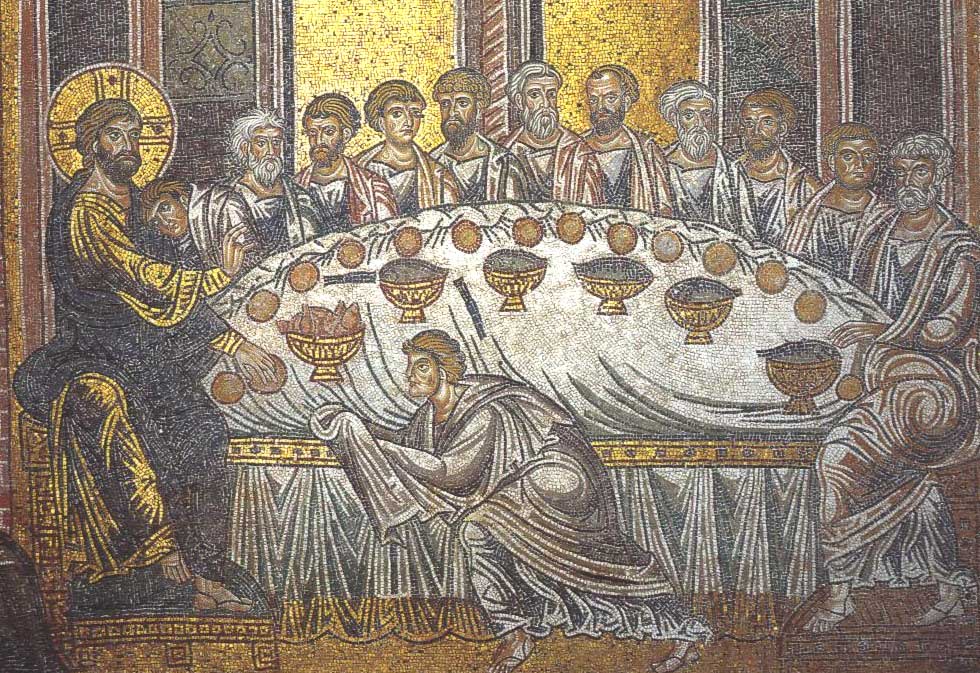
Pope Benedict’s Last Holy Thursday Homily
MASS OF THE LORD’S SUPPER HOMILY OF HIS HOLINESS BENEDICT XVI Basilica of St John Lateran Holy Thursday, 5 April 2012 Photo Gallery (Video) Dear Brothers and Sisters! Holy Thursday is not only the day of the institution of the Most Holy Eucharist, whose splendour bathes all else and in some ways draws it to[…]Continue reading→