
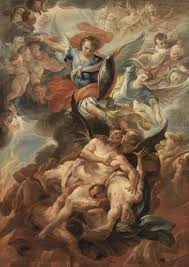
Saint Michael and the Eucharistic Eschatological Battle
The great dragon, the primeval serpent, known as the devil or Satan, who had deceived all the world, was hurled down to the earth and his angels were hurled down with him (Rev. 12:9).
Today in the Archdiocese of Toronto we celebrate the Feast of St. Michael, the Archangel and observe it as a Solemnity. There are nine choirs of angels: Seraphim, Cherubim, Thrones, Dominions, Virtues, Powers, Archangels, Principalities and Angels. Archangels are generally taken to mean “chief or leading angel” (Jude 9; 1 Thes. 4:16) and are the most frequently mentioned throughout the Bible. The Archangels have a unique role as God’s messenger to the people at critical times in history and in the history of salvation. St. Michael is a princely Seraph who has been invoked as patron and protector of the Church from the time of the Apostles.
In the year 490 A.D. there was an apparition of St. Michael in Italy on Mount Gargano, not far from the place where St. Pius of Pietrelcina or Padre Pio spent most of his priestly life. This shrine is part of what is known as the Sword of St. Michael, seven shrines dedicated to the Prince of the Heavenly Hosts. These seven sanctuaries are mysteriously linked by a straight line from Ireland to Israel. According to legend, the line represents the blow with which St. Michael sent the devil to hell. The seven shrines are: Skellig Michael or Michael’s Rock in Ireland, St. Michael’s Mount in England, and Mont St. Michel in France where St. Michael also appeared. The line continues to Italy and the shrines in Val de Susa and Gargano. From Italy, the next shrine is on the Greek island of Symi, and the seventh is at the Mount Carmel Monastery in Haifa, Israel. The details of such alignment are also astonishing: the three most important sites in France and Italy are all the same distance from one another. Some have observed that this is a reminder from St. Michael: we are expected to be righteous, walking the straight path.
It is our custom here to pray the prayer to St. Michael the Archangel at the end of Mass. Our Cardinal has asked that this prayer to St. Michael be once again recited after all Masses in our Archdiocese. The recitation of this prayer after Mass was universally observed for almost seventy years by Roman Catholics throughout the world. This prayer comprised what are known as the Leonine Prayers because it was Pope Leo XIII who ordered that they be recited after Low Mass.
What is the origin of this prayer? It is obviously inspired by the text from the book Revelation which we have just heard. Pope Leo instituted these prayers in 1886 as a result of a remarkable vision he had had after he had celebrated Mass in his private Vatican Chapel, attended by some of his staff. Several different reports relate that Pope Leo had a visible change come over his face during the vision and that his face was ‘pale and fearful’. A Cardinal at the time who knew the pope’s private secretary explains that Pope Leo XIII truly had a vision of demonic spirits, who were gathering in the Eternal City. From that experience…comes the prayer which he wanted the whole Church to recite. Understandably, with such an event legends have arisen, and as time went on a few embellishments started to appear regarding the vision, claiming that Pope Leo witnessed a conversation between Our Lord and Satan. What we know for certain is that as a result of a vision, the pope composed a prayer to be recited for the protection of the Church. The pope lived during particularly turbulent times and he believed that prayer, specifically an exorcism prayer was needed to dispel the darkness over the world.
The Leonine Prayers were recited after Low Mass for almost eighty years and one of the first liturgical changes introduced at the time of the Second Vatican Council was the suppression of these prayers in 1964. Astonishingly, or perhaps not in retrospect, in 1972, Pope Paul VI declared that through some fissure the smoke of Satan [had] entered the temple of God. The spiritual erosion witnessed and experienced by many of us when these frightening words were spoken and since, has now reached a critical mass. The forces of evil, aligned with the prince of darkness are aligned also in our own times against the Church of God.
To say that our times are turbulent is an understatement. The changes that have taken place especially in what concerns the moral order defy description when compared to the traditional moral order that is biblically based. Our culture has rejected and repudiated biblical morality. The decline of the Church’s vitality which we have witnessed and sadly continue to experience is not the result of the Church’s failure to conform to the times. This has always been the stated goal of those who through the ages have sought to fashion a church to suit our tastes and our beliefs, a modern church, as it were. Trusting tradition is a central feature of the Catholic Church. The pope takes an oath to guard and guarantee this Tradition. Catholics do not fashion their own belief system. We are bound by the Word of God, Sacred Tradition and the Magisterium of the Church.
The demonization and destruction of tradition however is a central feature of the revolutionary spirit, and for this reason, anything born of rebellion is ultimately destructive. The Church in our time has lost her vitality because we have relativized the truth of the Divine Revelation, and for this reason, we have lost our vitality. In many quarters of the universal Church there is theological illiteracy, which means that most people don’t know their faith; and what is worse, a laity – though some of the clergy can be included in this group – a laity that does not even want to be Christian. The Church is suffering grievously because of this diabolical disorientation. Robert Cardinal Sarah has recently observed that the decline of faith in the Real Presence of Jesus in the Eucharist is at the heart of the current crisis in the Church and its decline especially in the West.
Since her very founding the prince of this world has been at war with the Church and many times over the devil has incited persecution of the Church. The devil is not a fiction nor is this fallen angel a symbol. Over a century ago a pope was inspired to compose a prayer for the conversion of sinners, and for the liberty and exaltation of our Holy Mother and Church (The Leonine Prayers). As we celebrate this Feast of St. Michael, the Prince of Heavenly Host we pray that the Eucharistic Sacrifice be once again the true centre of the Church’s life and mission. St. Michael is a Seraph and the seraphim are the angels closest to God. They burn (In Hebrew saraph means to burn) with the love of God and before His throne call out: Holy, Holy, Holy is the Lord God of Hosts – words that we make our own at every Mass as God descends upon the Altar during the Canon of the Mass. May St. Michael obtain for each of us a burning love of God, especially in His Eucharistic Presence; and by the power of God, may St. Michael thrust into hell Satan and all the evil spirits who wander through the world seeking the ruin of souls.
(from our archives)

Remembering Father Alphonse de Valk
(Today marks the sixth anniversary of the death of Father Alphonse de Valk, C.S.B., a faithful, courageous and indefatigable Basilian priest, pro-life-and-family apostle, and the founder of Catholic Insight magazine. Here is what we wrote those on his entering into eternity five years ago, as we continue to remember him in our prayers and thoughts)[…]Continue reading→

Divine Mercy Sunday – An Echo of Every Mass
Reach out your hand and put it in my side. Do not doubt but believe’… ‘My Lord and my God!’ (Jn. 20:18)). Today is Divine Mercy Sunday, and as we celebrate the end of the Easter Octave, we contemplate the wounded side of our Saviour, the Church’s source of life. On Good Friday in the[…]Continue reading→

Saint Stanislaus of Szczepanów
We celebrate Saint Stanislaus today (+ April 11, 1079), in light of this Easter Octave, a bishop and martyr who accepted the episcopacy only at the direct order of Pope Alexander II. He proved a wise and courageous leader of his flock, put to death by his own king, Boleslaus, for rebuking the monarch’s ‘immoral[…]Continue reading→

First Holy Communion: Sermon from May 16, 1943
Here is a sermon from the good old days by +Rev. Msgr. Vincent Nicholas Foy (August 14, 1915 – March 13, 2017), from 1943. Readers may recall that Pope Saint Pius X, by the decree Quam Singulari in 1910, lowered the customary age of reception of Holy Communion – after the rigours of the plague[…]Continue reading→

In the Glorious Light of Easter, Alleluia!
Set your minds on things that are above, not on things that are on earth, for you have died, and your life is hidden with Christ in God. When Christ who is your life is revealed, then you also will be revealed with him in glory (Col. 3:3-4). The Resurrection of Our Lord and Saviour[…]Continue reading→

An Ancient Homily for Holy Saturday
The time between Good Friday and Easter Sunday is one of waiting, in silence, as the world wonders – anticipates – what will happen, after the death of Christ. We re-live this time each year in the anamnesis of our liturgy, and in turn look forward to the glorious re-creation of all things at the[…]Continue reading→

Europe’s Long Descent
(As we meditate on this day on Christ’s burial, and His descent into hell, it is fitting to ponder here with contributor Peter Marcus how the world seems to be heading there as well. The difference is that, although God cannot ‘redeem’ hell, nor those therein, He can and did redeem the world. There is[…]Continue reading→
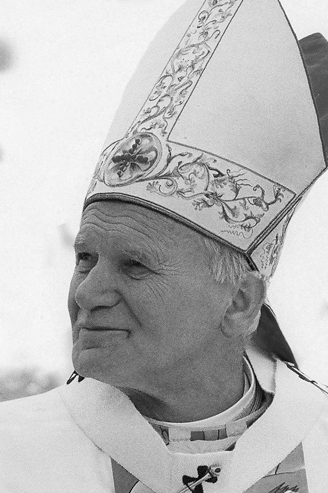
Pope Saint John Paul II’s First Good Friday Homily
ADDRESS OF HIS HOLINESS JOHN PAUL II AT THE CONCLUSION OF THE STATIONS OF THE CROSS AT THE COLOSSEUM Good Friday, 13 April 1979 When we make the Way of the Cross from one station to the next, in spirit we are always at the spot wherethis journey had its “historical” place: where it[…]Continue reading→
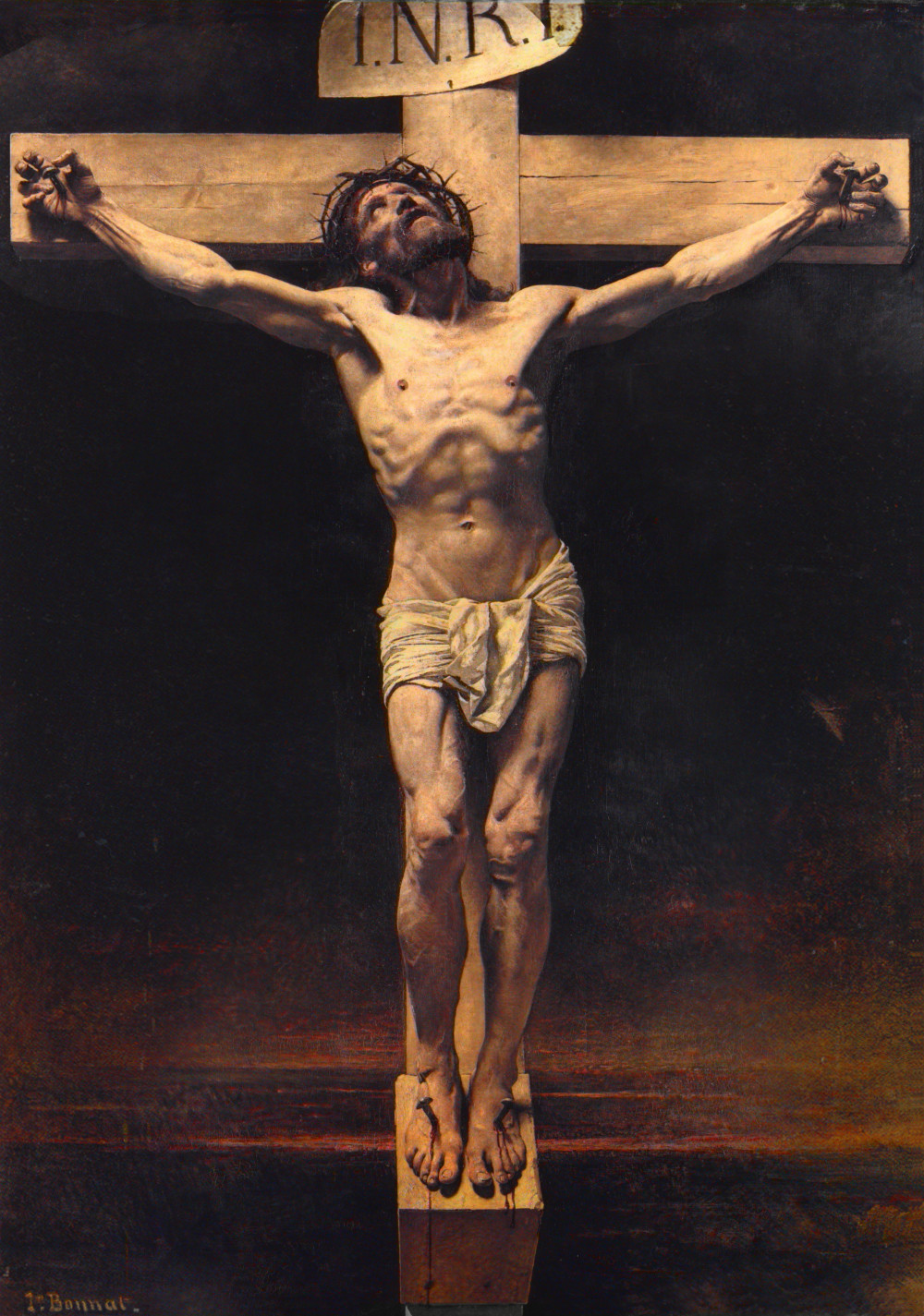
A Meditation for Good Friday: How To Undo the Effects of Sin?
Cardinal Newman, now Saint John Henry Newman, was a towering figure of nineteenth-century Catholicism who is almost universally admired. I say “almost” because not everyone likes him. I knew a priest once, Arthur Caulkins, who has become disenchanted with Newman. As an undergraduate Arthur had been enamoured of Newman, and this interest continued when he[…]Continue reading→
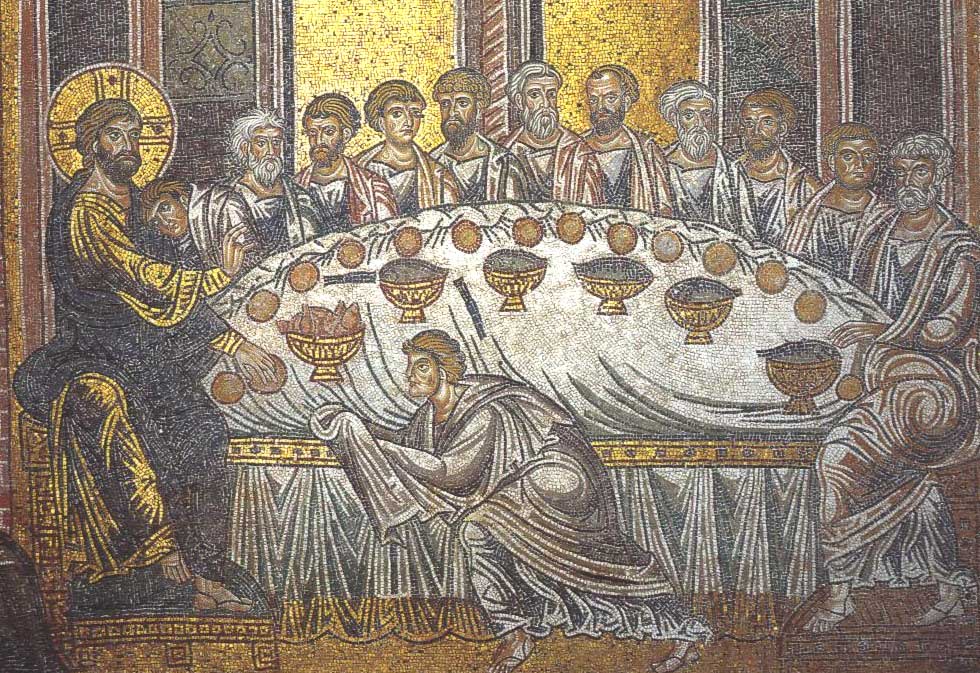
Pope Benedict’s Last Holy Thursday Homily
MASS OF THE LORD’S SUPPER HOMILY OF HIS HOLINESS BENEDICT XVI Basilica of St John Lateran Holy Thursday, 5 April 2012 Photo Gallery (Video) Dear Brothers and Sisters! Holy Thursday is not only the day of the institution of the Most Holy Eucharist, whose splendour bathes all else and in some ways draws it to[…]Continue reading→