
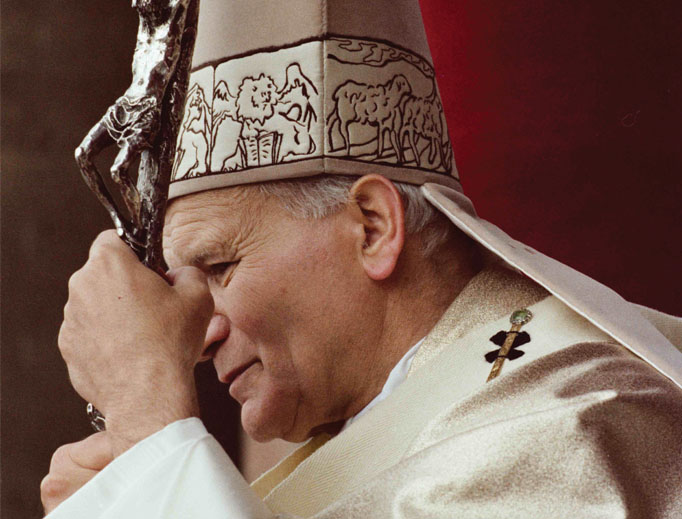
Pope Saint John Paul II Reflects on the Salvific Cross
(An excerpt from a homily preached by Pope Saint John Paul II in Lesotho, in 1988):
In the Gospel of this feast we are witnesses of a unusual conversation between Jesus and Nicodemus. The conversation takes place at night because Nicodemus, a prominent Jew, went to talk with Christ under the cover of darkness. Christ leads this man, a teacher, to the very heart of the mystery revealed by God. It is the mystery of the Son of God who descended from heaven and, as the Son of Man, accomplished the messianic mission among the people of Israel.
This mission was directed towards “the lifting up” of Christ on the Cross. Jesus says to Nicodemus: “The Son of Man must be lifted up as Moses lifted up the serpent in the desert” (Io. 3, 14). Nicodemus knows the Scriptures well; he knows the inspired message of the Old Testament. He can recall the event that took place during the journey of the chosen people in the desert. At the command of Yahweh, “Moses fashioned a bronze serpent which he put on a standard” (Nu. 21, 9).
This bronze serpent would restore to health and save the lives of the Israelites who had been bitten by the serpents. They were serpents with a poisonous venom; after being bitten by them many Israelites died. But the serpent made of bronze and placed on a high standard would become a means of salvation: whoever looked at it would live.
3. Jesus continues: “The Son of Man must be lifted up… so that everyone who believes may have eternal life in him” (Io. 3, 14-15). The human family had received at the very beginning of earthly history a deadly bite from the “ancient serpent”. He had injected a satanic venom – the venom of original sin – into the souls of the first man and woman. And from that time onward, man’s history on earth has been burdened by sin. A tendency towards sin has generated many evils in the lives of individual persons and the communities to which they belong, in families, in entire peoples and nations.
“The Son of Man must be lifted up”, says Jesus to Nicodemus. And he says this with a view to his crucifixion: The Son of Man must be lifted up on the Cross. Whoever believes in him, whoever sees in this Cross and in the Crucified One the Redeemer of the world, whoever looks with faith on the redemptive death of Jesus on the Cross, finds in him the power of eternal life. By this power, sin is overcome. People receive forgiveness of their sins at the price of the Sacrifice of Christ. They find again the life of God which had been lost by sin.
4. This is the meaning of the Cross of Christ. This is its power. “God sent his Son into the world not to condemn the world, but so that through him the world might be saved” (Io. 3, 17).
The feast that we celebrate today speaks of a marvellous and ceaseless action of God in human history, in the history of every man, woman and child. The Cross of Christ on Golgotha has become for all time the centre of this saving work of God. Christ is the Saviour of the world, because in him and through him the love with which God so loved the world is continuously revealed: “God loved the world so much that he gave his only Son” (Ibid. 3, 16).
– The Father gave him so that this Son, who is one in substance with him, would become man by being conceived of the Virgin Mary.
– The Father gave him so that as the Son of Man he would proclaim the Gospel, the Good News of salvation.
– The Father gave him so that this Son, by responding with his own infinite love to the love of the Father, might offer himself on the Cross.
5. From a human point of view, Christ’s offering of himself on the Cross was a sign of contradiction, an unthinkable disgrace. It was, in fact, the most profound humiliation possible.
In today’s liturgy, the Apostle Paul speaks to us in words that capture the mystery of the Cross of Christ: “His state was divine, yet he did not cling to his equality with God but emptied himself to assume the condition of a slave, and became as men are; and being as all men are, he was humbler yet, even to accepting death, death on a Cross. But God raised him high” (Phil. 2, 6-9).
Through his self-emptying on Golgotha, in the disgrace of the Cross and the crucifixion (at least in the human way of understanding these events) Christ receives the highest exaltation. In God’s eyes, the Cross is the greatest triumph. The way of human judgement is very different from God’s. God’s judgement far surpasses ours. What seems to us to be failure is, in God’s eyes, the victory of sacrificial love.
It is precisely this Cross of human disgrace that bears within itself the source of the exaltation of Christ in God.
“God raised him high and gave him the name which is above all other names so that all beings in the heavens, on earth and in the underworld, should bend the knee at the name of Jesus and that every tongue should acclaim Jesus Christ as Lord, to the glory of God the Father” (Ibid. 2, 9-11).
To the eyes of the Apostles this was revealed through the Resurrection of Christ. At that moment they understood that Christ is the Lord, that he has been given all power in heaven and on earth. At that moment their eyes and their hearts were opened, so that the lips of Thomas could profess: “My Lord and My God”! (Io. 20, 28). And once they had come to believe, through the power of the Spirit of Truth, they were ready to go forth into the whole world to teach all nations, baptizing them in the name of the Father and of the Son and of the Holy Spirit (Cfr. Matth. 28, 19).
6. Yes, it is through the Cross that Christ is exalted. Today’s feast of the Church speaks to us of this mystery. At the same time, it speaks of Christ who by means of the Cross lifts up humanity, lifts up all humanity and indeed all creation. “For God sent his Son into the world not to condemn the world, but so that through him the world might be saved” (Io. 3, 17).
Being “saved” means that every man and woman can be healed of the sin that poisoned the human family and all history. Jesus says to his Apostles after his Resurrection: “Those whose sins you forgive, they are forgiven”. And as he says it he shows them the wounds of his crucifixion, to let them know that it is precisely in the Cross that the power to forgive sins is hidden, the power to heal consciences and human hearts.
Generation after generation passes. And in the midst of this passing, the Cross of Christ remains. Through the Cross, God continuously proclaims to the world the infinite love which no created evil is able to overcome. Yes, the Cross remains, so that in it the world, indeed every human person, may find the way of salvation. For it is by this Cross that the world is saved!

Saint Kateri , Canada’s Protectress
This was the title given to Saint Kateri Tekakwitha, by Pope Benedict XVI, when he canonized her on October 28th, 2012, along with six others, in Saint Peter’ Square (she had been beatified by Pope John Paul II back in 1980). With Saint Joseph as our protector, along with the Canadian martyrs, we seem to[…]Continue reading→

Remembering Father Alphonse de Valk
(Today marks the sixth anniversary of the death of Father Alphonse de Valk, C.S.B., a faithful, courageous and indefatigable Basilian priest, pro-life-and-family apostle, and the founder of Catholic Insight magazine. Here is what we wrote those on his entering into eternity five years ago, as we continue to remember him in our prayers and thoughts)[…]Continue reading→

My Name is Bernadette
April 16th is a propitious day, for besides the anniversary of Father de Valk’s death, who founded Catholic Insight in its print form decades ago, and the commemoration of the ‘two Benedicts’, mentioned in accompanying posts, today we also recall Saint Bernadette Soubirous, the young visionary to whom the Virgin Mary appeared numerous times at[…]Continue reading→
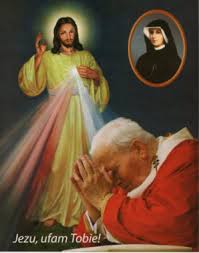
Canonizing Sister Faustina and Divine Mercy
HOMILY OF THE HOLY FATHER MASS IN ST PETER’S SQUARE FOR THE CANONIZATION OF SR MARY FAUSTINA KOWALSKA Sunday, 30 April 2000 1. “Confitemini Domino quoniam bonus, quoniam in saeculum misericordia eius”; “Give thanks to the Lord for he is good; his steadfast love endures for ever” (Ps 118: 1). So the Church sings on the Octave of[…]Continue reading→
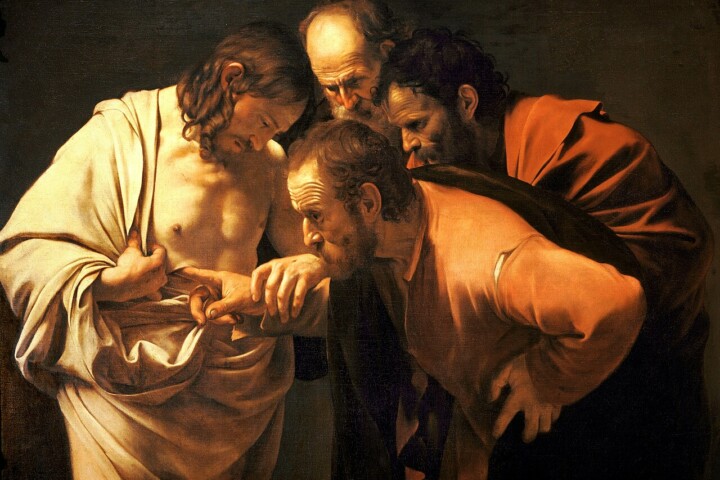
Divine Mercy Sunday – An Echo of Every Mass
Reach out your hand and put it in my side. Do not doubt but believe’… ‘My Lord and my God!’ (Jn. 20:18)). Today is Divine Mercy Sunday, and as we celebrate the end of the Easter Octave, we contemplate the wounded side of our Saviour, the Church’s source of life. On Good Friday in the[…]Continue reading→

Saint Stanislaus of Szczepanów
We celebrate Saint Stanislaus today (+ April 11, 1079), in light of this Easter Octave, a bishop and martyr who accepted the episcopacy only at the direct order of Pope Alexander II. He proved a wise and courageous leader of his flock, put to death by his own king, Boleslaus, for rebuking the monarch’s ‘immoral[…]Continue reading→
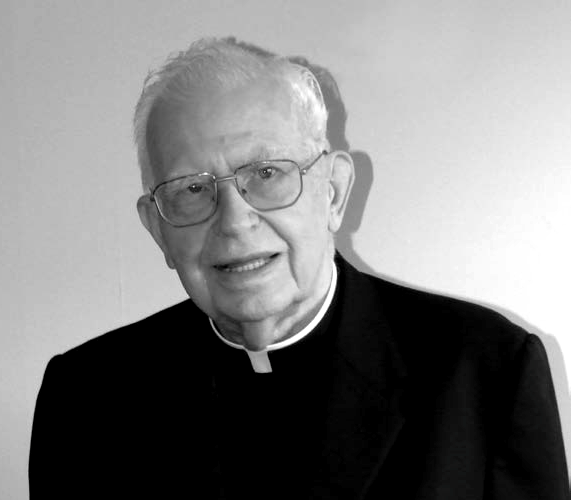
First Holy Communion: Sermon from May 16, 1943
Here is a sermon from the good old days by +Rev. Msgr. Vincent Nicholas Foy (August 14, 1915 – March 13, 2017), from 1943. Readers may recall that Pope Saint Pius X, by the decree Quam Singulari in 1910, lowered the customary age of reception of Holy Communion – after the rigours of the plague[…]Continue reading→
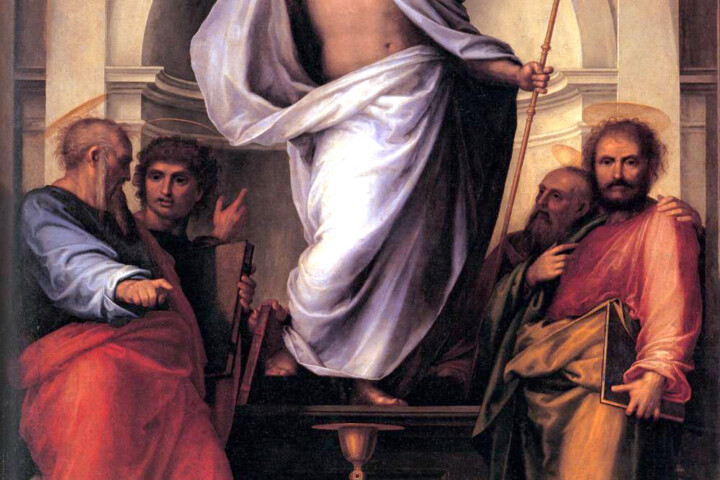
In the Glorious Light of Easter, Alleluia!
Set your minds on things that are above, not on things that are on earth, for you have died, and your life is hidden with Christ in God. When Christ who is your life is revealed, then you also will be revealed with him in glory (Col. 3:3-4). The Resurrection of Our Lord and Saviour[…]Continue reading→
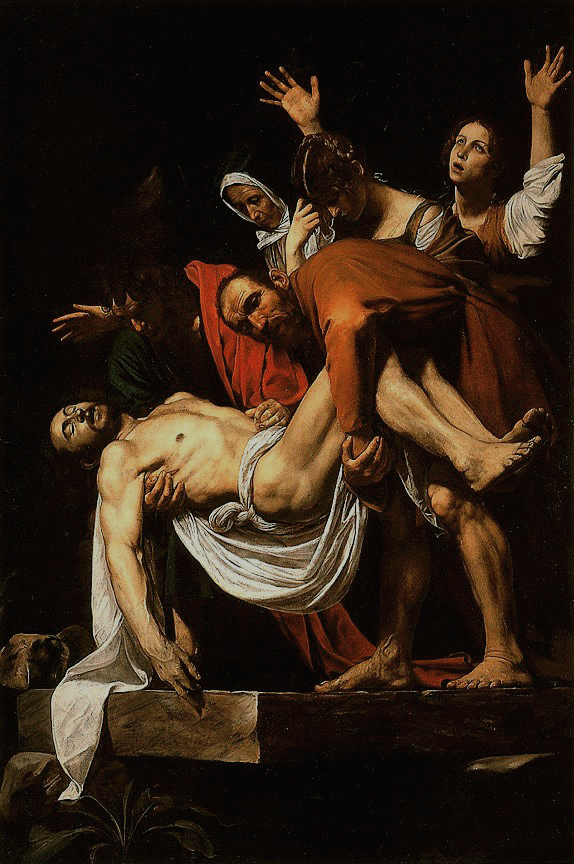
An Ancient Homily for Holy Saturday
The time between Good Friday and Easter Sunday is one of waiting, in silence, as the world wonders – anticipates – what will happen, after the death of Christ. We re-live this time each year in the anamnesis of our liturgy, and in turn look forward to the glorious re-creation of all things at the[…]Continue reading→
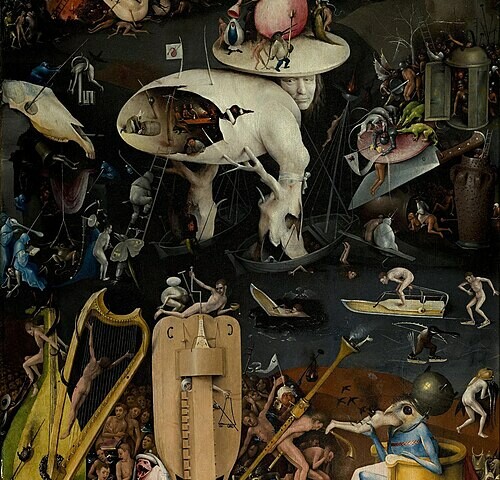
Europe’s Long Descent
(As we meditate on this day on Christ’s burial, and His descent into hell, it is fitting to ponder here with contributor Peter Marcus how the world seems to be heading there as well. The difference is that, although God cannot ‘redeem’ hell, nor those therein, He can and did redeem the world. There is[…]Continue reading→