
From Judaism to Catholicism: A Conversion Story
For as long as I can remember, I have believed in God.
A strange statement, coming from someone who was born in Israel and raised in a secular Jewish family. My mother, a cradle Catholic, had undergone a Reformed Jewish conversion to marry my father, an atheistic Jew.
I was born in Israel in 2004. Until age seven, when I emigrated to Canada, I grew up on a secular kibbutz, a socialist agricultural community. My life, albeit secular, centered around the Jewish liturgical calendar. In the fall, when the pomegranates would ripen, came Rosh Hashana, the Jewish New Year. This holiday was followed by Sukkot, the Feast of Tabernacles, where we would build and decorate sukkah and eat outside. Shabbat, Purim, Pesach, Lag Ba’Omer, Shavuot, Hanukkah, we celebrated them all. Each holiday had its biblical narrative, its food, its songs, and its traditions.
This is how I came to know God. Through the stories of Esther, Moses, and the Maccabees. And instinctively, I believed in Him.
After our move to Canada, my parents divorced. Leading up to their divorce and soon afterwards, my mother became more culturally Catholic. We started to celebrate Christmas and Easter, although not at church, and she even taught us to pray every night, making the sign of the Cross.
These cultural practices did not automatically lead to faith. My father, although an atheist, continued taking me to the synagogue more than my mother took me to church. I knew the Hebrew scriptures well, for I had lived them. But I knew nothing of Christ, and I felt torn between my parents and their respective faith traditions.
I knew there was a God, but I refused to believe in Him because belief meant trust, and at ten years old, after having suffered greatly with my parents’ divorce and with the turmoil of the immigration process to Canada, I felt like I could not rely on anyone, especially not He who was responsible for everything I had suffered.
And beyond that, I didn’t know exactly who He was.
But He knew me, and He loved me, and eventually, I came to love Him too. Through a series of seemingly random events, I accepted that although I did not understand why, God had not abandoned me. I began seeking Him out, wanting to know who He was.
In 2018, my mother moved to rural southern Ontario, where there were no French immersion or French schools other than the Catholic Francophone school one hour away from home. Thus, my parents, prioritizing our French, sent me there. There I learned the basics of the Catholic faith – who Christ was, what He had done for us, the importance of baptism and the sacraments.
More importantly, in Mass, I felt a sense of belonging like I had never felt before. A sense of total belonging I hadn’t experienced since I left my home country and became an immigrant, an “outsider” to the mainstream culture. I did not understand the Faith, but I knew it was true, and that it came from Christ, and that He really was who my teachers said He was.
With my parents’ permission, I was baptized on the feast day of Our Lady of Fatima at age 13 and completed my sacraments through my school.
Still, I did not regularly go to Mass – only once a month, when my school would celebrate Mass together. I did not pray. I didn’t really know how. I did not frequent any of the sacraments, I knew very little of who Christ actually was, the power of His transforming love in my life, a relationship with Him.
Yet I hungered for Him. I learned as much as I could about Him in my high school religion classes. I sought out the advice of my high school chaplain, who gave me the basis of my faith. With his help, I learned to pray.
My faith continued evolving throughout my teens. When I was fifteen, my mother came into a personal relationship with Christ, and began bringing my whole family to church every Sunday. Unfortunately, it was not a Catholic church. I discerned between following my family into the Protestant Church or remaining Catholic, and ultimately, St. Thérèse de Lisieux’s description and love of the Eucharist kept me in the Church. As a young adult, I chose to attend a Catholic university and began fully partaking in the sacraments and living life as a practising Catholic.
To me, Catholicism is not a rejection of the traditions with which I was raised. I still believe in the God of Abraham, Isaac and Jacob, the stories of Esther, Moses, and the Maccabees. I celebrate the Jewish holidays more seriously now, as they are my God-given spiritual heritage that have been fulfilled and made new by Christ. Becoming Catholic does not mean rejecting the irrevocable Covenant between God and Abraham – it means being part of the Old and New Covenant simultaneously, where the New completes the Old. Jewish practices and culture do not need to be abandoned, as long as there is a recognition that ultimately, salvation is found alone in Jesus Christ.
This cannot be understated. Being a Jewish convert to the faith, a Hebrew Catholic, has come with its own unique crosses that I would not have borne if I did not truly believe in the words of Christ. I have felt rejected by both Jews and by Catholics, as I am too Christian for some and too Jewish for others. But where else could I go? Only the Church has the fullness of the faith.
For this reason, it is up to us who are already in the Church to accept the gift of faith again and again, completely, every day, as Christ calls us to new challenges and greater intimacy with Him. Ultimately, converts or not, we all have our own reasons for rejecting Christ – anger, fear, distrust, shame, social and familial costs, lack of knowledge, love of sin, etc. But though He had far greater reasons than these, Christ did not reject us on the Cross. And He remains there, waiting for us to completely accept the gift which He is offering us.

Saint Kateri , Canada’s Protectress
This was the title given to Saint Kateri Tekakwitha, by Pope Benedict XVI, when he canonized her on October 28th, 2012, along with six others, in Saint Peter’ Square (she had been beatified by Pope John Paul II back in 1980). With Saint Joseph as our protector, along with the Canadian martyrs, we seem to[…]Continue reading→

Remembering Father Alphonse de Valk
(Today marks the sixth anniversary of the death of Father Alphonse de Valk, C.S.B., a faithful, courageous and indefatigable Basilian priest, pro-life-and-family apostle, and the founder of Catholic Insight magazine. Here is what we wrote those on his entering into eternity five years ago, as we continue to remember him in our prayers and thoughts)[…]Continue reading→

My Name is Bernadette
April 16th is a propitious day, for besides the anniversary of Father de Valk’s death, who founded Catholic Insight in its print form decades ago, and the commemoration of the ‘two Benedicts’, mentioned in accompanying posts, today we also recall Saint Bernadette Soubirous, the young visionary to whom the Virgin Mary appeared numerous times at[…]Continue reading→

Canonizing Sister Faustina and Divine Mercy
HOMILY OF THE HOLY FATHER MASS IN ST PETER’S SQUARE FOR THE CANONIZATION OF SR MARY FAUSTINA KOWALSKA Sunday, 30 April 2000 1. “Confitemini Domino quoniam bonus, quoniam in saeculum misericordia eius”; “Give thanks to the Lord for he is good; his steadfast love endures for ever” (Ps 118: 1). So the Church sings on the Octave of[…]Continue reading→

Divine Mercy Sunday – An Echo of Every Mass
Reach out your hand and put it in my side. Do not doubt but believe’… ‘My Lord and my God!’ (Jn. 20:18)). Today is Divine Mercy Sunday, and as we celebrate the end of the Easter Octave, we contemplate the wounded side of our Saviour, the Church’s source of life. On Good Friday in the[…]Continue reading→

Saint Stanislaus of Szczepanów
We celebrate Saint Stanislaus today (+ April 11, 1079), in light of this Easter Octave, a bishop and martyr who accepted the episcopacy only at the direct order of Pope Alexander II. He proved a wise and courageous leader of his flock, put to death by his own king, Boleslaus, for rebuking the monarch’s ‘immoral[…]Continue reading→
First Holy Communion: Sermon from May 16, 1943
Here is a sermon from the good old days by +Rev. Msgr. Vincent Nicholas Foy (August 14, 1915 – March 13, 2017), from 1943. Readers may recall that Pope Saint Pius X, by the decree Quam Singulari in 1910, lowered the customary age of reception of Holy Communion – after the rigours of the plague[…]Continue reading→
In the Glorious Light of Easter, Alleluia!
Set your minds on things that are above, not on things that are on earth, for you have died, and your life is hidden with Christ in God. When Christ who is your life is revealed, then you also will be revealed with him in glory (Col. 3:3-4). The Resurrection of Our Lord and Saviour[…]Continue reading→
An Ancient Homily for Holy Saturday
The time between Good Friday and Easter Sunday is one of waiting, in silence, as the world wonders – anticipates – what will happen, after the death of Christ. We re-live this time each year in the anamnesis of our liturgy, and in turn look forward to the glorious re-creation of all things at the[…]Continue reading→
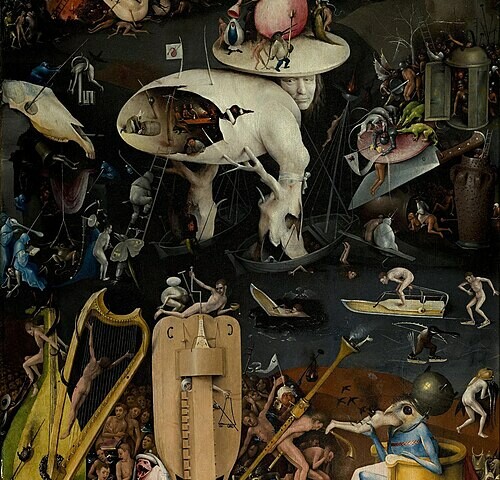
Europe’s Long Descent
(As we meditate on this day on Christ’s burial, and His descent into hell, it is fitting to ponder here with contributor Peter Marcus how the world seems to be heading there as well. The difference is that, although God cannot ‘redeem’ hell, nor those therein, He can and did redeem the world. There is[…]Continue reading→