
Maltese Bishops Condemn Voluntary Assisted Euthanasia
(Countries are falling like dominoes in the face of the culture of death. First, it was abortion – now it’s euthanasia, death-by-doctor. First legalized in the Netherlands, now it’s rampant, and it’s come for the small Catholic nation of Malta. They withstood the Muslims – may they withstand this specious form of murder. Ad vitam!)
On Saturday, 31st May, the Feast of the Visitation of the Blessed Virgin Mary to Elizabeth, the Bishops of Malta issued a pastoral letter regarding the present public consultation about the so-called Voluntary Assisted Euthanasia. As the Pastoral letter itself put it, it is being proposed that patients will be legally permitted to end their own lives with the assistance of medical professionals, either in hospital or at home, if they meet the following conditions: they are over 18, suffering from a terminal illness, and they have been told by doctors they have less than six months to live.
In the face of such a challenging issue which goes against God’s commandment and the natural law itself, “Thou shall not kill,” the Church felt duty bound to enlighten the conscience of Catholics, Christians and people of good will concerning this delicate issue. What is interesting is that this pastoral letter of our bishops is giving us hints that will help us weigh the government’s White Paper and then giving our singular contribution in the public consultation underway.
Let us never forget this foundational principle: every human life is precious. As a matter of fact, the Bishops boldly affirm that no one should feel worthless. What this means is that someone considering ending his or her life should not receive from the State the assistance to commit suicide, but rather, they should receive the support to live with dignity, surrounded by love and care. God’s commandment “You shall not kill”, a principle engraved in our hearts and at the core of our society, always continues to guide us in life. Therefore, the Bishops encourage the flock and people of good will: We must never be complicit in killing. They strengthen their argument on the fact that many doctors recognise their responsibility to remain faithful to the oath they took to save life and not to help end it.
The second insight the pastoral letter gives is that of always going towards the best possible care. What the Church is proposing is to strengthen, through all the investment necessary, palliative care for all who need it — and we emphasise for all — so that we can offer the best possible care until the final moments of life. In practice, this does not merely mean to say no to providing opportunities for assisted suicide but also to say yes with facts for holistic care that greatly reduces suffering. It is not just medical care to relieve pain, but also psychological, social and spiritual support. It is a genuine form of compassion.
The Maltese Bishops quote Pope Francis who spoke on palliative care: Palliative care, while seeking to alleviate the burden of pain as much as possible, is above all a concrete sign of closeness and solidarity with our brothers and sisters who are suffering. At the same time, this kind of care can help patients and their loved ones to accept the vulnerability, frailty and finitude that mark human life in this world. Within this context, the Bishops greatly encourage an investment to use medicine to ease the suffering of those in critical condition, and to administer this not with the intention of causing death, but to relieve pain, even if, as a consequence, life may be shortened. We believe a patient also has the right to refuse extraordinary medical treatment and to decline disproportionate treatment that causes unbearable suffering and offers no hope. That right is unfettered.
The Bishops made their own the strong affirmation, with Francis, that euthanasia is a “a failure of love, a reflection of a ‘throwaway culture’” in which “persons are no longer seen as a paramount value to be cared for and respected” (encyclical Fratelli Tutti, 18). Hence, euthanasia can never be compassion. This is so since real compassion means ‘to suffer with’, does not involve ending a life intentionally, but rather the willingness to share in the suffering of those who are facing the final stages of their journey on this earth. Let us show closeness, support and compassion through our empathy, closeness, great care, support and the necessary palliative care. Let us not accompany those who are suffering with love, not abandon them, and give them all the help they need in the difficult and trying circumstances in which they find themselves.
Let us pray that this pastoral letter helps foster a culture of life and never of death in Malta as well as throughout the whole world.
A Closed, Unsustainable, Descending Loop
As a follow-up to my thoughts on Payette’s payout, here be a stark image of where are here in Canada. As the graph shows in, well, graphic terms, since 2025, the public sector has contributed to 95.5% of economic growth. The private sector – which funds the public sector, or is supposed to – has[…]Continue reading→
Presidential Pardon of Weronika Krawczyk
As a good news, follow-up to our story from Poland, of the persecution of Weronika Krawczyk for her pro-life views, we heard that she has been granted a presidential pardon. One might still wonder why one needs a presidential pardon for simply holding the long-held belief that the child within the womb is a child,[…]Continue reading→
Pope Leo and a Rosary for Peace
Pope Leo XIV has asked Catholics across the world to join him in a Rosary for peace today, at 18:00 Rome time (6 pm), which would be noon from where I write (EST). If you are able, whether at that time or another, and in whatever way you pray, to join in intercession with the[…]Continue reading→
Payette’s Payout
I was glancing through some headlines, and noticed a mention of Julie Payette – engineer and astronaut and sometime the Queen’s representative in Canada – which brought back vague memories. She was appointed Governor-General by Justin Trudeau in 2017. Ms. Payette resigned in 2021, amidst claims that she created a ‘toxic work environment’, with allegations[…]Continue reading→
Weronika Krawczyk and Injustice in Poland
Catholic Action in Poland has issued a formal statement appealing to the President of the Republic of Poland to pardon Weronika Krawczyk—convicted for warning other women against an abortion-performing gynaecologist. Catholic Action (AK) emphasizes that no apology is owed to a doctor who has performed numerous abortions and proposed others; furthermore, the organization considers the[…]Continue reading→
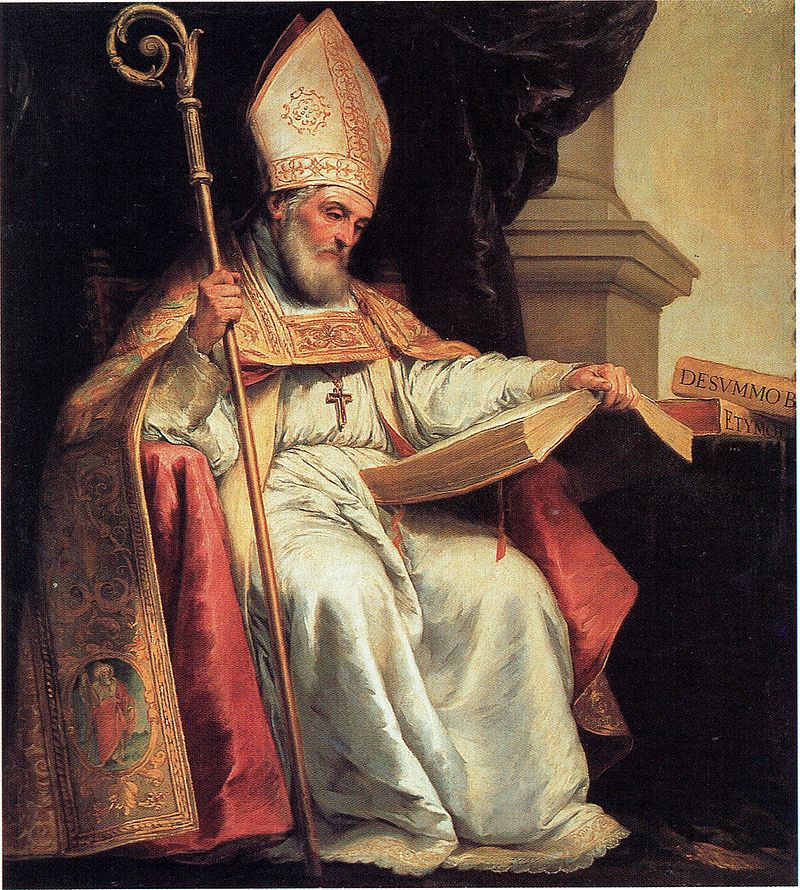
Saint Isidore of Seville, the Internet and Industriousness
Today, April 4th, muted this year by Holy Saturday, is the commemoration of Saint Isidore of Seville (560-636) a bishop and doctor of the Church during a tumultuous age, when civilization was crumbling, coming apart at its very seams, which may sound sort of au courant. Then again, the form of this world has always[…]Continue reading→
Bishop Fulton Sheen’s 58th Good Friday Reflection
Incredible, at the beginning of this reflection, that the Venerable Bishop Sheen declares that he has given nearly 58 Good Friday reflections – this, as far as I can gather, was his final one, and he seems in full vigour in mind and body. The good bishop and evangelist died in his 84th year on[…]Continue reading→
A Minimal Friar and the Death of a Great Pope
This April the second- overshadowed by Holy Thursday this year – marks the memorial of Saint Francis of Paola (1417-1507), founder of the ‘Minim’ friars, so called for their humility and poverty, who interpreted the rule of Saint Francis of Assisi in quite a literal sense: extreme poverty, trust in God, foregoing all animal and[…]Continue reading→
Woven versus Seamless Garments
The reflection on the worthy project by Magie Dominic was intriguing, and I thought I would offer a brief follow-up commentary. The garment woven out of many pieces is a poignant symbol, even a ‘sacramental’, inspired by prayer and grace. We are all united in some way, and should strive for such unity, wherever we[…]Continue reading→
Bill C-9: Prelude to Persecution?
Well, it happened, as I suppose was inevitable, at least in a secular sense (from God’ perspective, there’s always hope). Bill C-9, the ironically named ‘Combatting Hate Act’ passed the House of Commons with a 186-137 vote. Look on the good side – there’s still over a hundred sane people in parliament who believe in[…]Continue reading→