
Prayers Before the Conscecration of the Eucharist
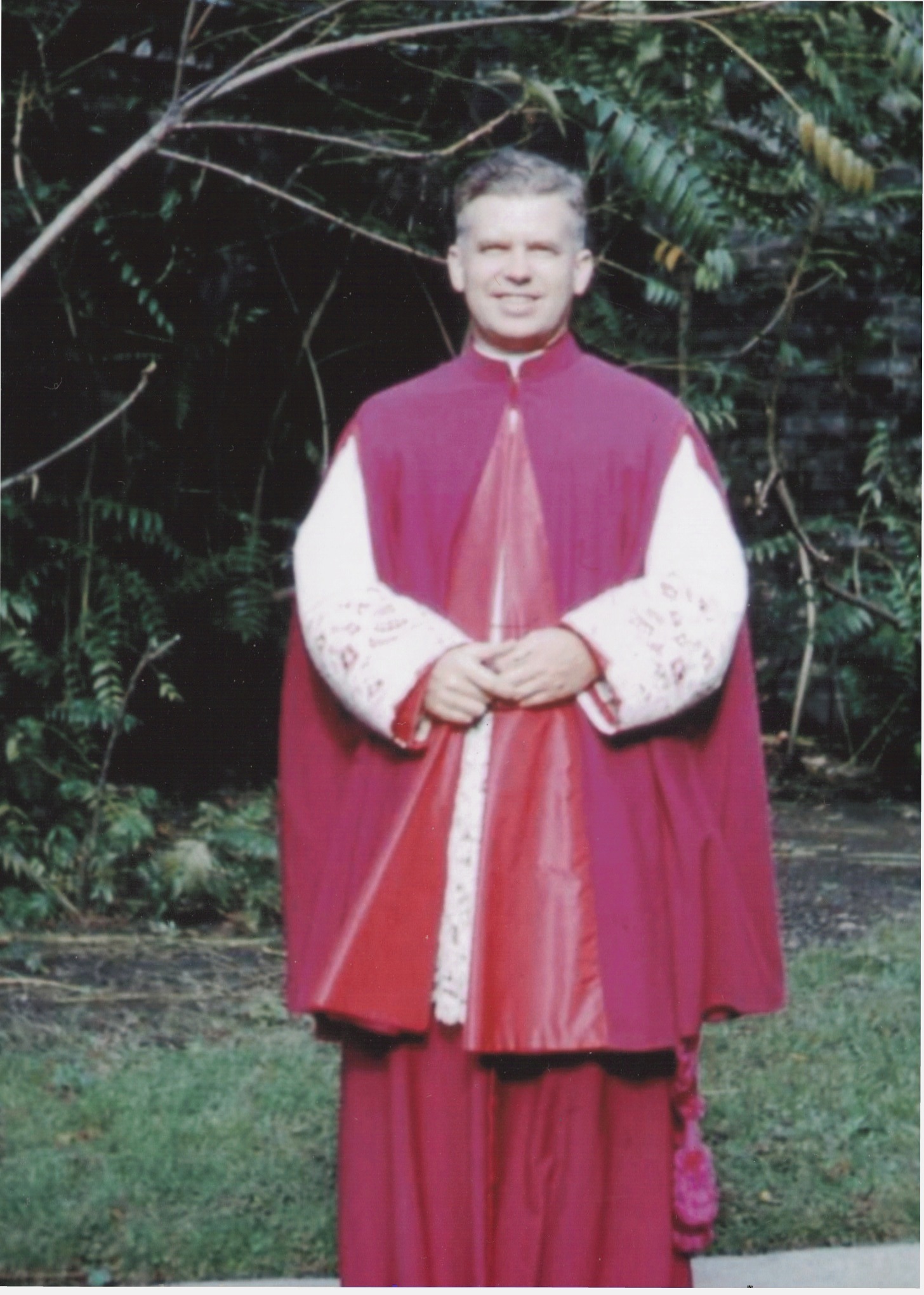
Here a glimpse into the past, of Canada, and the Church in Canada, with a sermon by Rev. Msgr. Vincent Nicholas Foy, preached at the evening Mass on Sunday, December 6, 1959 at St. Michael’s Cathedral, Toronto, before the changes made in the wake of the Second Vatican Council. As readers may know, Monsignor Foy was a stalwart warrior for the truth, especially in life issues, a foe of the disastrous ‘Winnipeg Statement’, and a good and faithful priest who lived to see his 101st birthday (!) and his 77th anniversary of ordination (!!). I was honoured to attend the Mass of his 75, if memory serves. May eternal light shine upon him, and may these few words help you participate more fully and consciously in the Holy Sacrifice of the Mass.
Part 1 – The Prayers before the Consecration (Introduction and Preface)
This evening, my dear brethren, we are going to consider briefly and, as it were, in a passing way, that part of the Mass which prepares us for the Consecration, which is the great centre, heart and essence of the Sacrifice of the Mass. This preparatory part of the Mass extends from the Preface to the last short prayer before the Consecration. This section of the Mass is also called the first part of the Canon of the Mass.
Perhaps it will help us to know what is meant by the Canon of the Mass. The Canon comprises the prayers at Mass from the Preface to the Pater Noster – Our Father. The word Canon means a rule or fixed measure and consists of parts of the Mass which, with slight exception, do not change but are the same for every Mass. It is interesting to reflect that in the beginning it was just the opposite. In the earliest Church the bishop or priest himself provided fitting prayers to surround the Consecration. St. Justin Martyr, wrote in the second century: “He who presides offers Eucharistic prayers and thanksgiving according to his ability.” Later, for the sake of uniformity and to ensure that these prayers were the most fitting possible, the Church determined and set the wording of the two beautiful and appropriate prayers surrounding the Consecration. These we call the Canon or fixed prayers and as we have them today, they go back at least to the fifth century.
The Canon begins with the Preface. The Preface sources the theme of the whole Eucharistic Sacrifice, which is one of thanksgiving. How fitting that we should be thankful for the coming of Christ:
- firstly into the world to save us
- secondly onto our Altar to unite us and apply the fruits of Calvary and
- thirdly into our hearts through Holy Communion to unite Himself with us and to sanctify us.
So we give thanks in the preface and the priest begins this prayer with the words “Lift up your hearts.” Surely, we have reasons enough at Mass to lift up our hearts, above our worries and ever grievous sufferings in the knowledge that Christ; Who can take care of us and them, and has taken our sins on His shoulders is coming down upon our Altar and into our hearts and souls. The priest continues: “Let us give thanks” and then “We should at all times and in all places give thanks to Thee, O holy Lord, Father Almighty.” The preface has been called worthy of a choir of angels. It ends with that beautiful prayer, the “Sanctus” one of the most ancient in the Church mentioned by St. Clement of Rome who died in the year 104.
In the Sanctus thanksgiving blends into praise; “Holy, Holy, Holy, Lord God of Celestial Hosts, Heaven and earth are full of Thy glory.”
Part 2: From the “Te Igitur” to the “Quam Oblationem”
All of the prayers that follow the Preface up to the Consecration refer to the Act of Sacrifice to take place. By the time the Sanctus bell has stopped ringing the priest is saying the Te Igitur or Prayer for the Church. The priest invokes the fruits of the Mass in the Church, the Spouse of Christ, in the pope and the bishop, who are mentioned by name. This petition recalls the prayers of Christ for His disciples at the Last Supper.
Then comes the “Memento Domine” or Memento for the Living. During the prayer the priest folds his hands and mentally recalls those of the living to whom he wishes to apply the Holy Sacrifice. The faithful should also recall their intentions at this time. Why not here remember living benefactors, relatives, or the sick or dying, or the suffering, or the mentally ill for the pagan or godless world? The priest prays here also for all those present. The faithful too should pray for their companions present in the church whose lives have converged, met and then go their separate ways – we pray in grace.
The next prayer is the Commemoration of the Saints. The prayers of the priest and people are here united with those of the souls in glory. First in the list comes Mary, “Mother of Our God and Lord Jesus Christ.” Then come the names of the twelve Apostles and twelve martyrs, an account of their lives spreads over the first four-hundred years of the Church’s existence. It is consoling to be privileged to unite our prayers with theirs.
After the Commemoration of the Saints is the “Hanc Igitur” or Preparation for the Consecration. During this prayer the priest places his hands over the bread and wine and the bell rings to remind us that the Consecration is at hand. In the Sacrifice of Atonement in the Old Law, the high priest placed his hands upon the head of the animal before it was slain to indicate that the sins of the people had been transferred to the victim of sacrifice. In the Mass the priest, and through him the people, virtually touch the sacrifices and in a symbolic manner transfer their sins to the elements which are to become the Body and Blood of Our Lord Jesus Christ, the scapegoat for our offenses.
There is another very brief prayer before the Consecration called the “Quam Oblationem” in which the bread and wine are given a final and special blessing.
Such are the prayers in preparation for that great moment of the Consecration when the Altar again becomes the table of the Last Supper. The priest stands in the place of Christ and the self-same words which Christ uttered are again pronounced in another tongue but with the same effect: bread and wine become the Living Christ.
May I suggest, my dear brethren, that we who are privileged to return through the Mass to the Last Supper and to Calvary continually study the Mass, assist at it with greater attention and devotion and participate in it more closely united with the priest and other members of the congregation – remembering that we are all one in Christ our Saviour.
Amen.
This handwritten sermon by + Msgr. Vincent Nicholas Foy, was typed for the first time on the Feast of St. Nicholas, December 6, 2024 by EUCHARISTIC ADORATION – www.perpetualeucharisticadoration.com

Remembering Father Alphonse de Valk
(Today marks the sixth anniversary of the death of Father Alphonse de Valk, C.S.B., a faithful, courageous and indefatigable Basilian priest, pro-life-and-family apostle, and the founder of Catholic Insight magazine. Here is what we wrote those on his entering into eternity five years ago, as we continue to remember him in our prayers and thoughts)[…]Continue reading→

Divine Mercy Sunday – An Echo of Every Mass
Reach out your hand and put it in my side. Do not doubt but believe’… ‘My Lord and my God!’ (Jn. 20:18)). Today is Divine Mercy Sunday, and as we celebrate the end of the Easter Octave, we contemplate the wounded side of our Saviour, the Church’s source of life. On Good Friday in the[…]Continue reading→

Saint Stanislaus of Szczepanów
We celebrate Saint Stanislaus today (+ April 11, 1079), in light of this Easter Octave, a bishop and martyr who accepted the episcopacy only at the direct order of Pope Alexander II. He proved a wise and courageous leader of his flock, put to death by his own king, Boleslaus, for rebuking the monarch’s ‘immoral[…]Continue reading→

First Holy Communion: Sermon from May 16, 1943
Here is a sermon from the good old days by +Rev. Msgr. Vincent Nicholas Foy (August 14, 1915 – March 13, 2017), from 1943. Readers may recall that Pope Saint Pius X, by the decree Quam Singulari in 1910, lowered the customary age of reception of Holy Communion – after the rigours of the plague[…]Continue reading→

In the Glorious Light of Easter, Alleluia!
Set your minds on things that are above, not on things that are on earth, for you have died, and your life is hidden with Christ in God. When Christ who is your life is revealed, then you also will be revealed with him in glory (Col. 3:3-4). The Resurrection of Our Lord and Saviour[…]Continue reading→

An Ancient Homily for Holy Saturday
The time between Good Friday and Easter Sunday is one of waiting, in silence, as the world wonders – anticipates – what will happen, after the death of Christ. We re-live this time each year in the anamnesis of our liturgy, and in turn look forward to the glorious re-creation of all things at the[…]Continue reading→

Europe’s Long Descent
(As we meditate on this day on Christ’s burial, and His descent into hell, it is fitting to ponder here with contributor Peter Marcus how the world seems to be heading there as well. The difference is that, although God cannot ‘redeem’ hell, nor those therein, He can and did redeem the world. There is[…]Continue reading→
Pope Saint John Paul II’s First Good Friday Homily
ADDRESS OF HIS HOLINESS JOHN PAUL II AT THE CONCLUSION OF THE STATIONS OF THE CROSS AT THE COLOSSEUM Good Friday, 13 April 1979 When we make the Way of the Cross from one station to the next, in spirit we are always at the spot wherethis journey had its “historical” place: where it[…]Continue reading→
A Meditation for Good Friday: How To Undo the Effects of Sin?
Cardinal Newman, now Saint John Henry Newman, was a towering figure of nineteenth-century Catholicism who is almost universally admired. I say “almost” because not everyone likes him. I knew a priest once, Arthur Caulkins, who has become disenchanted with Newman. As an undergraduate Arthur had been enamoured of Newman, and this interest continued when he[…]Continue reading→
Pope Benedict’s Last Holy Thursday Homily
MASS OF THE LORD’S SUPPER HOMILY OF HIS HOLINESS BENEDICT XVI Basilica of St John Lateran Holy Thursday, 5 April 2012 Photo Gallery (Video) Dear Brothers and Sisters! Holy Thursday is not only the day of the institution of the Most Holy Eucharist, whose splendour bathes all else and in some ways draws it to[…]Continue reading→