
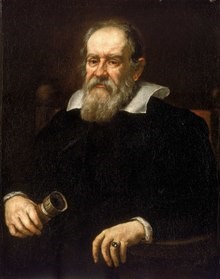
The Catholic Galileo
Galileo Galilei was born in Pisa, Italy. In his youth he considered several careers: first the priesthood; next medicine at the urging of his father; finally mathematics as his own preference. His keen grasp of geometry especially contributed to his attempt to mathematically map the geography of Dante’s Inferno, for which he received much attention and acclaim. In later years he turned his interest toward inventions, in particular the pendulum clock and various telescopes. His years teaching at the University of Padua increased his fascination with astronomy which became the thing he would be most remembered for. One of the telescopes he invented produced 30x magnification, opening up the heavens as a magnificent spectacle.
It was also during this period that quarrels began to erupt between Galileo and his Dominican and Jesuit critics, highly influential scholars committed to the traditional science of Ptolemy and Aristotle which claimed that the sun revolves about the earth. These were scholars whom Galileo sometimes unwisely did not to treat with respect, and whom he later thought to have been behind his future troubles with the Pope.
But Galileo knew that old Copernicus was right, that the earth is revolving about the sun. He proceeded to demonstrate this mathematically and further imperiled himself by mocking the view of Pope Urban VIII, who allowed that this new heliocentric theory might be true, but that Galileo had not proven it as a fact – which was true. For his persistence Galileo was punished by house arrest for the remainder of his life. It is another of those sad chapters in the history of power politics.
But that chapter was never confined to the seventeenth century. Ever so often it is read and cited again with great flourishes of rhetoric by those who imagine that science and religion must be at eternal war with each other. The truth is that Galileo saw no essential tension between science and religion. All his biographers insist he remained a devoted Catholic throughout the remainder of his life.
There was a reluctance of certain Church scholars to go along with heliocentric theory because of a Biblical passage (Joshua 10:12) that seems to contradict it by calling upon the sun to stand still, but the opposition to heliocentrism was just as much a function of scientific conservatism as anything else. Ptolemy and Aristotle (neither of them Catholics but both supporting the view that the sun revolves about the earth) had ruled the scientific roots of astronomy for thousands of years. As for Joshua 110:12, Galileo was merely following in the tradition of St. Augustine, which was to reason that the Bible shows us the way to go to heaven, not the way the heavens go.
In 1992 Pope John Paul II corrected the mistake of Pope Urban VIII by admitting he was wrong in persecuting Galileo for suspected heresy. The apology was a long time coming, but well deserved. Now if only those who scoff at religion could accept the apology and move on.
Let us give Galileo the last word:
I do not feel obliged to believe that the same God who endowed us with sense, reason, and intellect had intended for us to forgo their use.

Saint Kateri , Canada’s Protectress
This was the title given to Saint Kateri Tekakwitha, by Pope Benedict XVI, when he canonized her on October 28th, 2012, along with six others, in Saint Peter’ Square (she had been beatified by Pope John Paul II back in 1980). With Saint Joseph as our protector, along with the Canadian martyrs, we seem to[…]Continue reading→

Remembering Father Alphonse de Valk
(Today marks the sixth anniversary of the death of Father Alphonse de Valk, C.S.B., a faithful, courageous and indefatigable Basilian priest, pro-life-and-family apostle, and the founder of Catholic Insight magazine. Here is what we wrote those on his entering into eternity five years ago, as we continue to remember him in our prayers and thoughts)[…]Continue reading→

My Name is Bernadette
April 16th is a propitious day, for besides the anniversary of Father de Valk’s death, who founded Catholic Insight in its print form decades ago, and the commemoration of the ‘two Benedicts’, mentioned in accompanying posts, today we also recall Saint Bernadette Soubirous, the young visionary to whom the Virgin Mary appeared numerous times at[…]Continue reading→

Canonizing Sister Faustina and Divine Mercy
HOMILY OF THE HOLY FATHER MASS IN ST PETER’S SQUARE FOR THE CANONIZATION OF SR MARY FAUSTINA KOWALSKA Sunday, 30 April 2000 1. “Confitemini Domino quoniam bonus, quoniam in saeculum misericordia eius”; “Give thanks to the Lord for he is good; his steadfast love endures for ever” (Ps 118: 1). So the Church sings on the Octave of[…]Continue reading→

Divine Mercy Sunday – An Echo of Every Mass
Reach out your hand and put it in my side. Do not doubt but believe’… ‘My Lord and my God!’ (Jn. 20:18)). Today is Divine Mercy Sunday, and as we celebrate the end of the Easter Octave, we contemplate the wounded side of our Saviour, the Church’s source of life. On Good Friday in the[…]Continue reading→

Saint Stanislaus of Szczepanów
We celebrate Saint Stanislaus today (+ April 11, 1079), in light of this Easter Octave, a bishop and martyr who accepted the episcopacy only at the direct order of Pope Alexander II. He proved a wise and courageous leader of his flock, put to death by his own king, Boleslaus, for rebuking the monarch’s ‘immoral[…]Continue reading→
First Holy Communion: Sermon from May 16, 1943
Here is a sermon from the good old days by +Rev. Msgr. Vincent Nicholas Foy (August 14, 1915 – March 13, 2017), from 1943. Readers may recall that Pope Saint Pius X, by the decree Quam Singulari in 1910, lowered the customary age of reception of Holy Communion – after the rigours of the plague[…]Continue reading→
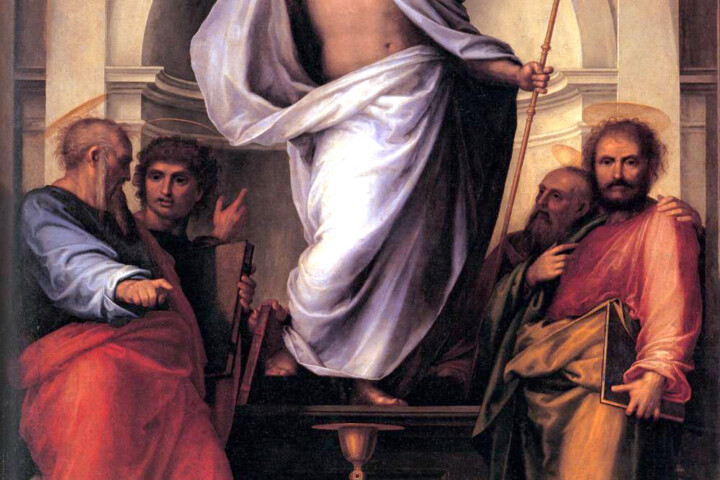
In the Glorious Light of Easter, Alleluia!
Set your minds on things that are above, not on things that are on earth, for you have died, and your life is hidden with Christ in God. When Christ who is your life is revealed, then you also will be revealed with him in glory (Col. 3:3-4). The Resurrection of Our Lord and Saviour[…]Continue reading→
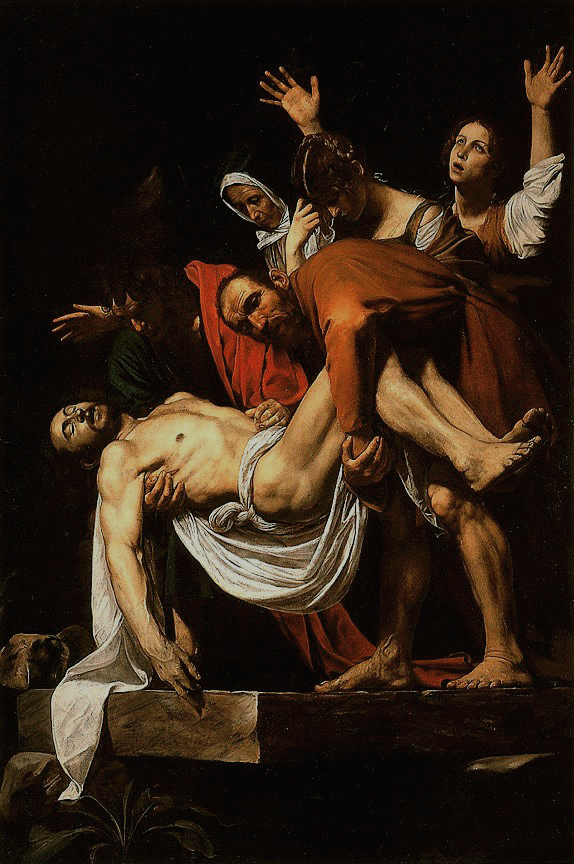
An Ancient Homily for Holy Saturday
The time between Good Friday and Easter Sunday is one of waiting, in silence, as the world wonders – anticipates – what will happen, after the death of Christ. We re-live this time each year in the anamnesis of our liturgy, and in turn look forward to the glorious re-creation of all things at the[…]Continue reading→
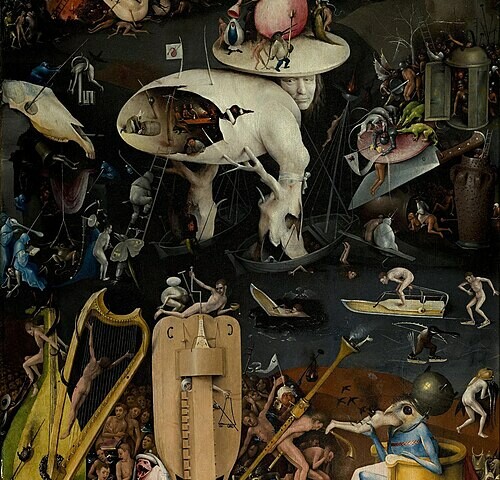
Europe’s Long Descent
(As we meditate on this day on Christ’s burial, and His descent into hell, it is fitting to ponder here with contributor Peter Marcus how the world seems to be heading there as well. The difference is that, although God cannot ‘redeem’ hell, nor those therein, He can and did redeem the world. There is[…]Continue reading→