
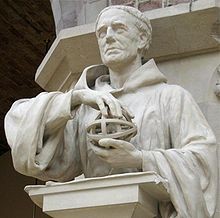
Roger Bacon: Seer of Science
(We are soon approaching the feast of Saint Albert the Great, Dominican, teacher of Saint Thomas, and patron saint of scientists on the 15th of this month. As a prelude, here is a reflection from contributor Carl Sundell on Albert’s Franciscan predecessor, Roger Bacon) Ed.
Roger Bacon was a contemporary of the great theologian Thomas Aquinas (both of them taught at the University of Paris within a few years of each other, but there is no evidence that they knew of each other’s works). He was educated at Oxford and Paris, later became a professor at Oxford, and was ordained a Franciscan priest about 1240. In the course of his studies he proved to be a prophet of inventions so impressive that Pope Clement IV urged him to secretly send manuscripts to him for examination. Some of these same ideas had caused Bacon’s Franciscan superiors to doubt his orthodoxy in religious matters, but the Pope gave Bacon as much leeway as possible to continue his work. Then Clement IV died prematurely, at least with respect to advancing the interests of Bacon, whose standing continued to fall as his superiors grew increasingly suspicious of him.
The most important works by Bacon include the Opus Majus, the Opus Minus, and the Tertium. In these works Bacon brings major charges against the “sinful” scholarship of his times, far too weighed down by metaphysical speculations and a nearly complete disregard for the great importance of mathematics and the experimental sciences. As he said, “All science requires mathematics. The knowledge of mathematical things is almost innate in us. This is the easiest of sciences, a fact which is obvious in that no one’s brain rejects it; for laymen and people who are utterly illiterate know how to count and reckon.”
Bacon indicted the theologians of his day not only for widespread ignorance, but also for willful distortion and corruption of the sacred truths of the faith. This at least partly, along with his perhaps excessive zeal in protesting, placed him in a difficult position to advance his own ideas, so that they remained buried for centuries before they could be resurrected by later scholars following Gutenberg’s invention of the printing press.
We examine now some of the things that mattered most to Bacon. Perhaps first we should acknowledge the style of the man. He was not simply the intellectual, but also the aesthete. For him science had to be both true and eloquent. “Science without eloquence is like a sharp sword in the hands of a paralytic, whilst eloquence without science is a sharp sword in the hands of a furious man.” Moreover, the eloquence of scriptures cannot be obscured or contradicted by the eloquence of science. But eloquence is not merely literary. Eloquence is also the description of things as they really are. “The strongest arguments prove nothing so long as the conclusions are not verified by experience. Experimental science is the queen of sciences and the goal of all speculation.” This viewpoint, so unusual in its day, may well have spurred that later seer of science, Francis Bacon, as he helped pave the way in his Novum Organum for the rise of modern science.
Bacon also presented as an ideal what we today call the Renaissance Man, the well-rounded scholar who knows not only foreign languages, scriptures, and moral philosophy, but who also has a practical knowledge of how to test and prove a scientific hypothesis. That moral philosophy was a requirement along with other scientific disciplines shows how much Bacon was not only far in advance of his own time, but also of the modern era in which the scientific community has been largely dominated by atheism and antagonism toward religion and traditional morality.
In many other ways Bacon was, like Leonardo da Vinci, a man born centuries ahead of the day, when his talents might have greatly flourished and borne fruit. For examples, he imagined a great ship being operated by one man without the need of oarsmen (steamships), a machine that would make possible the walking of men along the ocean floor (the diving bell), and a vehicle that could be propelled below water (the submarine). He also imagined a vehicle operating at high speeds without the need of any horsepower (the automobile), and a machine with a mechanical device in it that would make it fly above the earth.
Like the future Isaac Newton, Bacon became absorbed in the science of optics. He theorized that “Someday we may read the smallest letters at an incredible distance (binoculars) we may see objects however small they may be (microscopes) and we may cause the stars to appear wherever we wish” (telescopes). As for a new technology of light, there may sometime in the future appear “that device by which rays of light are led into any place that we wish and are brought together by refractions in such fashion that anything is burned which is placed there” (laser technology). These inventions would all take six to seven more centuries to materialize.
Bacon also pointed out the deficiencies of the Julian calendar which would lead three centuries later to the more accurate Gregorian calendar. It is true that the tardiness of the reception of his ideas about the calendar may have been related to the general neglect and suppression of Bacon’s entire work by his superiors. That Bacon was not able to be a scientist of the sort that he most admired was not his fault, nor the fault of the Church. Scientific “laboratories” of the type he envisioned were not yet known to be possible. Very likely his speculations, especially in the dangerous areas of astrology and alchemy condemned by the Church, led his superiors to think of him as an idle eccentric who needed to be placed under arrest for his own good and the good of the community. But his ideas, though undeveloped for centuries, were never entirely extinguished. His writings exist to prove that he was at least the prophet par excellence of a scientific priesthood that sorely needs today, as never before, to be devoted to the True, the Beautiful, and the Good.

Remembering Father Alphonse de Valk
(Today marks the sixth anniversary of the death of Father Alphonse de Valk, C.S.B., a faithful, courageous and indefatigable Basilian priest, pro-life-and-family apostle, and the founder of Catholic Insight magazine. Here is what we wrote those on his entering into eternity five years ago, as we continue to remember him in our prayers and thoughts)[…]Continue reading→

Divine Mercy Sunday – An Echo of Every Mass
Reach out your hand and put it in my side. Do not doubt but believe’… ‘My Lord and my God!’ (Jn. 20:18)). Today is Divine Mercy Sunday, and as we celebrate the end of the Easter Octave, we contemplate the wounded side of our Saviour, the Church’s source of life. On Good Friday in the[…]Continue reading→

Saint Stanislaus of Szczepanów
We celebrate Saint Stanislaus today (+ April 11, 1079), in light of this Easter Octave, a bishop and martyr who accepted the episcopacy only at the direct order of Pope Alexander II. He proved a wise and courageous leader of his flock, put to death by his own king, Boleslaus, for rebuking the monarch’s ‘immoral[…]Continue reading→
First Holy Communion: Sermon from May 16, 1943
Here is a sermon from the good old days by +Rev. Msgr. Vincent Nicholas Foy (August 14, 1915 – March 13, 2017), from 1943. Readers may recall that Pope Saint Pius X, by the decree Quam Singulari in 1910, lowered the customary age of reception of Holy Communion – after the rigours of the plague[…]Continue reading→
In the Glorious Light of Easter, Alleluia!
Set your minds on things that are above, not on things that are on earth, for you have died, and your life is hidden with Christ in God. When Christ who is your life is revealed, then you also will be revealed with him in glory (Col. 3:3-4). The Resurrection of Our Lord and Saviour[…]Continue reading→
An Ancient Homily for Holy Saturday
The time between Good Friday and Easter Sunday is one of waiting, in silence, as the world wonders – anticipates – what will happen, after the death of Christ. We re-live this time each year in the anamnesis of our liturgy, and in turn look forward to the glorious re-creation of all things at the[…]Continue reading→
Europe’s Long Descent
(As we meditate on this day on Christ’s burial, and His descent into hell, it is fitting to ponder here with contributor Peter Marcus how the world seems to be heading there as well. The difference is that, although God cannot ‘redeem’ hell, nor those therein, He can and did redeem the world. There is[…]Continue reading→
Pope Saint John Paul II’s First Good Friday Homily
ADDRESS OF HIS HOLINESS JOHN PAUL II AT THE CONCLUSION OF THE STATIONS OF THE CROSS AT THE COLOSSEUM Good Friday, 13 April 1979 When we make the Way of the Cross from one station to the next, in spirit we are always at the spot wherethis journey had its “historical” place: where it[…]Continue reading→
A Meditation for Good Friday: How To Undo the Effects of Sin?
Cardinal Newman, now Saint John Henry Newman, was a towering figure of nineteenth-century Catholicism who is almost universally admired. I say “almost” because not everyone likes him. I knew a priest once, Arthur Caulkins, who has become disenchanted with Newman. As an undergraduate Arthur had been enamoured of Newman, and this interest continued when he[…]Continue reading→
Pope Benedict’s Last Holy Thursday Homily
MASS OF THE LORD’S SUPPER HOMILY OF HIS HOLINESS BENEDICT XVI Basilica of St John Lateran Holy Thursday, 5 April 2012 Photo Gallery (Video) Dear Brothers and Sisters! Holy Thursday is not only the day of the institution of the Most Holy Eucharist, whose splendour bathes all else and in some ways draws it to[…]Continue reading→