
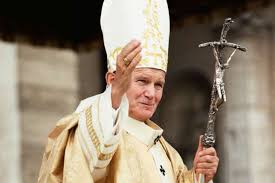
A Fateful Choice, Forty Six Years Ago
As we celebrate the memorial of Pope Saint John Paul II on October 22nd, we should also recall that it was on the 16th that he was elected Pope, and is now the forty-sixth anniversary of that fateful and providential election. We may remember his words spoken from the balcony of St Peter’s Basilica, Monday 16 October 1978:
We are all still saddened after the death of our beloved Pope John Paul I. And now the Most Eminent Cardinals have called a new bishop of Rome. They called him from a distant country… far away, but always so close for communion in faith and in Christian tradition. I was afraid in receiving this appointment, but I did it in the spirit of obedience towards Our Lord Jesus Christ and in total trust towards his Mother, the Most Holy Madonna. I don’t know if I can explain myself well in your… our Italian language. If I’m wrong you will correct me. And so I present myself to all of you, to confess our common faith, our hope, our trust in the Mother of Christ and of the Church, and also to begin again on this path of history and of the Church, with the help of God and with the help of men.
This great Pope, the Pope of Divine Mercy, started his journey as the 264th Pope, the Vicar of Christ and the successor of St Peter. Many are the characteristics with made him a great Pope. However we are going to limit to some features which clearly made this second long serving Pope in history, after the Papacy of Blessed Pius IX, great.
First, Pope John Paul powerfully and lovingly promoted an incredible love for Mary, Our Heavenly Mother. His famous Marian motto, Totus Tuus, “Totally Yours”, said it all. Really and truly his life was indelibly marked by a strong filial love towards Mary. It was thanks to Mary that he escaped an assassination attempt on the feast of Our Lady of Fatima, on May 13, 1981. He openly spoke about this unforgettable incident for him and for us. He said: It was a mother’s hand that guided the bullet’s path.
One of the most beautiful thoughts about Mary which John Paul II left is that given to us in his homily in the Solemnity of Mary, Mother of God and the XXXV World Day of Peace on Tuesday 1, 2002: If Jesus is Life, Mary is the Mother of Life. If Jesus is Hope, Mary is the Mother of Hope. If Jesus is Peace, Mary is the Mother of Peace, Mother of the Prince of Peace. Hence Mariology is based on Christology.
Let us not forget what Jason Evert writes in his brief overview on Pope St John Paul II’s life entitled: Saint John Paul the Great: His Five Loves: In True Devotion to Mary, St. Louis de Montfort wrote, ‘the most faithful servants of the Blessed Virgin, being her greatest favorites, receive from her the best graces and favors from heaven, which are crosses.’ If suffering is a sign of predilection, then John Paul II must have been one of our Lady’s favorites!” Of the importance of the rosary John Paul II declared, “[The rosary is] our daily meeting which neither I nor the Blessed Virgin Mary neglect.
The second aspect which features highly in the life of Pope St John Paul II is that he was a people’s Pope. His closeness with the people was simply incredible. From the first moments of his service, it was clear that this was a different kind of pope. Upon his election, he greeted the cardinals of the conclave—his “brothers”—standing rather than seated, which was the tradition. A few weeks after his election, he leaned out the windows of the Vatican palace to sing carols with 50,000 children gathered in St. Peter’s Square to celebrate Christmas. Instead of limiting his concerns to the administration of the church, he traveled far and wide to carry the message of Christianity to the people. Crowds, often numbering in the hundreds of thousands to millions, gathered to see him around the globe. In 1979 he made his first trip to the United States, after which Time magazine ran a cover story with the headline, “John Paul, Superstar.” Pope John Paul fought for freedom of religion in every place he went, even challenging his Communist homeland. His call for solidarity greatly aided to the downfall of communism in Poland and across the Eastern bloc. He published regularly—memoirs as well as books of prayers, lessons, meditations, and poetry. Despite his active ministry on the world stage, he remained loyal to the teachings of the Church. When he died on April 2, 2005, he was hailed both as a holy man and a man of peace by Christians and non-Christians alike.
Third, Pope St John Paul II promoted the Sacrament of Confession. Let us taste some of his memorable teachings on the subject. On 14 September 1987 Pope John Paul II said: Confession is an act of honesty and courage – an act of entrusting ourselves, beyond sin, to the mercy of a loving and forgiving God.
In his encyclical letter on the Eucharist and its relationship to the Church, Ecclesia De Eucharistia, he wrote: The two sacraments of the Eucharist and Penance are very closely connected. Because the Eucharist makes present the redeeming sacrifice of the Cross, perpetuating it sacramentally, it naturally gives rise to a continuous need for conversion, for a personal response to the appeal made by St Paul to the Christians of Corinth: ‘We beseech you on behalf of Christ, be reconciled to God’ (2 Cor 5:20). If a Christian’s conscience is burdened by serious sin, then the path of penance through the sacrament of Reconciliation becomes necessary for full participation in the Eucharistic Sacrifice (no.37).
Moreover, confession is a medicine which heals us from the damage of sin. In his post-synodal apostolic exhortation on reconciliation and penance in the mission of the Church today, Reconciliatio et Paenitentia, Pope John Paul II stated: It is thanks to the medicine of confession that the experience of sin does not degenerate into despair. The Rite of Penance alludes to this healing aspect of the sacrament, to which modern man is perhaps more sensitive, seeing as he does in sin the element of error but even more the element of weakness and human frailty (no.31.II). What a blessing the ministry of the confessional is! Within the same exhortation the Holy Father reminded us of the ministry of confessors. I also wish to pay homage to the innumerable host of holy and almost always anonymous confessors to whom is owed the salvation of so many souls who have been helped by them in conversion, in the struggle against sin and temptation, in spiritual progress and, in a word, in achieving holiness. I do not hesitate to say that even the great canonized saints are generally the fruit of those confessionals, and not only the saints but also the spiritual patrimony of the church and the flowering of a civilization permeated with the Christian spirit! Praise then to this silent army of our brothers who have served well and serve each day the cause of reconciliation through the ministry of sacramental penance! (no.29).
The sacrament of confession and devotion to the Virgin Mary, particularly the Rosary, are really two beautiful gifts which the forty-six anniversary from the election of Pope St John Paul II is giving to us today.
Oh, St. John Paul, from the window of heaven, grant us your blessing! Bless the church that you loved and served and guided, courageously leading it along the paths of the world in order to bring Jesus to everyone and everyone to Jesus. Bless the young, who were your great passion. Help them dream again, help them look up high again to find the light that illuminates the paths of life here on earth.
May you bless families, bless each family! You warned of Satan’s assault against this precious and indispensable divine spark that God lit on earth. St. John Paul, with your prayer, may you protect the family and every life that blossoms from the family.
Pray for the whole world, which is still marked by tensions, wars and injustice. You tackled war by invoking dialogue and planting the seeds of love: pray for us so that we may be tireless sowers of peace.
Oh St. John Paul, from heaven’s window, where we see you next to Mary, send God’s blessing down upon us all. Amen.

Saint Kateri , Canada’s Protectress
This was the title given to Saint Kateri Tekakwitha, by Pope Benedict XVI, when he canonized her on October 28th, 2012, along with six others, in Saint Peter’ Square (she had been beatified by Pope John Paul II back in 1980). With Saint Joseph as our protector, along with the Canadian martyrs, we seem to[…]Continue reading→

Remembering Father Alphonse de Valk
(Today marks the sixth anniversary of the death of Father Alphonse de Valk, C.S.B., a faithful, courageous and indefatigable Basilian priest, pro-life-and-family apostle, and the founder of Catholic Insight magazine. Here is what we wrote those on his entering into eternity five years ago, as we continue to remember him in our prayers and thoughts)[…]Continue reading→

My Name is Bernadette
April 16th is a propitious day, for besides the anniversary of Father de Valk’s death, who founded Catholic Insight in its print form decades ago, and the commemoration of the ‘two Benedicts’, mentioned in accompanying posts, today we also recall Saint Bernadette Soubirous, the young visionary to whom the Virgin Mary appeared numerous times at[…]Continue reading→

Canonizing Sister Faustina and Divine Mercy
HOMILY OF THE HOLY FATHER MASS IN ST PETER’S SQUARE FOR THE CANONIZATION OF SR MARY FAUSTINA KOWALSKA Sunday, 30 April 2000 1. “Confitemini Domino quoniam bonus, quoniam in saeculum misericordia eius”; “Give thanks to the Lord for he is good; his steadfast love endures for ever” (Ps 118: 1). So the Church sings on the Octave of[…]Continue reading→

Divine Mercy Sunday – An Echo of Every Mass
Reach out your hand and put it in my side. Do not doubt but believe’… ‘My Lord and my God!’ (Jn. 20:18)). Today is Divine Mercy Sunday, and as we celebrate the end of the Easter Octave, we contemplate the wounded side of our Saviour, the Church’s source of life. On Good Friday in the[…]Continue reading→

Saint Stanislaus of Szczepanów
We celebrate Saint Stanislaus today (+ April 11, 1079), in light of this Easter Octave, a bishop and martyr who accepted the episcopacy only at the direct order of Pope Alexander II. He proved a wise and courageous leader of his flock, put to death by his own king, Boleslaus, for rebuking the monarch’s ‘immoral[…]Continue reading→

First Holy Communion: Sermon from May 16, 1943
Here is a sermon from the good old days by +Rev. Msgr. Vincent Nicholas Foy (August 14, 1915 – March 13, 2017), from 1943. Readers may recall that Pope Saint Pius X, by the decree Quam Singulari in 1910, lowered the customary age of reception of Holy Communion – after the rigours of the plague[…]Continue reading→

In the Glorious Light of Easter, Alleluia!
Set your minds on things that are above, not on things that are on earth, for you have died, and your life is hidden with Christ in God. When Christ who is your life is revealed, then you also will be revealed with him in glory (Col. 3:3-4). The Resurrection of Our Lord and Saviour[…]Continue reading→

An Ancient Homily for Holy Saturday
The time between Good Friday and Easter Sunday is one of waiting, in silence, as the world wonders – anticipates – what will happen, after the death of Christ. We re-live this time each year in the anamnesis of our liturgy, and in turn look forward to the glorious re-creation of all things at the[…]Continue reading→

Europe’s Long Descent
(As we meditate on this day on Christ’s burial, and His descent into hell, it is fitting to ponder here with contributor Peter Marcus how the world seems to be heading there as well. The difference is that, although God cannot ‘redeem’ hell, nor those therein, He can and did redeem the world. There is[…]Continue reading→