
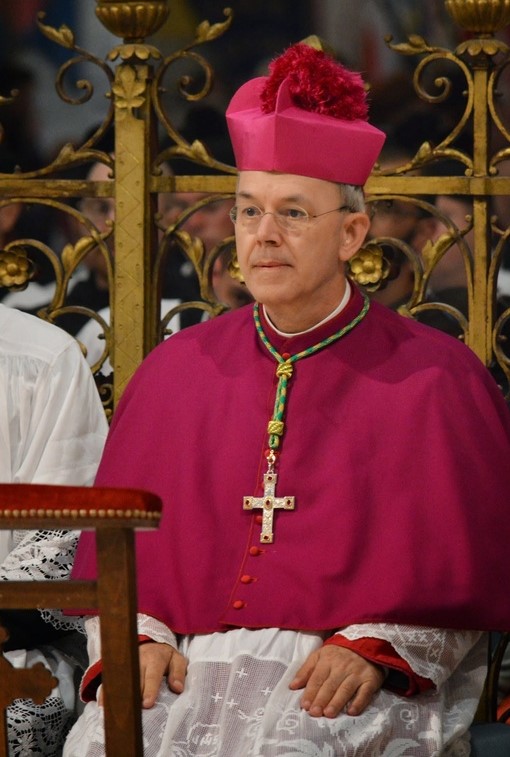
Auxiliary Bishop Athanasius Schneider: A Catholic Conscience and Credo
Born in Kyrgyzstan under Soviet repression, to intensely devout Catholic parents, the future Auxiliary Bishop Athanasius Schneider was essentially raised in the Catholic underground. His parents, who had been prisoners in the Gulag, would often travel dozens of kilometers under the cover of darkness to attend Mass. Had they been captured, the consequences would have been severe – a return to the Gulag, loss of job status or worse.
The Cultural Revolution
Upon moving to West Germany in the 1970s, he and his family were amazed to see the radical changes made in the wake of the Second Vatican Council, especially those made to the Catholic Mass, influenced by the ‘60s cultural revolution with its diminished sense of the Sacred.
Bishop Schneider observed that many things the Church clergy taught were rather ambiguous and uncertain. The Church, he suggests, has now reached the “culmination” of what began in the ‘60s with “ambiguity,” is now an effort to please the world.
In many places, Schneider says, worship “became a kind of entertainment. And so the center became man,” God was marginalized to the periphery, and we began to worship ourselves, which “is the death of every true religious sense.”
The task before us now, Schneider argues, is to “…urgently restore in the Catholic Church again the proven, millennium-old forms of worship which were practiced with love, with faith.”
First and foremost, this writer believes restoration of the Tridentine Mass should be the priority effort – as the rule rather than an “authorized” exception to the Novus Ordo Missae.
The bishop advises those seeking a more traditional Catholicism to consult the old catechisms that are without ambiguity. The bishop himself has written an up-to-date catechism entitled “Credo,” which addresses today’s moral issues as well as how to restore society: right belief, right moral action, and prayer and worship.
Pluralism and the Diversity of Religions
Two years ago this September, Pope Francis spoke at the Seventh Congress of Leaders of World and Traditional Religions in Nur-Sultan (Astana), Kazakhstan – home to Bishop Schneider.
At the gathering, a declaration from the congress was issued drawing almost verbatim on the Document on Human Fraternity for World Peace and Living Together, signed by Pope Francis and a prominent sheik in Abu Dhabi in February 2019, which states:
The pluralism and the diversity of religions, color, sex, race and language are willed by God in His wisdom, through which He created human beings
(As per the version published by the Vatican).
Speaking to EWTN in Kazakhstan, Bishop Schneider said the congress attended by Pope Francis risked giving the impression of a “supermarket of religions.”
While praising the congress for promoting “understanding, harmony, and peace,” Schneider warned, reported the National Catholic Register, “there is also a danger that we the Catholic Church should not appear simply as one of the many religions.”
The Credo
In October of last year, Sophia Institute Press released Credo – Compendium of the Catholic Faith by Bishop Schneider. The work is the first of its kind by a Catholic bishop in more than 50 years. Essentially a layman’s catechism, the text aims to assist the reader to know what to believe, how to live, and how to pray as Christ taught.
The new compendium of the Catholic faith provides clear answers to many of the Church’s contemporary problems. It aims to counter the ambiguity, ambivalence and postmodern relativism now prevalent in both Western society and the Church.
In fact, the most pressing issues as Bishop Schneider sees it, are relativism in doctrine in general and concretely, through the issue of the pluralism of religions, as its modern liberal advocates call it. The phenomenon associated with this notion –interreligious dialogue – has been promoted since the Second Vatican Council. It creates, the bishop asserts, the most profound danger. This sometimes-ambiguous teaching on the diversity of religions and practice promotes the relativism of truth itself, it diminishes the uniqueness of who Jesus Christ was and the exclusive nature of the Catholic faith and Church.
A Profession of Faith
In response to Pope Francis’s declaration at the Congress of Leaders of World and Traditional Religions in Nur-Sultan (Astana), Kazakhstan and his most recent claim in Singapore that “all religions are paths to God,” Bishop Schneider composed a profession of Faith offered at the recent Catholic Identity Conference 2024. It is offered in part below:
…We believe that it is “contrary to the Catholic faith to consider the Church as one way of salvation alongside those constituted by the other religions, seen as complementary to the Church or substantially equivalent to her, even if these are said to be converging with the Church toward the eschatological kingdom of God” (Congregation for the Doctrine of the Faith, Declaration Dominus Iesus, 21).
We furthermore hold that Divine Revelation, faithfully transmitted by the Church’s perennial Magisterium, forbids affirming:
- That all religions are paths to God,
- That the diversity of religious identities is a gift of God, and
- That the diversity of religions is an expression of the wise will of God the Creator.
We hold, therefore, that Christians are not simply “traveling companions” along with adherents of false religions — which God forbids.
Much has been made of the problems in the aftermath of Vatican II. Pope Benedict XVI’s refrain was cogent. The Council must be understood in the context of the Church’s constant teaching. Only a “hermeneutic of continuity” Benedict argued can ensure a proper understanding.
This writer suggests that what Benedict means is that the Council was not a break with previous Church teaching regarding Vatican I and before; the Church, by her very nature, cannot break with her own past. To suggest that previous teachings were wrong, and only now are we “getting things right,” is to deny that the Church is and always has been guided by the Holy Spirit. To do otherwise is to forsake Christ’s words in Matthew 16:18-19, the apostolicity and catholicity of the office of the Pope and to our great detriment – the very nature of the Church, itself.
Much of that to which Bishop Schneider feels compelled to respond (and that to which the Church ought to) is a “dis-ease” dividing the world in its struggle with itself and with God. The source of this malady is modern liberalism and its self-aggrandizing attitude about what it deems best for “everybody else” as well as its disdain for and fear of objective truth, which undermines its premise of relativism. It was this “malady” of self-aggrandizement, hubris and hyperbole which pushed to extremes the improper interpretations of the Second Vatican Council.
A critical distinction began in the 1960s and ‘70s – and not between nations or even ideologies; rather, modern liberalism’s embrace of materialism as opposed to transcendence created a chasm in people’s consciousness between the self and God – and thus a sense of the Sacred. Before modernity people had at least some sense of the Sacred; whereas today, modern liberalism and its dangerous “cousin” – postmodernism – seem immune to the Sacred or worse, “averse” to it. And this orientation has been occurring and deepening for the last 60 years.
Asked how we as a society are to restore a sense of the Sacred, Bishop Schneider retorts:
We must “believe in a right manner, live in a right manner,” and pray in a right manner.”
Perhaps what Bishop Schneider is telling us is that the faithful who have strayed from traditional Catholicism, on both sides of the Atlantic, must (in the midst of modernity) recover a sense of relatedness to that which is the sufficient reason why there is something rather than nothing – why the universe is rather than is not – God.
It is this sense of relatedness to the Sacred that compels one to offer to another in dialogue (interreligious or otherwise) the greatest gift one can – the exclusive message of the Catholic Church – “the truth, the way and the life” (Jn 14:6).

Remembering Father Alphonse de Valk
(Today marks the sixth anniversary of the death of Father Alphonse de Valk, C.S.B., a faithful, courageous and indefatigable Basilian priest, pro-life-and-family apostle, and the founder of Catholic Insight magazine. Here is what we wrote those on his entering into eternity five years ago, as we continue to remember him in our prayers and thoughts)[…]Continue reading→

Divine Mercy Sunday – An Echo of Every Mass
Reach out your hand and put it in my side. Do not doubt but believe’… ‘My Lord and my God!’ (Jn. 20:18)). Today is Divine Mercy Sunday, and as we celebrate the end of the Easter Octave, we contemplate the wounded side of our Saviour, the Church’s source of life. On Good Friday in the[…]Continue reading→

Saint Stanislaus of Szczepanów
We celebrate Saint Stanislaus today (+ April 11, 1079), in light of this Easter Octave, a bishop and martyr who accepted the episcopacy only at the direct order of Pope Alexander II. He proved a wise and courageous leader of his flock, put to death by his own king, Boleslaus, for rebuking the monarch’s ‘immoral[…]Continue reading→
First Holy Communion: Sermon from May 16, 1943
Here is a sermon from the good old days by +Rev. Msgr. Vincent Nicholas Foy (August 14, 1915 – March 13, 2017), from 1943. Readers may recall that Pope Saint Pius X, by the decree Quam Singulari in 1910, lowered the customary age of reception of Holy Communion – after the rigours of the plague[…]Continue reading→
In the Glorious Light of Easter, Alleluia!
Set your minds on things that are above, not on things that are on earth, for you have died, and your life is hidden with Christ in God. When Christ who is your life is revealed, then you also will be revealed with him in glory (Col. 3:3-4). The Resurrection of Our Lord and Saviour[…]Continue reading→

An Ancient Homily for Holy Saturday
The time between Good Friday and Easter Sunday is one of waiting, in silence, as the world wonders – anticipates – what will happen, after the death of Christ. We re-live this time each year in the anamnesis of our liturgy, and in turn look forward to the glorious re-creation of all things at the[…]Continue reading→
Europe’s Long Descent
(As we meditate on this day on Christ’s burial, and His descent into hell, it is fitting to ponder here with contributor Peter Marcus how the world seems to be heading there as well. The difference is that, although God cannot ‘redeem’ hell, nor those therein, He can and did redeem the world. There is[…]Continue reading→
Pope Saint John Paul II’s First Good Friday Homily
ADDRESS OF HIS HOLINESS JOHN PAUL II AT THE CONCLUSION OF THE STATIONS OF THE CROSS AT THE COLOSSEUM Good Friday, 13 April 1979 When we make the Way of the Cross from one station to the next, in spirit we are always at the spot wherethis journey had its “historical” place: where it[…]Continue reading→
A Meditation for Good Friday: How To Undo the Effects of Sin?
Cardinal Newman, now Saint John Henry Newman, was a towering figure of nineteenth-century Catholicism who is almost universally admired. I say “almost” because not everyone likes him. I knew a priest once, Arthur Caulkins, who has become disenchanted with Newman. As an undergraduate Arthur had been enamoured of Newman, and this interest continued when he[…]Continue reading→
Pope Benedict’s Last Holy Thursday Homily
MASS OF THE LORD’S SUPPER HOMILY OF HIS HOLINESS BENEDICT XVI Basilica of St John Lateran Holy Thursday, 5 April 2012 Photo Gallery (Video) Dear Brothers and Sisters! Holy Thursday is not only the day of the institution of the Most Holy Eucharist, whose splendour bathes all else and in some ways draws it to[…]Continue reading→