
Saint Camillus de Lellis: The Great Revolutionary of Charity Towards the Sick
As the secular world celebrates the French revolution on July 14th, during which thousands of innocent human persons simply were guillotined by ferocious people whose hunger for power made them forget that they were dealing with other human beings, the Church celebrates one of her own great revolutionaries. But this revolution was not political, but rather a ‘revolution’ of charity towards the sick. This great man is none other than St Camillus de Lellis.
In 1574, at the age of twenty-four, Camillus, from Abruzzo, central Italy, was practically finished. Born to an elderly mother on the Sunday of Pentecost of the holy year 1550, he was a normal child – indeed he was much more robust and taller than normal. Moreover, his mother’s heart became saddened due to some sad premonitions. No one managed to educate him. At the age of only thirteen, a little irremediable rebel, he started to accompany his father from one military campaign to another, attaining from him a destructive passion for gambling at dice or cards and from that world the attitude of a vulgar swashbuckler.
Camillus spent some of his years as a mercenary soldier, risking his life in battles, in fights, in order to gamble the money that he acquired in this way. After that in 1574 he just escaped a shipwreck, he landed at Naples and his uncontrollable passion for gambling to the extent of ‘also lost his shirt’ truly occurred to him. Due to this sad situation Camillus ended up like a stray dog, a wanderer with nowhere to go. Out of shame, he asked for alms outside churches with ‘infinite embarrassment’. Finally he had to work on the building of a Capuchin friary, leading two mules loaded with stones, lime and water for the men building the walls.
Having said that, his life was to experience a decisive turning point. But nearness to those friars, who had just been reformed and were still at the height of their enthusiasm, was not a matter of no consequence for him. During his journey to the friary of San Giovanni Rotondo, this was the holy year 1575, he met a Capuchin friar who took him to one side to say to him: God is everything. The rest is nothing. One should save one’s soul which does not die. During the long return journey, amidst the hollows of Gargano, Camillus entered into a serious examination of conscience. Immediately he got down from the saddle, threw himself to the ground and wept: Lord, I have sinned. Forgive this great sinner! How unhappy I have been for so many years not to have known you and not to have loved you. Lord, give me time to weep for a long time for my sins. He asked to become a Capuchin, however, but was discharged from the friary due to a wound that did not stop suppurating.
Like Saint Francis of Assisi three centuries before him, Camillus’ renewed spirit led him to the sick, precisely the Roman Hospital of Saint James, the hospital to which illness appeared to have chained him. Here he had to deal with the most horrible illnesses. In the past he had even been employed to look after the other patients, thereby earning some money. At the Hospital of the Incurables there arrived the most repugnant sick people, the rejects of society, who were often terrible to behold, and who were even dumped down at the gates of the building.
The historical milieu of the sixteenth century had it that the sick were in the hands of mercenaries. Some of the latter were simply criminals forced to do such jobs. Others did this because they were forced to do so due to the fact that they had no other way of making a living. A chronicler of the sixteenth century gives us with the subsequent vision of the wards of hospitals of the time: ‘They were forced…to use, so to speak, the scum of the world, that is to say ministers who were ignorant, outlaws or investigated for some crime, forced to stay for penance or punishment inside those places…It was at least certain that the dying poor would be there for three whole days, struggling and suffering in their pitiable agonies without someone saying to them the least word of consolation or comfort.
Similar situations could be encountered in other hospitals too in those days. When Camillus and his religious family began to work in the Major Hospital of Milan (the ‘Ca’ granda’) they found the places where the sick people lay in such a state that Camillus thought that they were a cause of death. God knows how many of them die because of this state of those dirty, fetid and muddy places!
God’s grace kept working in his life. His fruits of conversion opened for him the door of being appointed the Master of the House, in other words, the person directly responsible for the economic and organisational side of things. Upon his appointment he started to organize things in an orderly way. Day and night he used to appear when nobody expected him, appealing to, rebuking and forcing each person to do their work and to do it well. He controlled the purchases, argued with the tradesmen, and sent back the consignments of bad goods. Without stopping he exhorted the servants and explained to them: The sick poor are the eyes and heart of God and…what you did to these poor people you did to God Himself’
When Camillus realized the opposition to his ideas due to some people at the Incurable started realizing that God wanted from his other things. Camillus wanted to have people with him not for pay but voluntarily and out of love for God serve the sick with that lovingness that mothers have for their own sick children. Hence, the move from the Incurables to the great Roman Hospital of the Holy Spirit was the next in this exciting journey of conversion. At the Hospital of the Holy Spirit Camillus and his friends gradually became a new religious Congregation: the Order of the Ministers of the Sick. Hence their charism was centred on the committed service to the sick through tenderness. With how much loving care he attended the sick! His authentic adoration of the sick was attested to by a witness who saw him on his knees near a poor sick man who had a pestilential and stinking cancer in his mouth, it was not possible to bear such a stench, and with all of this Camillus was near to him breath to breath, he gave him words of very great affection, he seemed to be mad with his love, calling him in particular: my Lord, my soul, what can I do to serve you? Believing that he was his beloved Lord Jesus Christ (from the Acts of Canonisation). From time to time he would shout: More heart, I want to see more maternal affection or More soul in those hands.
Camillus died at the age of sixty-four. Like Saint Francis of Assisi he dictated his own testament to entrust himself to God till the end. This testament is a total and minute handing over of himself: I, Camillus de Lellis…leave my body of earth to the same land which produced it…I leave to the Devil, iniquitous tempter, all the sins and all the offences that I have committed against God and I repent from my soul…In the same way I leave and give my soul and every power of it to my beloved Jesus and his Holy Mother…Lastly, I leave to the Crucified Jesus Christ the whole of myself in soul and body and I trust that, by his immense goodness and mercy, he will receive me and forgive me as he forgave Mary Magdalene.
He entered the Father’s Heavenly House on July 14, 1614.
Glorious Saint Camillus, turn your merciful eyes upon those who suffer and those who care for them. Grant to the sick, Christian resignation and trust in the goodness and power of God. Make those who take care of the sick be generous and lovingly dedicated. Help us to understand the mystery of suffering as a means of redemption and the way to God. May your protection comfort the sick and their families and encourage them to live together in love. Bless those who dedicate themselves to the sick. And may the good God grant peace and hope to all. Amen.
Saint Camillus, pray for us.
A Closed, Unsustainable, Descending Loop
As a follow-up to my thoughts on Payette’s payout, here be a stark image of where are here in Canada. As the graph shows in, well, graphic terms, since 2025, the public sector has contributed to 95.5% of economic growth. The private sector – which funds the public sector, or is supposed to – has[…]Continue reading→
Presidential Pardon of Weronika Krawczyk
As a good news, follow-up to our story from Poland, of the persecution of Weronika Krawczyk for her pro-life views, we heard that she has been granted a presidential pardon. One might still wonder why one needs a presidential pardon for simply holding the long-held belief that the child within the womb is a child,[…]Continue reading→
Pope Leo and a Rosary for Peace
Pope Leo XIV has asked Catholics across the world to join him in a Rosary for peace today, at 18:00 Rome time (6 pm), which would be noon from where I write (EST). If you are able, whether at that time or another, and in whatever way you pray, to join in intercession with the[…]Continue reading→
Payette’s Payout
I was glancing through some headlines, and noticed a mention of Julie Payette – engineer and astronaut and sometime the Queen’s representative in Canada – which brought back vague memories. She was appointed Governor-General by Justin Trudeau in 2017. Ms. Payette resigned in 2021, amidst claims that she created a ‘toxic work environment’, with allegations[…]Continue reading→
Weronika Krawczyk and Injustice in Poland
Catholic Action in Poland has issued a formal statement appealing to the President of the Republic of Poland to pardon Weronika Krawczyk—convicted for warning other women against an abortion-performing gynaecologist. Catholic Action (AK) emphasizes that no apology is owed to a doctor who has performed numerous abortions and proposed others; furthermore, the organization considers the[…]Continue reading→
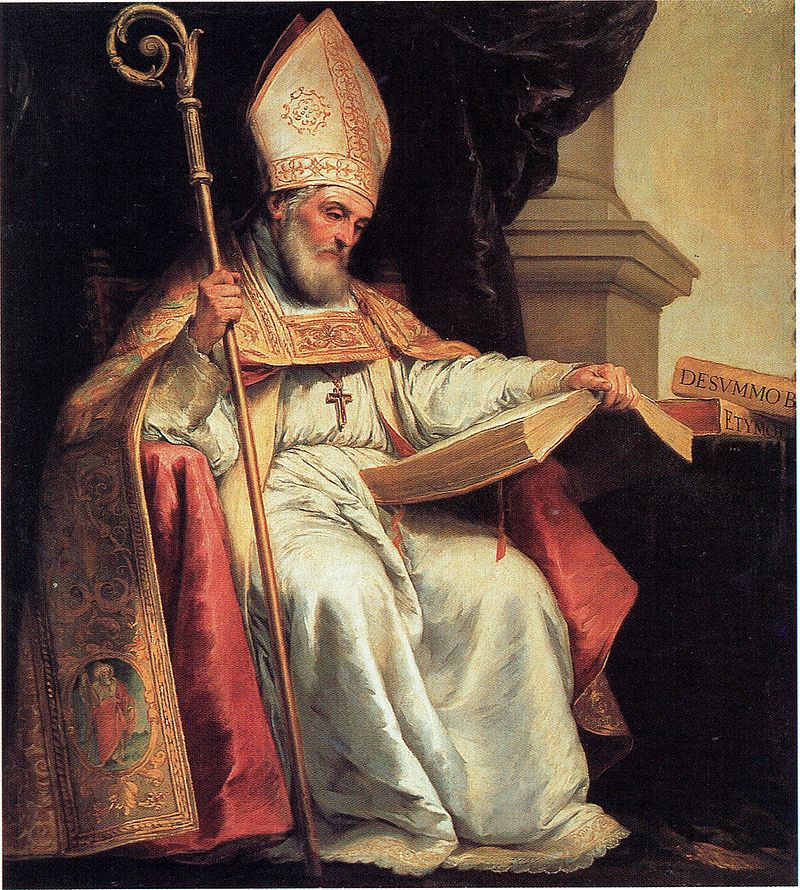
Saint Isidore of Seville, the Internet and Industriousness
Today, April 4th, muted this year by Holy Saturday, is the commemoration of Saint Isidore of Seville (560-636) a bishop and doctor of the Church during a tumultuous age, when civilization was crumbling, coming apart at its very seams, which may sound sort of au courant. Then again, the form of this world has always[…]Continue reading→
Bishop Fulton Sheen’s 58th Good Friday Reflection
Incredible, at the beginning of this reflection, that the Venerable Bishop Sheen declares that he has given nearly 58 Good Friday reflections – this, as far as I can gather, was his final one, and he seems in full vigour in mind and body. The good bishop and evangelist died in his 84th year on[…]Continue reading→
A Minimal Friar and the Death of a Great Pope
This April the second- overshadowed by Holy Thursday this year – marks the memorial of Saint Francis of Paola (1417-1507), founder of the ‘Minim’ friars, so called for their humility and poverty, who interpreted the rule of Saint Francis of Assisi in quite a literal sense: extreme poverty, trust in God, foregoing all animal and[…]Continue reading→
Woven versus Seamless Garments
The reflection on the worthy project by Magie Dominic was intriguing, and I thought I would offer a brief follow-up commentary. The garment woven out of many pieces is a poignant symbol, even a ‘sacramental’, inspired by prayer and grace. We are all united in some way, and should strive for such unity, wherever we[…]Continue reading→
Bill C-9: Prelude to Persecution?
Well, it happened, as I suppose was inevitable, at least in a secular sense (from God’ perspective, there’s always hope). Bill C-9, the ironically named ‘Combatting Hate Act’ passed the House of Commons with a 186-137 vote. Look on the good side – there’s still over a hundred sane people in parliament who believe in[…]Continue reading→