
A Sixth Century Saint Still Speaks to Us
Even if, as Pope Benedict XVI tells us in his catechesis on St Benedict of Nursia on St Benedict of Norcia, Benedict’s earthly life ended on 21 March 547 this saint’s spiritual and monastic legacy is simply incredible. Within the same catechesis the great German Pope did not hesitate to call Saint Benedict the Founder of Western Monasticism and also the Patron of [his] Pontificate.
Saint Benedict lives on by the immense spiritual heritage he left us, particularly in his Rule. How powerful are the words which we find in the prologue of the Rule for everyone who wants to grow in their personal and monastic journey aided by the foundational monastic virtues of humility, silence, obedience and directives for daily living. Saint Benedict gives us God’s frequency of the heart to which the monk has to attune himself. In the very opening lines of the Prologue we find written these very important words: Listen carefully, my child, to your master’s precepts, and incline the ear of your heart (Prov. 4:20). Receive willingly and carry out effectively your loving father’s advice, that by the labor of obedience you may return to Him from whom you had departed by the sloth of disobedience. To you, therefore, my words are now addressed, whoever you may be, who are renouncing your own will to do battle under the Lord Christ, the true King, and are taking up the strong, bright weapons of obedience.
In a world where one’s autonomy and self-determination have become a living dogma it is so decisive to go back to this attitude of listening to God carefully. This carefulness in listening reminds us of that same carefulness adopted by the prophet Samuel when he received God’s call through Eli. The biblical text cannot be as clear as it is: And Samuel grew, and the Lord was with him and let none of his words fall to the ground (1 Sam 3:19). From the experience of Samuel with the Lord we can easily deduce that one’s spiritual progress greatly depends upon his willing reception and obeying God’s word. This biblical thrust is also at the basis of Saint Benedict’s Rule. If we are to reign with Christ we are to let God’s sovereignty in our lives take reign. Saint Paul reminds us of this very important commitment you and I are called to live and invest our time in: Therefore I endure everything for the sake of the elect, that they also may obtain salvation in Christ Jesus with its eternal glory. The saying is sure: If we have died with him, we shall also live with him; if we endure, we shall also reign with him; if we deny him, he also will deny us; if we are faithless, he remains faithful – for he cannot deny himself (2 Tim 2:10-13).
Saint Benedict’s total commitment to Christ is detailed in his Rule when it comes to common prayer, meditative reading as well as manual work. Everything reminds me of Christ’s love and things like the details of common living such as clothing, sleeping arrangements, food and drink, care of the sick, reception of guests, recruitment of new members, journeys away from the monastery and so forth become an occasion for one to grow in holiness. Beyond the legislation that he gives, Benedict might have had in mind that beautiful passage taken from the letter of Saint Paul to the Romans which says: We know that in everything God works for good with those who love him, who are called according to his purpose (Rom 8:28). Another text which complements Benedict’s purpose is that taken from the Letter to the Colossians when Saint Paul writes: And whatever you do, in word or deed, do everything in the name of the Lord Jesus, giving thanks to God the Father through him (Col 3:17).
In his teaching, Saint Benedict strongly advocates humility. He said: The first degree of humility is prompt obedience. In his seventh chapter on humility, Benedict writes: The first degree of humility is obedience without delay. This is the virtue of those who hold nothing dearer to them than Christ; who, because of the holy service they have professed, and the fear of hell, and the glory of life everlasting, as soon as anything has been ordered by the Superior, receive it as a divine command and cannot suffer any delay in executing it.
Of these the Lord says, “As soon as he heard, he obeyed Me” (Ps. 17[18]:45). And again to teachers He says, “He who hears you, hears Me” (Luke 10:16).
In a world where everyone wants to be his own boss these words act as an urgent reminder of God’s primacy in our lives through the authority he gives to others to lead us to him. Are we bold enough to discern how God is working through others invested with his authority to provide for us some guidance in life?
Other portions of knowledge Benedict gives us are the following: The sleepy like to make excuses; Be careful to be gentle, lest in removing the rust, you break the whole instrument; Run while you have the light of life, lest the darkness of death overtake you; Prayer ought to be short and pure, unless it be prolonged by the inspiration of Divine grace; Idleness is an enemy of the soul; One who never stops talking cannot avoid falling into sin; We read it is true, that wine is by no means a drink for monastics; but since the monastics of our day cannot be persuaded of this let us at least agree to drink sparingly and not to satiety because ‘wine makes even the wise fall away’ (Eccles. 19:2); Let all guests who arrive be received like Christ, for He is going to say, ‘I came as a guest, and you received Me’ (Matt. 25:35); and In the salutation of all guests, whether arriving or departing, let all humility be shown. Let the head be bowed or the whole body prostrated on the ground in adoration of Christ, who indeed is received in their persons. How can we put these ideas as part of our discernment in life?
As Cardinal Ratzinger, Pope Benedict shows the greatest relevance of this sixth century holy voice full of wisdom of Saint Benedict, one of Europe’s Patron Saints. At the conclusion of his famous lecture given in Italian at the convent of Saint Scholastica in Subiaco, Italy, precisely on the day before Pope Saint John Paul II left for the Father’s House in Heaven, while speaking On Europe’s Crisis of Culture he said:
Only through men who have been touched by God, can God come near to men. We need men like Benedict of Norcia, who at a time of dissipation and decadence, plunged into the most profound solitude, succeeding, after all the purifications he had to suffer, to ascend again to the light, to return and to found Montecasino, the city on the mountain that, with so many ruins, gathered together the forces from which a new world was formed.
In this way Benedict, like Abraham, became the father of many nations. The recommendations to his monks presented at the end of his “Rule” are guidelines that show us also the way that leads on high, beyond the crisis and the ruins.
“Just as there is a bitter zeal that removes one from God and leads to hell, so there is a good zeal that removes one from vices and leads to God and to eternal life. It is in this zeal that monks must exercise themselves with most ardent love: May they outdo one another in rendering each other honor, may they support, in turn, with utmost patience their physical and moral infirmities … May they love one another with fraternal affection … Fear God in love … Put absolutely nothing before Christ who will be able to lead all to eternal life” (Chapter 72).
O glorious St. Benedict, sublime model of all virtues, pure vessel of God’s grace! Behold me, humbly kneeling at thy feet. I implore thy loving heart to pray for me before the throne of God. To thee I have recourse in all the dangers which daily surround me. Shield me against my enemies, inspire me to imitate thee in all things. May thy blessing be with me always, so that I may shun whatever God forbids and avoid the occasions of sin.
Graciously obtain for me from God those favors and graces of which I stand so much in need, in the trials, miseries and afflictions of life. Thy heart was always so full of love, compassion, and mercy towards those who were afflicted or troubled in any way. Thou didst never dismiss without consolation and assistance anyone who had recourse to thee. I therefore invoke thy powerful intercession, in the confident hope that thou wilt hear my prayers and obtain for me the special grace and favor I so earnestly implore (mention it), if it be for the greater glory of God and the welfare of my soul.
Help me, O great St. Benedict, to live and die as a faithful child of God, to be ever submissive to His holy will, and to attain the eternal happiness of heaven. Amen.
A Closed, Unsustainable, Descending Loop
As a follow-up to my thoughts on Payette’s payout, here be a stark image of where are here in Canada. As the graph shows in, well, graphic terms, since 2025, the public sector has contributed to 95.5% of economic growth. The private sector – which funds the public sector, or is supposed to – has[…]Continue reading→
Presidential Pardon of Weronika Krawczyk
As a good news, follow-up to our story from Poland, of the persecution of Weronika Krawczyk for her pro-life views, we heard that she has been granted a presidential pardon. One might still wonder why one needs a presidential pardon for simply holding the long-held belief that the child within the womb is a child,[…]Continue reading→
Pope Leo and a Rosary for Peace
Pope Leo XIV has asked Catholics across the world to join him in a Rosary for peace today, at 18:00 Rome time (6 pm), which would be noon from where I write (EST). If you are able, whether at that time or another, and in whatever way you pray, to join in intercession with the[…]Continue reading→
Payette’s Payout
I was glancing through some headlines, and noticed a mention of Julie Payette – engineer and astronaut and sometime the Queen’s representative in Canada – which brought back vague memories. She was appointed Governor-General by Justin Trudeau in 2017. Ms. Payette resigned in 2021, amidst claims that she created a ‘toxic work environment’, with allegations[…]Continue reading→
Weronika Krawczyk and Injustice in Poland
Catholic Action in Poland has issued a formal statement appealing to the President of the Republic of Poland to pardon Weronika Krawczyk—convicted for warning other women against an abortion-performing gynaecologist. Catholic Action (AK) emphasizes that no apology is owed to a doctor who has performed numerous abortions and proposed others; furthermore, the organization considers the[…]Continue reading→
Saint Isidore of Seville, the Internet and Industriousness
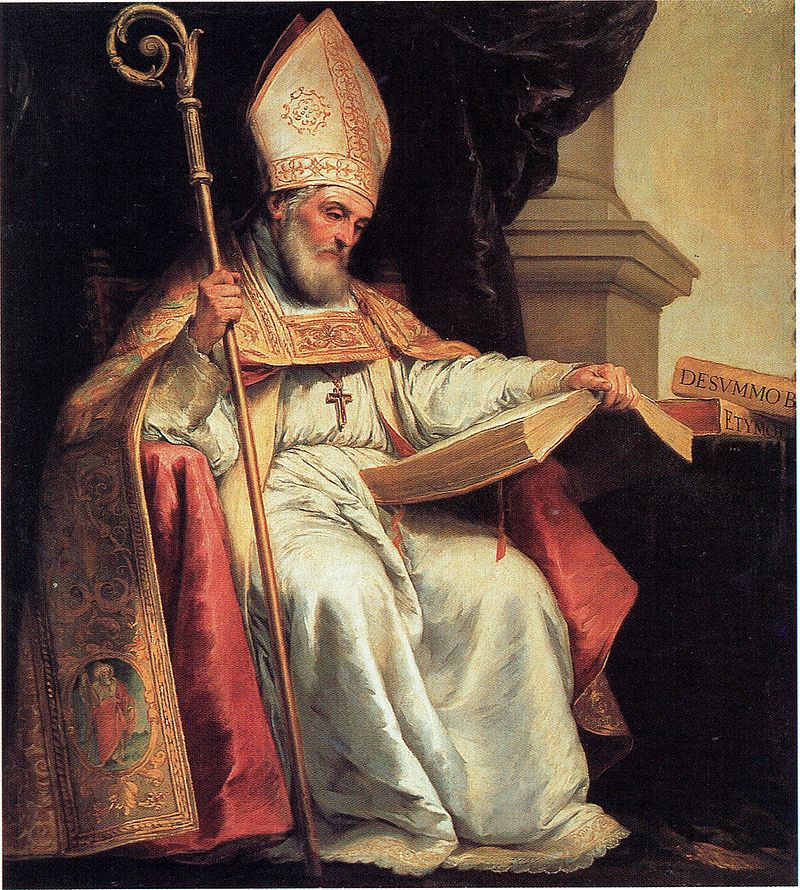
Today, April 4th, muted this year by Holy Saturday, is the commemoration of Saint Isidore of Seville (560-636) a bishop and doctor of the Church during a tumultuous age, when civilization was crumbling, coming apart at its very seams, which may sound sort of au courant. Then again, the form of this world has always[…]Continue reading→
Bishop Fulton Sheen’s 58th Good Friday Reflection
Incredible, at the beginning of this reflection, that the Venerable Bishop Sheen declares that he has given nearly 58 Good Friday reflections – this, as far as I can gather, was his final one, and he seems in full vigour in mind and body. The good bishop and evangelist died in his 84th year on[…]Continue reading→
A Minimal Friar and the Death of a Great Pope
This April the second- overshadowed by Holy Thursday this year – marks the memorial of Saint Francis of Paola (1417-1507), founder of the ‘Minim’ friars, so called for their humility and poverty, who interpreted the rule of Saint Francis of Assisi in quite a literal sense: extreme poverty, trust in God, foregoing all animal and[…]Continue reading→
Woven versus Seamless Garments
The reflection on the worthy project by Magie Dominic was intriguing, and I thought I would offer a brief follow-up commentary. The garment woven out of many pieces is a poignant symbol, even a ‘sacramental’, inspired by prayer and grace. We are all united in some way, and should strive for such unity, wherever we[…]Continue reading→
Bill C-9: Prelude to Persecution?
Well, it happened, as I suppose was inevitable, at least in a secular sense (from God’ perspective, there’s always hope). Bill C-9, the ironically named ‘Combatting Hate Act’ passed the House of Commons with a 186-137 vote. Look on the good side – there’s still over a hundred sane people in parliament who believe in[…]Continue reading→