
The Splendid Witness of the Martyrs of Gorkum
Today, July 9th, is the feast of the Martyrs of Gorkum in the Netherlands, and their story is truly fascinating.
At the beginning of the 16th century, everyone was Catholic in the Netherlands, but that changed with the Reformation, whose beginning we may trace to Luther’s proclamation of 1517. The people who joined this movement called themselves the Reformed and, much later, the Protestants. The invention of the printing press enabled their ideas to spread like wildfire. The Reformed were against Catholics, whom they viewed as superstitious – religious wars broke out everywhere, including Gorkum.
The Reformed wanted to practice their own faith. They did this by meeting outside the walls of the Catholic city of Gorkum on Sundays. Here they held what were called hedge sermons. They protested against the power and great wealth of the Catholic Church. They demanded that they be allowed to practice their own religion within the city walls. In 1566, these protests led to the iconoclasm, in which a lot of damage was inflicted to Catholic churches as well as monasteries.
In Gorkum, the battle between the religions was temporarily settled by giving the Reformed a wooden shed outside the city walls. There they met on Wednesdays and Sundays for their own services. The shed was called Geuzen House but it was not a great success. What they really wanted was a church in the City. But the Catholics, of course, would not give up any of their churches. At the time Philip II of Spain ruled all of Europe, so he also ruled over the County of Holland and its leader William of Orange. William was a Protestant, so he fled to Germany and from there organized a revolt against the King of Spain.
Philip II was incensed and sent one of his most implacable generals, the Duke of Alba, to Holland. The Duke had three goals in mind: First, to collect taxes to pay for the war; to second, to prosecute the Protestant rebels; and third, to restore peace. From then on, everyone had to give a tenth of all they owned to the Spanish occupier. This was known in history as the tenth penny. This fact caused more and more unrest among the people of Holland. Soon enough was enough; the country rebelled and the rebels called themselves Beggars.
On 1 April 1572, the protestant Sea Beggars led by admiral Lumey sailed their ships to Brielle (Den Briel). Together with 1,100 soldiers, they captured the city. The Catholic clergy were chased out of the city, imprisoned or even killed. The Beggars then sailed further up the river towards Gorkum.
Most of the people of Gorkum were pleased with the arrival of the Sea Beggars, who were allowed through the city gates if they promised not to plunder the town. But Gorkum’s castle, The Blue Tower, was defended by the mayor Casper Turck, who was still loyal to the Spanish king, Philip II. Priests sought safety within the strong walls of the castle, but the Beggars set fire to the castle gatehouse. Soon afterwards, the gate fell and the Beggars captured the castle.
The valuable church treasures were sold by the city council, who wanted to use the proceeds to improve the city’s defences, and nineteen Catholic clergy members were arrested and tortured because they refused to give up their faith. The clerics comprised eleven Friars Minor with their superior, priests and their assistants, one Dominican, one Augustinian and two Norbertine monks. Most of them came from Gorkum, so they were called the Martyrs of Gorkum. Shortly afterwards they were taken away by ship to Dordrecht.
A stopover in Dordrecht meant more humiliation for the clergy prisoners. When the ship was anchored in the harbour, the soldiers took away the cleric’s clothes and sold them at the market. Cruelly, the men were exhibited in their undergarments for anyone willing to pay a fee. The crowds rushed out to see this extraordinary spectacle as well as to boo them.
Later, the ship sailed on to Brielle. The gallows stood ready nearby, but first the clerics were tortured in the dungeon of the city prison. There they almost gave up due to fatigue, pain and misery. They were once again brutally questioned in a final attempt to get them to give up their faith. All but one refused, and so death awaited them.
Meanwhile, William of Orange ordered that the clerics be released, but Lumey ignored William’s order. The clerics were finally hanged on the gallows, which stood ready in a turf shed at the St. Elizabeth Monastery in the village of Rugge near Brielle. Thus, nineteen men died a violent death because they would not give up their faith.
In 1675, the clerics were beatified by Pope Benedict XIV, and canonized as martyrs by Pius IX in 1867. There was even a small miracle associated with these martyrs. A priest picked a flower with three petals that was growing on their grave. He put it away, but more than three years later he found the flower again, not dried but blooming.
In the village of Rugge, near Brielle, a monument to commemorate these terrible events and the outstanding witness of these heroic martyrs now stands on the field where the murders took place. The Martyrs are well known in Holland and even in other places around the world and can be seen depicted in paintings, statues and stained glass windows. They are remembered for their unshakeable faith even though brutally punished for their beliefs.
O Holy Martyrs of Gorkum, you who remained faithful to Christ and the Church even unto death, pray for us, that we may have the courage to stand firm in our faith amidst adversity. Help us to foster unity and solidarity within our communities, supporting one another in love and faithfulness. Through your intercession, may we be strengthened by the Holy Spirit to live out our faith with conviction and charity. Amen.
A Closed, Unsustainable, Descending Loop
As a follow-up to my thoughts on Payette’s payout, here be a stark image of where are here in Canada. As the graph shows in, well, graphic terms, since 2025, the public sector has contributed to 95.5% of economic growth. The private sector – which funds the public sector, or is supposed to – has[…]Continue reading→
Presidential Pardon of Weronika Krawczyk
As a good news, follow-up to our story from Poland, of the persecution of Weronika Krawczyk for her pro-life views, we heard that she has been granted a presidential pardon. One might still wonder why one needs a presidential pardon for simply holding the long-held belief that the child within the womb is a child,[…]Continue reading→
Pope Leo and a Rosary for Peace
Pope Leo XIV has asked Catholics across the world to join him in a Rosary for peace today, at 18:00 Rome time (6 pm), which would be noon from where I write (EST). If you are able, whether at that time or another, and in whatever way you pray, to join in intercession with the[…]Continue reading→
Payette’s Payout
I was glancing through some headlines, and noticed a mention of Julie Payette – engineer and astronaut and sometime the Queen’s representative in Canada – which brought back vague memories. She was appointed Governor-General by Justin Trudeau in 2017. Ms. Payette resigned in 2021, amidst claims that she created a ‘toxic work environment’, with allegations[…]Continue reading→
Weronika Krawczyk and Injustice in Poland
Catholic Action in Poland has issued a formal statement appealing to the President of the Republic of Poland to pardon Weronika Krawczyk—convicted for warning other women against an abortion-performing gynaecologist. Catholic Action (AK) emphasizes that no apology is owed to a doctor who has performed numerous abortions and proposed others; furthermore, the organization considers the[…]Continue reading→
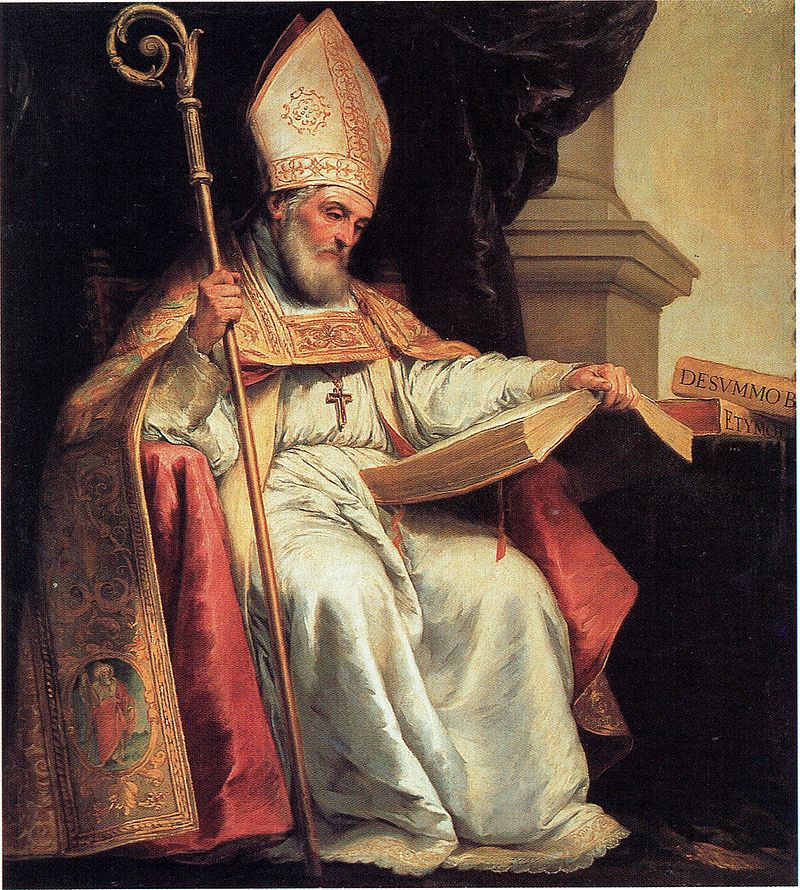
Saint Isidore of Seville, the Internet and Industriousness
Today, April 4th, muted this year by Holy Saturday, is the commemoration of Saint Isidore of Seville (560-636) a bishop and doctor of the Church during a tumultuous age, when civilization was crumbling, coming apart at its very seams, which may sound sort of au courant. Then again, the form of this world has always[…]Continue reading→
Bishop Fulton Sheen’s 58th Good Friday Reflection
Incredible, at the beginning of this reflection, that the Venerable Bishop Sheen declares that he has given nearly 58 Good Friday reflections – this, as far as I can gather, was his final one, and he seems in full vigour in mind and body. The good bishop and evangelist died in his 84th year on[…]Continue reading→
A Minimal Friar and the Death of a Great Pope
This April the second- overshadowed by Holy Thursday this year – marks the memorial of Saint Francis of Paola (1417-1507), founder of the ‘Minim’ friars, so called for their humility and poverty, who interpreted the rule of Saint Francis of Assisi in quite a literal sense: extreme poverty, trust in God, foregoing all animal and[…]Continue reading→
Woven versus Seamless Garments
The reflection on the worthy project by Magie Dominic was intriguing, and I thought I would offer a brief follow-up commentary. The garment woven out of many pieces is a poignant symbol, even a ‘sacramental’, inspired by prayer and grace. We are all united in some way, and should strive for such unity, wherever we[…]Continue reading→
Bill C-9: Prelude to Persecution?
Well, it happened, as I suppose was inevitable, at least in a secular sense (from God’ perspective, there’s always hope). Bill C-9, the ironically named ‘Combatting Hate Act’ passed the House of Commons with a 186-137 vote. Look on the good side – there’s still over a hundred sane people in parliament who believe in[…]Continue reading→