
Traditionalism, the Charismatic Renewal and the End of Christendom
Christendom is dead and God is calling His Church to rise up and rebuild His Church.
I see myself as a “tradismatic” Catholic, to borrow a made-up word from Scott Hahn, which means I don’t like when people try to pigeonhole me into a particular subset of Catholicism. I encountered Jesus as a teenager and fell in love with His Catholic Church. I am a Bible-believing, Holy-Spirit-Come, P&W, “Jesus is my personal Lord and Saviour” Catholic who also loves the Traditional Latin Mass and who is radically committed to the Church’s doctrinal and moral teachings. I tick off people from both sides. I have often been criticized for being too conservative by some and too liberal by others.
I had no faith as a child. Although I was sacramentalized, I was not evangelized and so was one of the many “baptized pagans” of today. As a result of the thrust of Vatican II and the exhortation of many 20th-century popes to “re-evangelize the baptized”, I was reached with the Gospel as a teenager through various youth ministry endeavors. Most significantly, I encountered Christ during Eucharistic Adoration on a Saturday night at a Teens Encounter Christ weekend in May 2005.
As a young adult, my discipleship was forged in a large charismatic missionary community in which I proclaimed the gospel and formed missionaries for over a decade. I learned to pray, evangelize and live in community life. I fell more in love with the Church and her teachings.
Then the Lord led me to become a student at a wonderfully reverent and orthodox Catholic university. This tradionalist-leaning school is an oasis of clarity in a world gone mad. The liberal arts have helped reform parts of my mind that have been warped by secularism. The truth reigns in this institution, which paradoxically allows for greater academic freedom, for the truth always sets us free. Now I can say I’ve tasted both the charismatic and traditionalist circles.
What both of these circles have in common is that they find themselves in a culture where Christendom is dead. These two circles are “pressing on” amidst very similar societal obstacles. They both are facing the wonderful opportunity to rebuild Christendom.
Is Christendom really dead? Aren’t there still many Catholic institutions such as schools, hospitals and church buildings being maintained in various levels of viability?
According to Venerable Fulton Sheen’s 1974 definition of Christendom as “economic, political [and] social life as inspired by Christian principles”, I would say it is a thing of the past. Take stock of the economic, political and social teachings of secularism today, fifty years after Sheen’s declaration. Are they being inspired by Christian principles? Sheen himself asserted that “we are at the end of Christendom”.1
Both charismatic and traditionalist Catholics have the same mission: to rebuild Christendom, which means a culture where Christ is King. This idea came to me when I read OnePeterFive’s mission statement: Rebuilding Catholic Culture. Restoring Catholic Tradition. While there are so many fights between these two groups (often on the internet), and much division, I believe deep down we want the same thing. We want Christ to reign. The end goal is the same but the approach and method are often different.
The strength of charismatic-missionary Catholics is evangelization. We need to rebuild the Church from the ground up, one soul at a time. We need to lead our friends and family to a place where we can personally invite them to commit their lives to Christ. We are in new apostolic times and God is revealing Himself through signs, wonders and prophecies to win over hearts just like He did in the Gospels and the book of Acts.
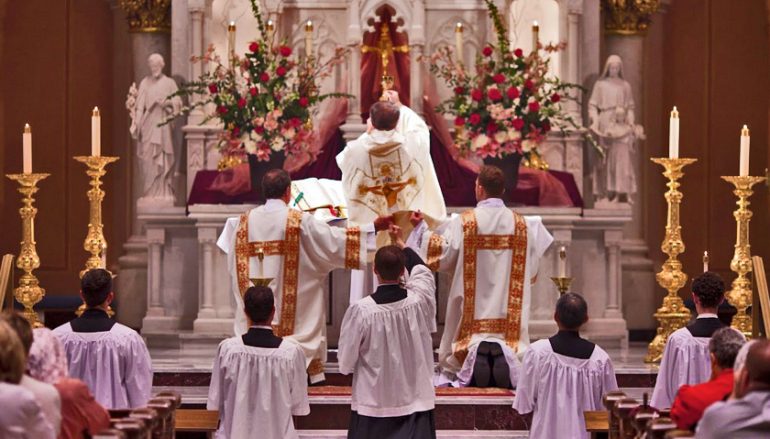
The strength of traditionalist Catholics is a radical commitment to Church teaching and beautiful liturgy. Many seekers today want authenticity, and many traditionalist Catholics are living it. Many seekers are wooed by the smells, bells and chants. People searching for truth find it in the Catholic intellectual tradition. When the case for the existence of God, the divinity of Christ and the one true Catholic Church is presented clearly and in orthodoxy, obstacles are removed and many become believers.
Further, traditionalist Catholics are often leading the rest of the Church in standing up for human dignity in the secular milieu, such as in fighting abortion and sex/gender issues.
Both groups are needed. It is helpful to have two working arms when in a boxing match. The Church needs to use both head and heart to win souls and the whole culture for Christ. She needs Catholics that will strive for excellence in liturgy while also being willing to do anything short of sin to convert one more soul. All three transcendentals, truth, goodness and beauty, are needed in full force to face the secularism of today. Therefore, God is calling all groups of Cathlics to rise up an evangelize.
Evangelization must be both direct and indirect. First, in terms of direct evangelization, many charismatic-missionary Catholics excel. We know that today, words are needed, despite whether Saint Francis ever said “proclaim the Gospel always, and if necessary use words”. Even if it be doubtful he said those words he spent most of his missionary career travelling and “using words”.
Secular folks today need to hear the words of the Gospel simply and clearly. Sin is real, we’ve been separated from God through sin, Christ came to restore this broken relationship through the Paschal mystery and we much each personally choose to believe in Him and commit to Him.
Secondly, evangelization must also be indirect. Trust must be built. Obstacles must be removed. Many who lean into traditionalism shine here. Their lives witness to the truth with profound authenticity. They communicate with clarity. They attract through beautiful liturgy. Their priests preach with boldness.
What these two groups have in common is that we all find ourselves in a post-Christian society. I believe we all deeply desire for Christendom to be restored, which means that Christ reigns both personally and over the culture at large.
There are weaknesses on both sides.
Perhaps those of us who lean more into traditionialism need a deeper, more personal relationship with Christ. Our religion needs to be less of a theory and more of a love affair, according to Chesterton. Further, one of my professors cautioned against subtly thinking if we attend “perfect” TLM liturgy then we have no need to navigate the murky waters of the interior life. Often other vices creep in such as spirital/religious pride, intellectualism, anger, self-righteousness and slander towards Church leaders.
Perhaps those of us who lean into the charismatic renewal need to have greater reverence for the Eucharist and for liturgy. Some of us need to dive deeper into the intellectual tradition, the Church Fathers, the papal documents, the writings of the ecumenical councils, etc. We want to be so relevant to the culture out of a desire to influence it that we become influenced by it.
It is beyond my paygrade to give conclusive answers to these questions. The Church is a big tent. It is dangerous to even try to group Catholics as I have, for the charismatic and traditionist labels are more like two ends of a spectrum upon which Catholics find themselves. It is not either evangelization or reverent liturgy, for example. It is both/and. The Church exists both to worship God and to spread the Gospel.
Christendom is dead. No matter what flavour of Catholicism we feel more drawn to, the culture is no longer influenced by Christianity. Let this not be a temptation to despair but a wonderful challenge to rise up, live the Gospel radically, invite others to know Christ, and rebuild Christendom through cultural, political, economic, social, intellectual and moral reform.
May the Sacred Heart of Christ reign forever!
Cor Jesu Sacratissimum, miserere nobis.
———
- Cited in From Christendom to Apostolic Mission, University of Mary.

Remembering Father Alphonse de Valk
(Today marks the sixth anniversary of the death of Father Alphonse de Valk, C.S.B., a faithful, courageous and indefatigable Basilian priest, pro-life-and-family apostle, and the founder of Catholic Insight magazine. Here is what we wrote those on his entering into eternity five years ago, as we continue to remember him in our prayers and thoughts)[…]Continue reading→

Divine Mercy Sunday – An Echo of Every Mass
Reach out your hand and put it in my side. Do not doubt but believe’… ‘My Lord and my God!’ (Jn. 20:18)). Today is Divine Mercy Sunday, and as we celebrate the end of the Easter Octave, we contemplate the wounded side of our Saviour, the Church’s source of life. On Good Friday in the[…]Continue reading→

Saint Stanislaus of Szczepanów
We celebrate Saint Stanislaus today (+ April 11, 1079), in light of this Easter Octave, a bishop and martyr who accepted the episcopacy only at the direct order of Pope Alexander II. He proved a wise and courageous leader of his flock, put to death by his own king, Boleslaus, for rebuking the monarch’s ‘immoral[…]Continue reading→
First Holy Communion: Sermon from May 16, 1943
Here is a sermon from the good old days by +Rev. Msgr. Vincent Nicholas Foy (August 14, 1915 – March 13, 2017), from 1943. Readers may recall that Pope Saint Pius X, by the decree Quam Singulari in 1910, lowered the customary age of reception of Holy Communion – after the rigours of the plague[…]Continue reading→
In the Glorious Light of Easter, Alleluia!
Set your minds on things that are above, not on things that are on earth, for you have died, and your life is hidden with Christ in God. When Christ who is your life is revealed, then you also will be revealed with him in glory (Col. 3:3-4). The Resurrection of Our Lord and Saviour[…]Continue reading→

An Ancient Homily for Holy Saturday
The time between Good Friday and Easter Sunday is one of waiting, in silence, as the world wonders – anticipates – what will happen, after the death of Christ. We re-live this time each year in the anamnesis of our liturgy, and in turn look forward to the glorious re-creation of all things at the[…]Continue reading→
Europe’s Long Descent
(As we meditate on this day on Christ’s burial, and His descent into hell, it is fitting to ponder here with contributor Peter Marcus how the world seems to be heading there as well. The difference is that, although God cannot ‘redeem’ hell, nor those therein, He can and did redeem the world. There is[…]Continue reading→
Pope Saint John Paul II’s First Good Friday Homily
ADDRESS OF HIS HOLINESS JOHN PAUL II AT THE CONCLUSION OF THE STATIONS OF THE CROSS AT THE COLOSSEUM Good Friday, 13 April 1979 When we make the Way of the Cross from one station to the next, in spirit we are always at the spot wherethis journey had its “historical” place: where it[…]Continue reading→
A Meditation for Good Friday: How To Undo the Effects of Sin?
Cardinal Newman, now Saint John Henry Newman, was a towering figure of nineteenth-century Catholicism who is almost universally admired. I say “almost” because not everyone likes him. I knew a priest once, Arthur Caulkins, who has become disenchanted with Newman. As an undergraduate Arthur had been enamoured of Newman, and this interest continued when he[…]Continue reading→
Pope Benedict’s Last Holy Thursday Homily
MASS OF THE LORD’S SUPPER HOMILY OF HIS HOLINESS BENEDICT XVI Basilica of St John Lateran Holy Thursday, 5 April 2012 Photo Gallery (Video) Dear Brothers and Sisters! Holy Thursday is not only the day of the institution of the Most Holy Eucharist, whose splendour bathes all else and in some ways draws it to[…]Continue reading→